
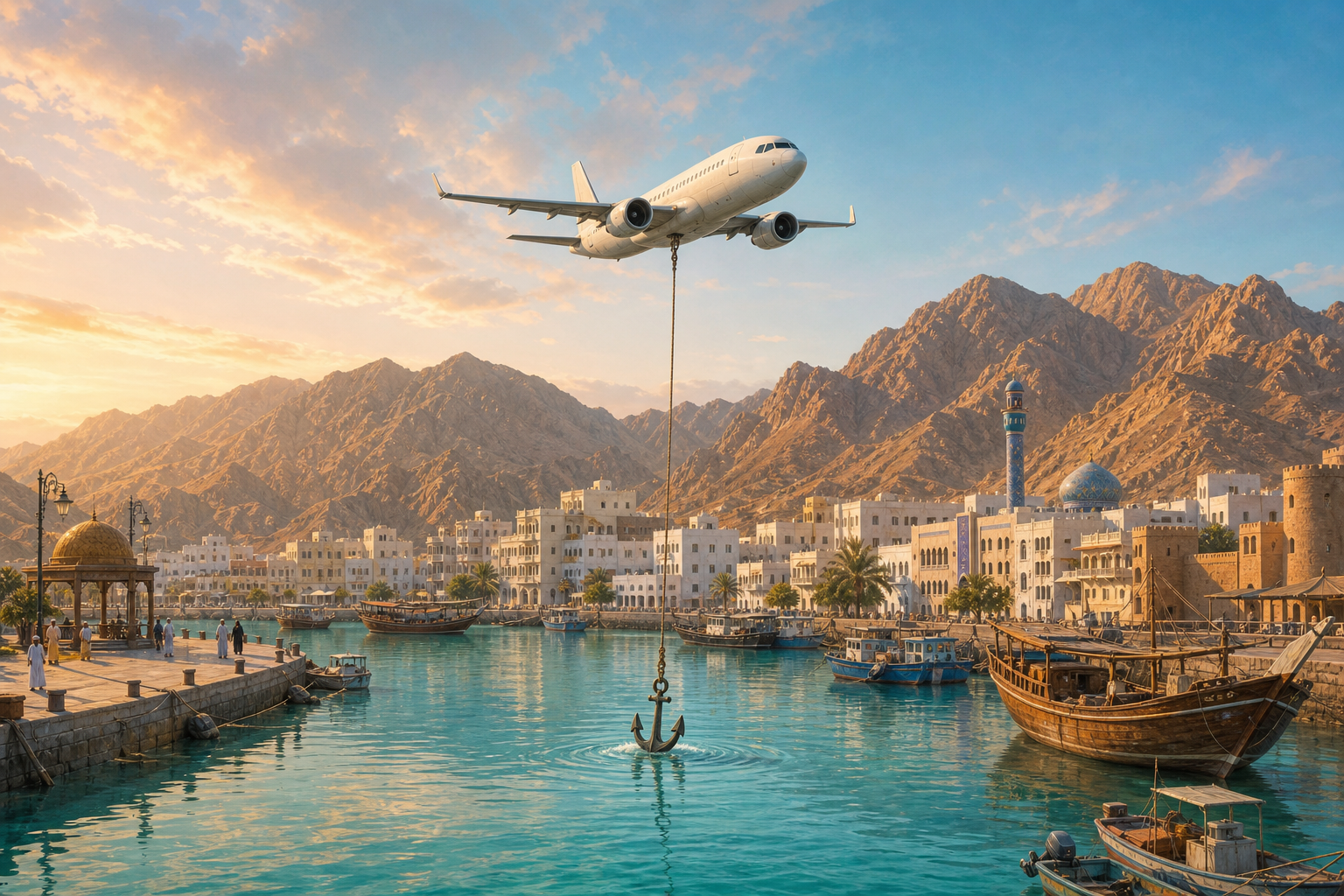
Muscat, Oman: The Gulf City That Doesn’t Behave Like a Gulf City
View larger map | Map data © OpenStreetMap contributors
Most people arrive in Muscat en route to somewhere else — a connection from Europe to Southeast Asia, or a quick refuel on the way to East Africa. Oman Air’s hub geography makes the stopover tempting, and that’s where the misread usually starts. Muscat is not Dubai with different signage. It’s quieter, lower-rise by law, and genuinely oriented toward something other than spectacle.
Two or three nights gives you enough time to actually get a read on the city. Less than that and you’re skimming a surface that requires some patience to understand.
The Layout Problem Nobody Warns You About
Muscat is not a walkable capital in the conventional sense. The city sprawls across a coastline broken up by headlands and rocky jebels, which means what you think of as “central Muscat” is actually a string of distinct neighborhoods — Mutrah, Old Muscat, Ruwi, Qurum, Al Khuwair — strung together by a single coastal highway. The distance between Mutrah Souq and the Sultan Qaboos Grand Mosque is around 12 kilometers. A lot of visitors base themselves near the airport or in the business district of Al Khuwair without realizing how far they’ve parked themselves from the parts worth seeing.
Stay in or near Mutrah if you can. It’s the oldest functioning commercial district in the city, it’s adjacent to the old walled town, and it’s where most of what’s worth walking around is actually concentrated.
Mutrah Souq: Still Worth It, But With Lowered Expectations
Mutrah Souq gets recommended so often that the resulting crowds have changed what it is. It’s still architecturally interesting — the covered alleys, the silver traders, frankincense burning at roughly every third stall — but the ratio of tourist-oriented stalls to genuine commercial activity has shifted in the direction you’d expect. The deeper lanes away from the main entrance see fewer tour groups. Go in the late afternoon, not mid-morning.
Frankincense is Oman’s actual historic export, traded out of the southern Dhofar region long before the Gulf’s oil economy existed. Buying a small resin block here rather than a packaged tourist version is straightforward and worth doing. The grade matters: vendors who know their product will show you the difference between low-resin filler grades and the higher-quality translucent pieces from Dhofar. You don’t need to be a connoisseur to notice the distinction in color and smell.
The Corniche and What’s at the End of It
The Mutrah Corniche is a genuinely pleasant waterfront promenade — not in a manufactured resort way, but in the way that a working harbor with dhows, a fish market at one end, and mountains behind it just happens to look good. Walk it in the early morning or after sunset. Midday between May and September is genuinely dangerous heat, not just uncomfortable — Muscat regularly records some of the highest wet-bulb temperatures on earth during summer, and October through March is the only window where being outside in the afternoon is pleasant for most visitors.
At the eastern end of the corniche, the old walled city district contains Al Jalali and Al Mirani forts, both Portuguese-era fortifications from the 16th century that remain military installations and aren’t open for interior access. Worth seeing from outside. The Royal Palace (Al Alam Palace) sits right next to them — the ceremonial facade is viewable from the public approach road and is one of the more photogenic things in the city, less because of architectural excess than because of how it sits against the jebel behind it.
Sultan Qaboos Grand Mosque: Non-Negotiable Visit, With One Condition
This is one of the better mosques open to non-Muslim visitors in the region — not just because of scale, but because it’s well-run for the visit itself. It opens to visitors Saturday through Thursday from 8am to 11am (closed Fridays), and the dress code is enforced at the entrance, not just suggested. Women need a full abaya and headscarf; men need long trousers and covered shoulders. Arriving without these means turning back, and the mosque is far enough from most accommodations that doing so wastes a significant part of a morning.
The main prayer hall carpet is often cited as one of the world’s largest hand-woven carpets — around 4,000 square meters, made in Iran, requiring roughly 600 weavers over four years. Whether or not the superlative still holds, the thing is extraordinary up close in a way photographs don’t capture.
Daytrip Worth Taking: Wadi Shab
About two hours southeast of Muscat on the coastal highway toward Sur, Wadi Shab is one of the more accessible wadis in Oman for someone without a 4WD or serious hiking experience. The walk in follows a stream bed through palm plantations and pools, takes about 90 minutes each way at a relaxed pace, and ends at a cave with a small waterfall inside that you reach by swimming through a narrow channel. The water is cold. The cave ceiling has a gap that lets light in, which makes the interior look better than the photographs — the photographs are always somehow worse than the reality, which is genuinely unusual.
Hiring a driver from Mutrah for the day is the practical move. The road involves a short ferry crossing in a flat-bottomed boat (a few hundred Omani baisa — essentially nothing) that’s operationally confusing if you don’t know to expect it. Most hotels can arrange a driver, or ask at the souq.
The Honest Case Against Staying Longer Than Three Nights
Three nights is probably the right ceiling for Muscat as a standalone trip, and two is enough for most people. The city doesn’t reveal hidden depths the way somewhere like Tbilisi or Sarajevo does with extra time — what you see in the first few days is largely what it is. The real argument for Oman as a longer destination is leaving Muscat for the interior: Nizwa, the Hajar Mountains, the Wahiba Sands, the village of Misfat Al Abriyeen. Those require either renting a car (4WD for the mountain routes; a regular car is fine for Nizwa) or committing to guided day trips that add up in cost quickly.
Oman is more expensive to travel independently than its Gulf neighbors in some ways and cheaper in others. Accommodation in Muscat is reasonably priced compared to Dubai. Food at local restaurants — anything labeling itself as Omani or Indian-Pakistani, which is the actual working-class food culture here — is cheap. Tourist-packaged excursions are where the cost stacks up.
One Thing Worth Knowing Before You Book
Oman runs on a Friday-Saturday weekend, which means government sites, some museums, and plenty of locally-run businesses have reduced hours or closures on those days. The Royal Opera House Muscat — which is, somewhat surprisingly, one of the better-programmed mid-sized venues in the region — has its own schedule worth checking if your dates overlap. Tickets have historically been far more affordable than comparable European venues.
If you’re building an itinerary around two nights and thinking about pushing on afterward: front-load the mosque visit and the wadi trip rather than leaving either for the end. Both require earlier starts than feels natural on vacation. Both are also the two things most likely to change how you think about the place — which is a better use of early-morning energy than most alternatives.