
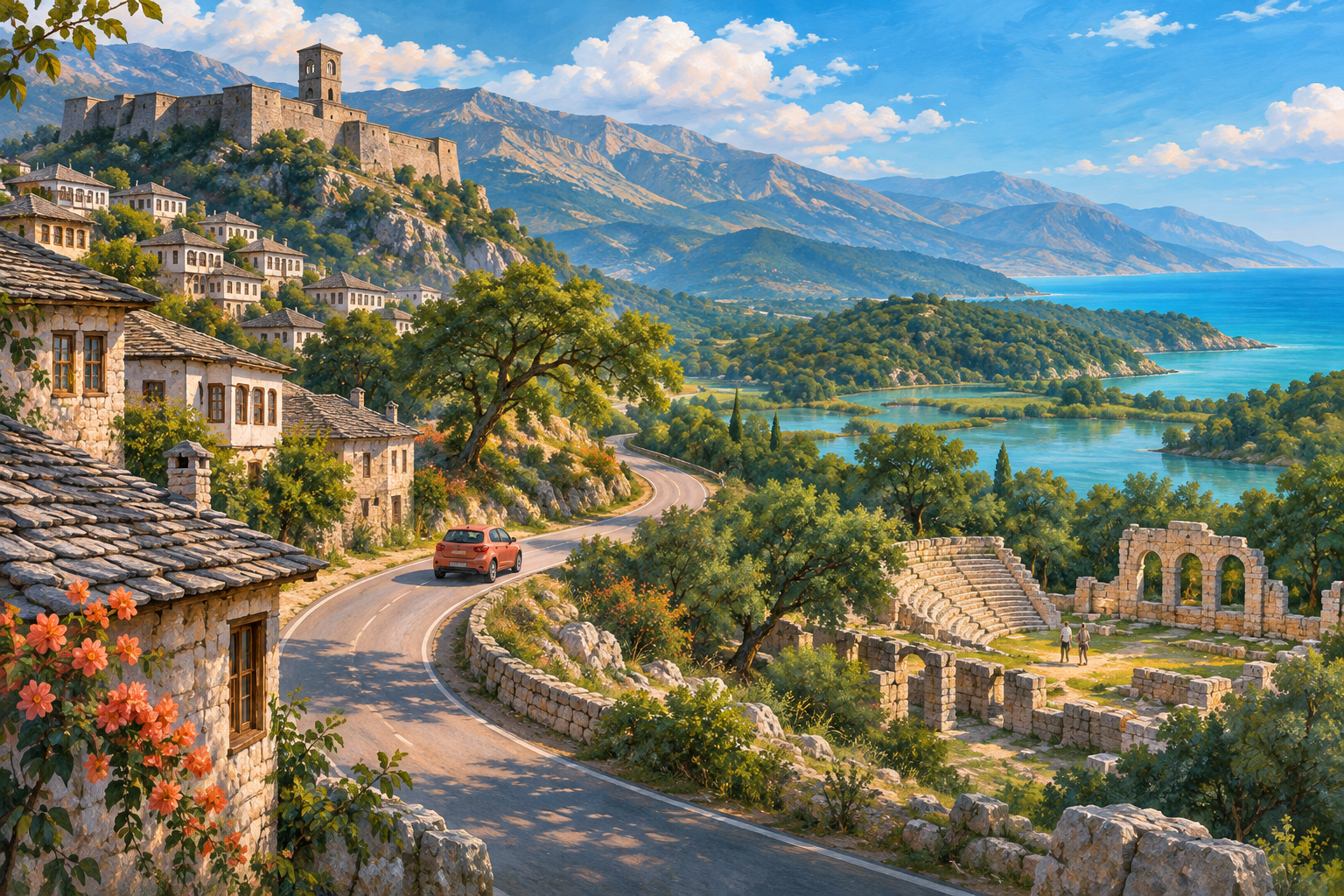
Most Balkans itineraries hit Tirana for two nights, maybe swing through Berat, then loop back north or cross into North Macedonia. Southern Albania — the stretch from Gjirokastër down to the Butrint ruins near Saranda — stays almost entirely off those routes. That’s a genuine miss, not just a contrarian travel take.
View larger map | Map data © OpenStreetMap contributors
Gjirokastër: What the UNESCO Label Doesn’t Fully Explain
Gjirokastër earned its World Heritage status as a preserved Ottoman-era town, and the stone architecture is legitimately striking — not in a “nicely restored old square” way, but in the sense that the whole upper town is built on a steep ridge and looks like it grew out of the mountain rather than onto it. The characteristic rooflines, gray slate shingles covering walls as well as rooftops, give the place a texture you don’t see anywhere else in the Balkans.
The castle dominates the ridge above everything. Walk it properly and you’re looking at a real hour, minimum. In the courtyard there’s a captured US Air Force plane from the Cold War era — left there by the Hoxha regime as a propaganda exhibit and never moved. Nobody seems entirely sure what to do with it now. It works as an accidental museum of the absurdities of that period.
The bazaar district below the castle is where most of the guesthouses and restaurants cluster. Skip anything that lists its menu in four languages out front. There are family-run places serving tavë kosi (baked lamb and yogurt) and stuffed peppers that charge roughly what a local would pay, and they’re not hard to find if you walk a block past the obvious strip. Gjirokastër is also Enver Hoxha’s birthplace — his childhood home is preserved as a museum and worth an hour if you want context for how completely the communist period tried to erase and then weaponize Albanian history.
One honest note on timing: Gjirokastër gets genuinely hot in July and August, and the stone streets radiate heat something fierce by midday. The shoulder months — May, early June, September, October — give you the same town without feeling like you’re being cooked. The light in October is also exceptional for the slate rooftops.
Getting Down to Butrint
Butrint is about 90 kilometers southwest of Gjirokastër, near the Greek border, and the most practical base is Saranda — a coastal town on the Ionian that’s functional rather than charming. The ruins themselves sit on a wooded peninsula jutting into a lagoon, which is part of what makes the site work visually: Greek, Roman, Byzantine, and Venetian remains layered on top of each other in a setting dense with oak and laurel. Virgil referenced Butrint in the Aeneid; the city had been significant for centuries before that.
The site is walkable in two to three hours at a relaxed pace. The Greek theater is small but intact enough to actually read as a theater rather than a pile of stone. The baptistery floor mosaic — a large 6th-century composition with animals and geometric patterns — is kept under a protective structure requiring a separate ticket. Worth it. The Venetian tower at the northern end of the loop gives you a view over the lagoon toward Corfu, which sits close enough to feel like you could wade to it.
Get there early, before 9am if you can manage it. By 11am in summer, tour groups arrive from Saranda and from the Corfu day-trip ferries, and the site is small enough that the numbers matter. There’s no great solution if you’re arriving late — the site closes at dusk, the late afternoon light is beautiful, but so is the near-empty crowd situation at 8am.
The Saranda Question
Saranda is a beach resort town that’s developed fast and fairly chaotically over the last fifteen years. The seafront promenade is fine for an evening walk, the fish is fresh, and the ferry connection to Corfu (the fast ferry runs around 30-35 minutes) makes it a logical endpoint if you’re crossing into Greece. Don’t stay more than two nights expecting Saranda to entertain you — it’s a base, not a destination.
If you want something smaller, Ksamil is 15 kilometers south of Saranda, closer to Butrint, with beaches that are genuinely among the better ones on the Albanian coast — shallow, clear water, small islands you can swim to. It books up fast in July and August. Outside peak summer it’s quiet enough to be pleasant.
The Logistics of Actually Getting Here
Renting a car in Tirana and driving south is what makes this region work. The route via the SH4 through the Muzina Pass to Gjirokastër is straightforward and takes around three hours from Tirana on a good day. The mountain section is scenic and the road quality has improved significantly in recent years — it’s not the white-knuckle drive it was a decade ago, though the pass warrants attention in winter or heavy rain.
Buses do connect Tirana to Gjirokastër and Gjirokastër to Saranda, and they’re cheap — roughly 1,000-1,500 ALL (around €10-15) for the Tirana-Gjirokastër run. The tradeoff is that reaching Butrint from Saranda without your own wheels means either a taxi or joining a tour, both manageable but friction-adding. If you’re doing this loop without a car, the Saranda-to-Butrint furgon (shared minibus) runs in the morning and is the most sensible option.
The border crossing into Greece at Kakavia (the main land crossing north of Ioannina) is functional and usually faster than its reputation suggests outside Greek summer holidays. If your plan is Albania south → Ioannina → onward in Greece, this route makes clean geographic sense.
How Long to Spend
Three nights covers it without rushing: two in Gjirokastër, one in Saranda or Ksamil. A day at Butrint, a day on the castle and bazaar, and the drive itself as part of the experience. You could stretch to four nights if you want to explore the Llogara Pass area on the coastal road north of Saranda, which cuts through mountain terrain above the Ionian and is worth the detour if coastal scenery is what you’re after.
What you should actually book ahead: accommodation in Gjirokastër in peak summer. The guesthouses in the old town are small — most run eight to twelve rooms — and they fill up. The ones inside the UNESCO zone are worth the slight premium over the modern hotels lower in the new town; waking up to that ridgeline matters.
Butrint tickets don’t require advance booking, but confirm opening hours before you go — they adjust seasonally and the Albanian national parks website isn’t always current. A quick call to your Saranda hotel the evening before is more reliable than anything you’ll find online. That’s not a knock on Albanian tourism infrastructure so much as a practical reality for a site that gets updated faster on the ground than on any webpage.