
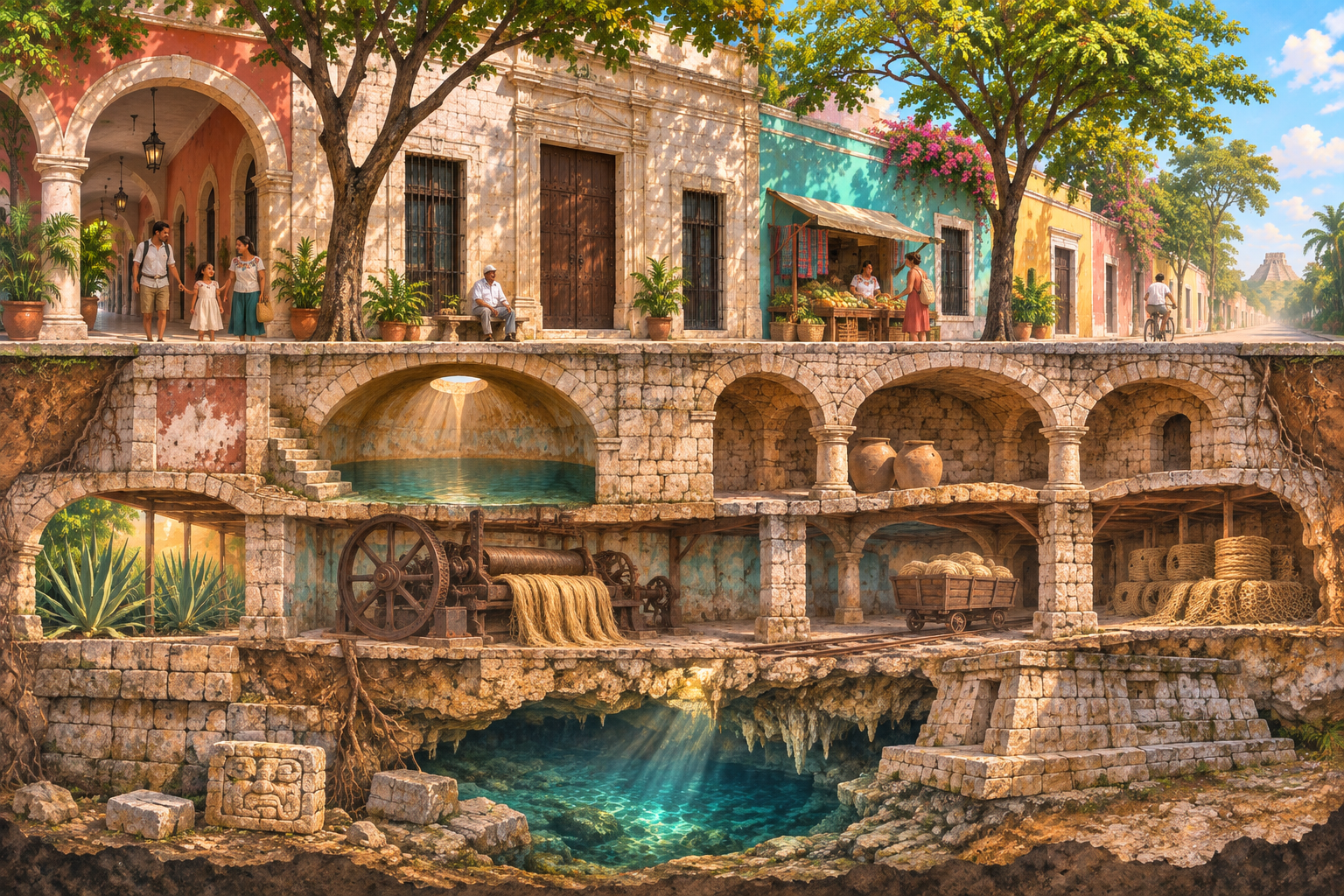
Mérida Is Not Just a Chichén Itzá Shuttle
View larger map | Map data © OpenStreetMap contributors
Most visitors spend roughly one night, do the 7am bus to Chichén Itzá, and leave. The city functions as a logistics hub — a clean, cheap base with good flight connections — and nothing more. That’s a waste. Mérida is one of the most walkable, genuinely interesting colonial cities in the Americas, and it has enough within reach to justify five or six days without padding the schedule.
It sits at the northwest corner of the Yucatán Peninsula, 320 kilometers from Cancún by road, and has been continuously inhabited since the Spanish founded it in 1542 on top of the Maya city T’Hó. The Maya didn’t stop living there — they kept living there alongside the Spanish. That layering is visible everywhere if you’re paying attention.
The City Center Is Worth Actual Time, Not Just an Hour
The Plaza Grande could be in a dozen Mexican cities, but Mérida’s version has two things that earn a slower look. The Catedral de San Ildefonso, completed in 1598, is one of the oldest cathedrals on the continent. Directly opposite it, the Casa de Montejo has a 16th-century façade showing conquistadors literally standing on the heads of Maya figures — one of the bluntest pieces of colonial iconography still standing in public in Mexico. Worth reading up close, not photographing from across the street and moving on.
The Paseo de Montejo, the wide boulevard running north from the center, takes a moment to place — it looks almost like a Haussmann-era Parisian street dropped into a tropical climate, which is essentially what it is. Wealthy henequen (sisal fiber) families built their mansions here in the late 19th century, when Yucatán was producing around 90% of the world’s sisal supply. That boom collapsed in the 1930s when synthetic fiber arrived. The mansions are still there, most converted to museums, hotels, or restaurants. The Gran Museo del Mundo Maya at the northern end of the boulevard is genuinely good — large, well-funded, not the kind of dusty provincial collection you half-expect from a regional city museum.
The Food Situation Is Specific to Here
Yucatecan food is not Mexican food in the sense most people mean. The cuisine carries significant Maya and Lebanese influence — there was a substantial Lebanese immigration to the Yucatán in the late 19th and early 20th centuries, and you can taste it in the sour orange marinades, the tamarind, the fried stuffed preparations that look almost like kibbeh. Cochinita pibil is the dish everyone names, and rightly so: pork marinated in achiote and sour orange, wrapped in banana leaves, slow-cooked in a pit. The version at the Mercado de Santa Ana on Sunday mornings is better than anything served at a sit-down restaurant nearby, and it’s gone by 10am.
Papadzules — tortillas dipped in pumpkin seed sauce, filled with hard-boiled egg — are stranger and older, pre-dating Spanish contact. Order them. They’re not a tourist novelty; they’re genuinely what people eat here.
Skip anywhere with an English-language menu on the door, particularly around the Plaza Grande. Walk four blocks in any direction and prices drop by half.
What’s Actually Worth the Day Trip — and What Isn’t
Chichén Itzá is an hour and 45 minutes east by bus. It’s worth going, but go on a weekday, leave by 6am, and understand you’re visiting a UNESCO site that sees roughly 2 million visitors per year. The crowds by 10am are substantial, the vendors are relentless, and rope lines keep you well back from the main pyramid. None of that makes it not worth going — just calibrate expectations before you arrive.
Uxmal, 80 kilometers south, is the smarter pick if you’re choosing one. Fewer visitors, more complex architecture, and the Pyramid of the Magician has a curved profile unlike anything else in the Maya world. No straightforward bus runs there — you rent a car or join a tour — but the extra effort is worth it.
The cenotes are the real hidden variable. The Yucatán Peninsula sits on a limestone shelf riddled with sinkholes filled with fresh groundwater; the Maya considered them sacred entrances to the underworld, and there are thousands of them across the peninsula. Cenote Xlacah, inside the Dzibilchaltún archaeological site 15 kilometers north of Mérida, is reachable independently without a car (combi from the market) and significantly less crowded than the famous cenotes near Chichén Itzá. Swim in it. The water holds around 24°C year-round.
Getting to Progreso Is Worth Half a Day
Mérida is 36 kilometers from the Gulf of Mexico, and the beach town of Progreso sits at the end of a straight road directly north. The beach is not spectacular — the Gulf here is shallow and the sand is average — but Progreso is a working port, not a resort, and the seafood along the malecón is priced for locals. Fish tacos and fried whole fish, eaten outside, with a beer. The return bus runs every 15 minutes from Calle 62 in Mérida’s center, costs around 20 pesos, and takes 45 minutes. That’s not a complicated logistics problem.
When to Go and What to Avoid
Mérida is genuinely hot. It sits at low altitude in a tropical climate, and from May through September the heat and humidity combine in a way that makes midday sightseeing exhausting — 35°C with 70–80% humidity is a normal afternoon. December through February is the practical sweet spot: temperatures around 24–28°C during the day, drier air, and the city’s festival calendar peaks around January when the Festival de las Artes runs for several weeks.
Semana Santa brings Mexican domestic tourists in large numbers and hotel prices rise accordingly. Not a reason to avoid Mérida that week, but book accommodation early and don’t expect a quiet Plaza Grande.
One real caveat worth stating plainly: Mérida’s crime statistics are low relative to most of Mexico, and it’s often cited as one of the safer large cities in the country. The city center and the Paseo de Montejo corridor are genuinely fine for getting around on foot. That framing can create false confidence about the broader state, though — getting in a car late at night in unfamiliar neighborhoods anywhere in Yucatán is a different risk calculation. Use registered taxis or Uber within the city.
Logistics
Mérida’s Manuel Crescencio Rejón International Airport (MID) has direct connections to Mexico City, Cancún, and a handful of US cities including Miami and Houston. Coming from Cancún overland, the ADO bus is comfortable, runs frequently, and costs a fraction of flying — roughly 200–250 pesos for a four-hour ride. The city center is walkable; you don’t need a car for anything above except Uxmal.
Stay in the centro histórico if you can. The restored mansions converted to boutique hotels on and around Calle 60 are some of the better-value colonial accommodation in Mexico. Book ahead for December through February.
If Mérida is on your radar only because of Chichén Itzá, reverse the framing: use the ruins as the punctuation, not the point.