
Why Prizren, Not Pristina
View larger map | Map data © OpenStreetMap contributors
Most people who get to Kosovo fly into Pristina, do a day or two of Newborn monument selfies and Bill Clinton Boulevard, and leave. That itinerary isn’t wrong exactly, but it misses the point. Pristina is a capital city doing capital-city things — construction cranes, government buildings, decent coffee. Prizren, 80 kilometers south, is where Kosovo actually looks like itself.
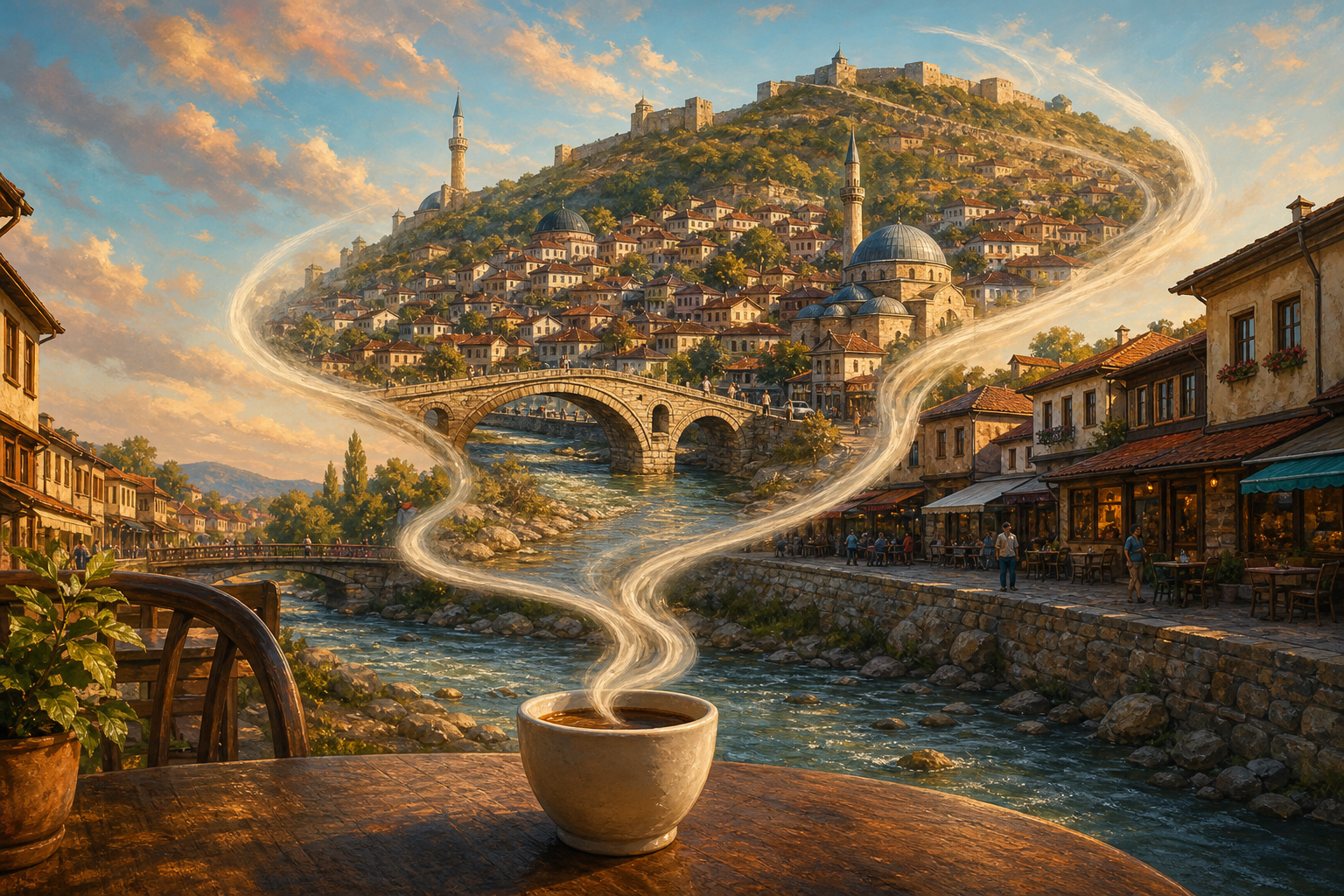
The old town is Ottoman, genuinely so, not in the restored-for-tourism way you get in some Balkan cities. The Sinan Pasha Mosque dates to 1615. The bazaar streets behind it are still a working bazaar, not a souvenir corridor. The Bistrica River runs straight through the center, and the cafes lining both banks are full of locals in a way that makes you feel like you stumbled into someone’s neighborhood rather than a heritage zone.
The Fortress First
Prizren Fortress sits on the ridge above the old town and takes about 20 minutes to walk up from the bazaar. Go in the morning before the sun gets directly overhead — the stone reflects heat in summer and the climb is steeper than it looks from below. The fortress is partially ruined and partially restored, and there’s no fee to enter. What you get from the walls is the best single view in the city: the Sinan Pasha dome, the League of Prizren building, the river, and the Albanian mountains visible on clear days to the southwest.
The League of Prizren is not a minor footnote. It’s where the 1878 Albanian national movement formalized — the actual building is now a museum, and it’s worth 30 minutes inside even if you’re arriving with no background on the history. The exhibit is bilingual (Albanian and English) and doesn’t require prior knowledge to follow.
The Mosque and the Cathedral, Fifty Meters Apart
Prizren does something most Balkan cities don’t: puts an Ottoman mosque, a Serbian Orthodox cathedral, and a Catholic church within a few minutes’ walk of each other, all actively used. The Sinan Pasha Mosque is the main one. It was damaged in the 2004 riots that followed Kosovo’s post-war period, subsequently rebuilt, and the interior is clean and open to visitors outside prayer times. The Cathedral of Our Lady of Perpetual Help is newer (completed in 2000) and less architecturally interesting, but the fact that it’s operating at all in this context is itself notable.
The Church of Our Lady of Ljeviš is the more historically significant Christian building — a 14th-century Serbian medieval church, UNESCO-listed, also damaged in 2004. It has been in long-term restoration for years; check current access before building a visit around it, because how much you can actually see has varied depending on where the work stands in a given season.
The Bazaar Streets
Shadervan square is where the main pedestrian area opens up, and from there the lanes branch into actual market streets selling hardware, textiles, food, the occasional tourist trinket. Go slightly off the main drag and it stops feeling touristed almost immediately. A couple of side streets still have coppersmith workshops operating — the kind of thing that’s usually been replaced by souvenir shops in comparable cities elsewhere in the region.
Filigree jewelry is the local craft worth paying attention to. Prizren has a specific tradition of silver filigree work that’s genuinely distinct, and there are a handful of shops in the bazaar where you can watch it being made. It’s not cheap relative to other Kosovar crafts, but it’s not the mass-produced stuff you’d find in a tourist market either.
Eating and Drinking
Kosovo runs on qebapa (grilled minced meat, the same dish that appears across the former-Yugoslav region under various spellings) and byrek, the flaky pastry filled with meat or spinach and cheese. Both are cheap and good in Prizren — under €3 for a burek breakfast from a bakery, more like €5–8 for a full qebapa plate at a sit-down place.
The riverside cafes deserve more time than the itinerary strictly requires. Coffee culture here is real — not in a specialty-roaster sense, but in the sense that this city takes its afternoon coffee seriously and the expectation is that you will too. Macchiato is the default order. Sit, watch the Bistrica, let the afternoon go slower than planned. Prizren specifically rewards that; a tighter itinerary would miss it entirely.
For something more substantial in the evening, Marashi is the most-cited local restaurant for traditional Albanian food and usually delivers on that reputation. Expect stuffed peppers, lamb dishes, decent house wine. Book ahead on weekends in summer.
Getting There and When to Go
From Pristina, shared furgons (minivans) run to Prizren regularly from the main bus station area and cost around €3–4 one way, about an hour and a half depending on traffic. There’s also a regular bus. Renting a car isn’t necessary unless you plan to go into the surrounding mountains, which is worth considering — the Sharr Mountains south of Prizren have hiking trails that are genuinely underdeveloped tourism-wise, meaning less infrastructure but essentially no crowds.
June and September are the best months. July and August bring Dokufest, an international documentary film festival usually held in mid-August, which is a legitimate reason to time a visit around it — the festival uses the old town and fortress as venues, and the programming is serious. It also means accommodation fills fast, so book several weeks out if that’s your window.
Winter is cold and some of the outdoor cafes close, but the city doesn’t shut down and accommodation prices drop noticeably. The fortress in snow is worth seeing if you’re in the region anyway.
Accommodation
Prizren’s guesthouses are concentrated in and near the old town, and several occupy renovated Ottoman-era buildings. Prices are low by any Balkan standard — €30–50 per night for a double in a decent guesthouse is realistic. Staying inside the old town or within five minutes of it makes a practical difference: you wake up and walk to the fortress rather than commuting to the interesting part of the city every morning.
One real limitation worth flagging: English is widely spoken among younger Kosovars but patchier among older residents and some guesthouse owners. Having Google Translate working is more practically useful here than in, say, Albania’s coastal towns, where tourism infrastructure has caught up faster.
How Long to Stay
Two nights is enough to see everything listed here without rushing. Three nights gives you a full day for the mountains or a day trip toward Gjakova, another Ottoman-era town 45 kilometers northwest that gets almost no outside visitors and has its own bazaar worth seeing. One night isn’t enough — you’ll spend it getting oriented and leave before the city actually opens up.
If you’ve already done Sarajevo, Ohrid, and Kotor, Prizren is the logical next addition — it’s genuinely different in character from all three, and Kosovo’s specific post-war, post-independence history gives the city a context that doesn’t map onto anywhere else in the region. The question worth sitting with before you go: how much of the former Yugoslavia have you seen only from the outside, moving fast between landmarks? Prizren is the kind of place that makes that question feel answerable.