
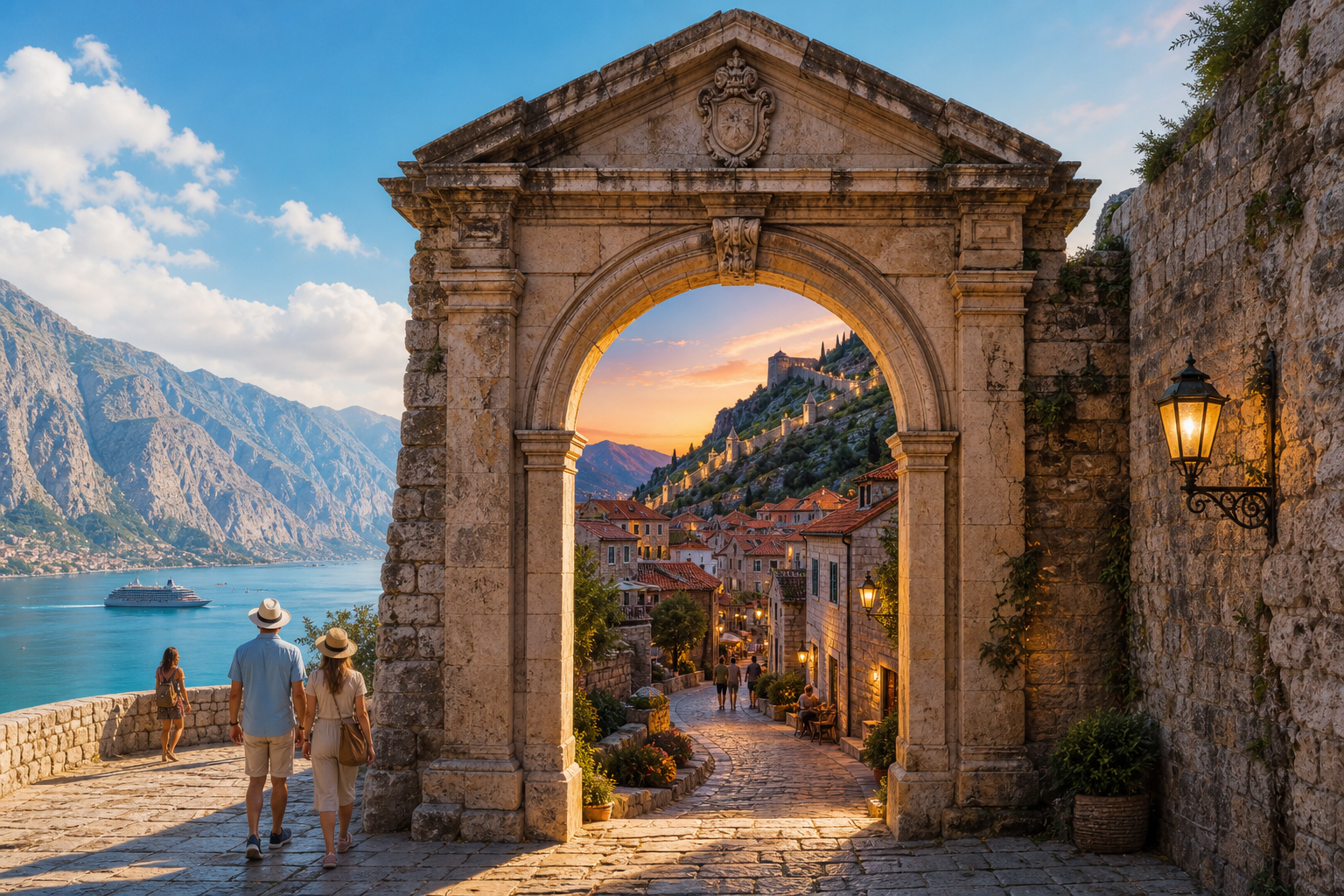
Most People See Kotor for Four Hours. That’s the Wrong Amount.
View larger map | Map data © OpenStreetMap contributors
Kotor, Montenegro sits inside one of the best-preserved medieval walled cities on the Adriatic, backed by a fjord-like bay that genuinely looks like someone edited the mountains to be more dramatic. It also gets somewhere around a million cruise passengers a year, which means the old town is periodically flooded with people who have four hours, see the Cathedral of Saint Tryphon, buy a fridge magnet, and leave with the impression they’ve done it.
They haven’t. But the fix isn’t just “stay longer” — it’s understanding what Kotor actually rewards and what it doesn’t.
The Wall Climb Is Not Optional
The old town is ringed by a defensive wall that climbs steeply up the limestone cliff behind it, reaching the ruined Fortress of St. John at around 260 meters above sea level. The hike takes 45 minutes to an hour each way, it’s almost entirely exposed steps rather than a trail, and entry costs €8. None of that is a reason to skip it.
The view from the top is the reason Kotor exists in the imagination — the bay curls away in both directions below you, red-roofed buildings compressed inside the walls, and the Boka Bay stretches west toward the Adriatic in a way that doesn’t fully read from ground level. Go early. The steps face south and east, which means midday in summer turns the climb into a slow-motion oven. Before 8am or after 5pm, the experience is genuinely different from making the same ascent at noon with 400 other people sweating their way past you.
Cruise ships typically dock from around 9am, which is worth building around if your timing is at all flexible.
What the Old Town Itself Is Actually Like
The walled city is small — you can walk across it in ten minutes. That’s part of what makes staying overnight so different from a day visit. By 8pm, after the cruise crowds have returned to their ships, the main squares drain and the restaurants have actual table space. The stone lanes are well lit, the temperature drops fast because of the surrounding mountains, and it feels like a different place than it did at 11am. Not a more photogenic version of the same place — actually different.
The Cathedral of Saint Tryphon is worth the entry fee and gets less attention than it deserves. It dates to the 12th century, the facade rebuilt more than once after earthquakes — the 1979 Montenegro earthquake did significant structural damage — and the interior has a 14th-century ciborium above the altar that most visitors walk past without registering. The Maritime Museum in the Grgurina Palace covers Boka Bay’s shipping history in enough depth to be genuinely interesting rather than just decorative. Montenegro’s centuries under Venetian rule explains most of what you’re looking at architecturally, and the museum makes that connection explicit.
Getting Out of the Old Town
Two stops within easy reach that most itineraries skip entirely:
Perast is a 30-minute drive or bus ride northwest along the bay — a nearly intact Baroque village that had its moment of prosperity during Venetian rule and never quite updated itself afterward. Two small islands sit just offshore; Our Lady of the Rocks (Gospa od Škrpjela) is artificial, built up over centuries by sailors dropping stones on the site, and you can hire a small boat from the Perast waterfront for a few euros to reach it. The church interior is covered in over 2,000 silver votive tablets left by sailors who made it home safely. That’s specific and strange in a way that generic “charming Adriatic village” phrasing doesn’t capture.
Lovćen National Park sits directly above Kotor — the road up from the old town has 25 hairpin bends and takes about 40 minutes to drive. The Njegoš Mausoleum at the summit (1,657m) is Montenegro’s most-visited inland site, partly because it holds the country’s most significant ruler-poet and partly because the 360-degree terrace view on a clear day is exceptional. A taxi from Kotor runs around €25–30 each way. Renting a car for the day to combine Lovćen and Perast is the more flexible option and usually works out cheaper once you split it.
How Long to Actually Stay
Two nights minimum. One night gives you one evening after the day-trippers leave, which is better than nothing, but doesn’t leave room for the wall climb at a sensible hour, a half-day out to Perast, and any actual sitting-still time in the main square with a coffee.
Three nights is roughly the ceiling before the walled city starts feeling repetitive — it’s genuinely small, and a third full day requires committing to a real excursion. Lovćen works for that. Going further toward Cetinje or the Durmitor region is a different trip entirely and shouldn’t be bolted onto a Kotor stay without its own planning.
When to Go
July and August are peak cruise season and peak summer heat at the same time. The bay is enclosed by mountains on three sides, creating a bowl effect that traps heat in a way that open coastal towns don’t get — Kotor regularly hits 35°C+ in midsummer with almost no breeze at bay level. Plan your activities around early morning and evening and assume a long midday stop somewhere with shade or air conditioning.
May, June, and September balance decent weather against manageable crowds. October is quieter and the light is good, though some restaurants and boat services start cutting hours toward the end of the month. One real caveat on weather: Kotor has one of the highest annual rainfall totals in Europe, over 4,900mm recorded by regional meteorological stations, almost all of it falling between October and March. Late autumn visits carry genuine weather risk, not just inconvenient drizzle.
Getting There
The nearest airport is Tivat (TIV), about 25km from Kotor, with seasonal service from UK and western European cities — primarily easyJet and Ryanair routes during summer. Dubrovnik Airport (DBV) in Croatia is 90km away and has broader year-round connectivity; the drive takes roughly 90 minutes depending on the wait at the Debeli Brijeg border crossing, which can add anywhere from ten minutes to over an hour on a busy summer day. Bus connections from Dubrovnik exist but use the same crossing and take 2–3 hours in total.
There is no functioning rail connection into this part of Montenegro that makes practical sense from the coast.
One Honest Caveat
Accommodation inside the old town walls has reached a price point that’s harder to justify against what you actually get. The rooms are often small, stone walls carry sound, and most properties are older conversions without lifts. Staying just outside — in the newer town or up toward Dobrota along the bay — costs noticeably less, and the walk back to the old town gate is five minutes. For most people that trade-off is straightforward. The specific romance of sleeping inside a medieval walled city is real; so is the premium you’re paying for it.
If your Montenegro itinerary currently shows one night in Kotor as a through-stop between Dubrovnik and somewhere else, it’s worth asking honestly whether you’re visiting Kotor or just passing through it very slowly.