
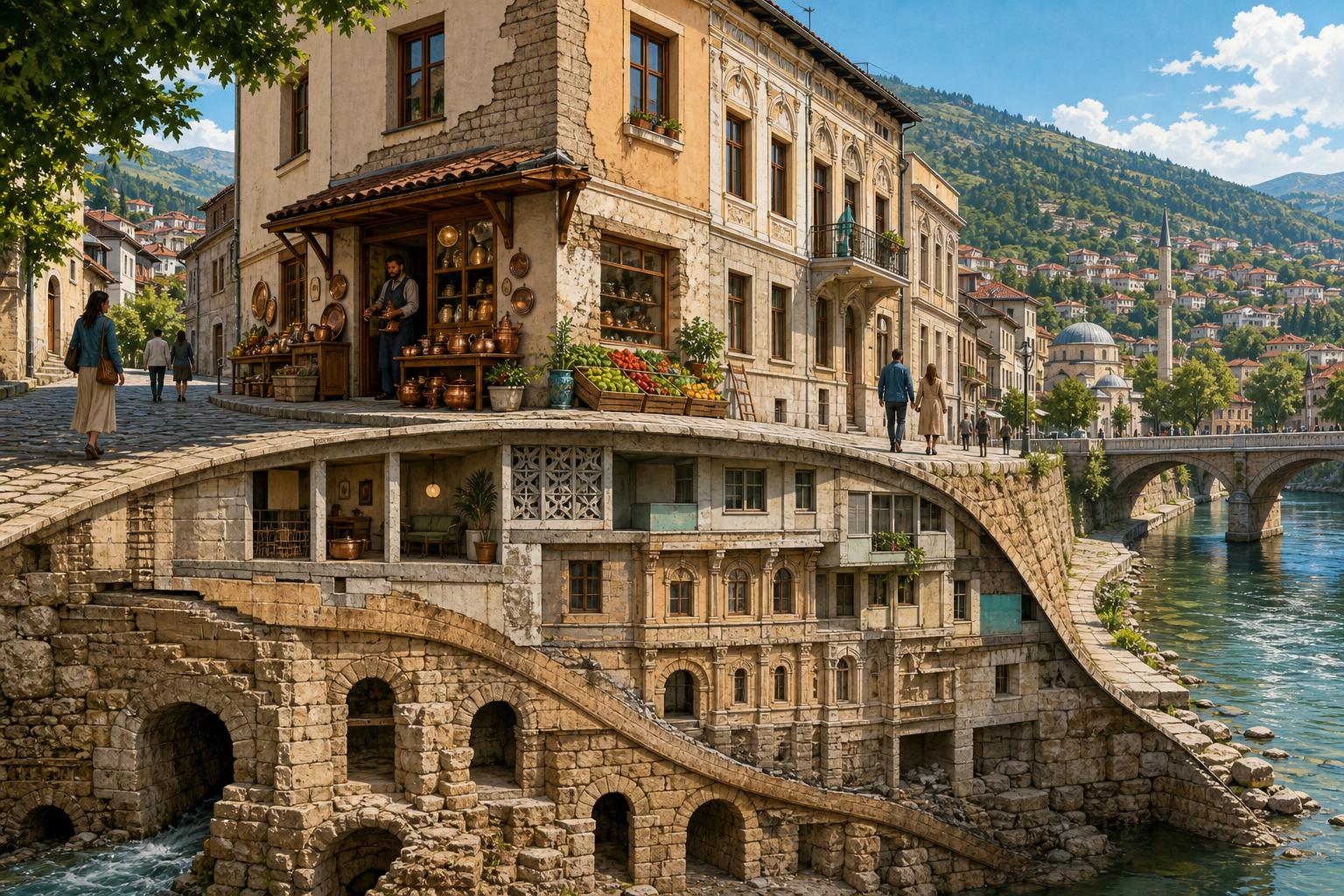
Sarajevo is one of those cities people discover by accident — a stopover on the way to Dubrovnik, or a detour off a Balkans train route — and then end up staying three days longer than planned. That’s not a coincidence. The city is genuinely unusual in ways that take a bit of time to register, and first impressions don’t quite capture it.
View larger map | Map data © OpenStreetMap contributors
What tourist photography mostly shows you is the Ottoman quarter, Baščaršija, and the Sarajevo roses — the mortar impact scars in the pavement filled with red resin that mark civilian deaths during the siege. Both are real and worth your time. But Sarajevo’s texture is in how abruptly its eras collide: you walk out of a 16th-century covered market, round a corner, and you’re in front of an Austro-Hungarian municipal building that wouldn’t look out of place in Vienna. Walk another five minutes and you’re in socialist-era residential blocks. That full transition happens inside about fifteen minutes of walking. No other European city I’ve been in compresses that much history into that small a footprint.
Start in Baščaršija, but Don’t Spend Your Whole Day There
The old Ottoman bazaar is the obvious starting point and deservedly so — the Gazi Husrev-beg Mosque, built in 1531, is architecturally remarkable, and the covered Brusa Bezistan still has working coppersmiths and jewelers rather than being entirely given over to souvenir stalls. But Baščaršija is tourist-dense by mid-morning, and a lot of first-time visitors make the mistake of treating it as the whole center of gravity for the trip.
Use it for the first morning: eat ćevapi at Ćevabdžinica Zeljo (the smaller of the two locations, on Kundurdžiluk street), drink Bosnian coffee, walk the bazaar while it’s still quiet. Then leave. The city opens up considerably once you cross into the Austro-Hungarian quarter.
The Austro-Hungarian Quarter Is the Part Most Visitors Underuse
Vijećnica — the building that now houses the National Library, originally opened as city hall in 1896 — is one of the most striking pieces of architecture in the western Balkans. Shelling and fire in 1992 gutted it almost completely, and the restoration took over two decades. The interior is open now, and the rebuilt atrium ceiling is worth seeing specifically because the restoration choices are legible: they didn’t attempt a seamless reconstruction, so you can read the damage and the repair at the same time.
The Latin Bridge, where Archduke Franz Ferdinand was assassinated in June 1914, is a two-minute walk from Vijećnica. The museum attached to it is small but precise — the actual mechanics of that day are explained clearly enough that you leave understanding why the assassination happened where and how it did, not just that it did. That’s rarer than it should be in historical museums.
The Tunnel Museum Is Not Optional
It’s a 20-minute taxi ride from the center to the Tunnel of Hope museum in the Butmir neighborhood, near the airport. During the 1992–1995 siege — the longest siege of a capital city in the history of modern warfare — this tunnel, dug beneath the UN-controlled airport runway, was one of the only routes for food, weapons, and people to move in and out of the city. You walk through a preserved section of it, roughly 25 meters of the original 800-meter passage. The family whose house sits above the tunnel still runs the museum, which matters: this isn’t curated distance from events, it’s recent history explained by people who lived inside it.
The documentary they show before you walk through is worth watching in full. Budget half a day including transit.
Where to Eat Beyond the Obvious
Ćevapi is the thing everyone mentions, and rightly — Sarajevo’s version uses a specific mix of beef and lamb, served in somun flatbread with raw onion and kajmak (a clotted cream that’s richer than the name suggests). It’s genuinely one of the better cheap meals in Europe and costs almost nothing. Do it once or twice, not every meal.
For something slower, Inat Kuća — the “Spite House,” named for the story that its owner refused to move it when the Austro-Hungarians wanted the land, so they relocated the entire building instead — has a terrace over the Miljacka River and serves traditional Bosnian dishes: lamb and veal in clay pots, burek with better pastry than most places in the bazaar. Prices are higher than street-food level but well below what you’d pay for equivalent quality in Lisbon or Kraków.
The Markale market, the covered fresh market in the center, is worth a morning stop for coffee and produce. It was the site of two mortar attacks during the siege, and there’s a small memorial. The market is still fully operational. Both things are true simultaneously, and that coexistence is very Sarajevo.
How Long to Stay
Two full days is the minimum to see the Tunnel Museum, spend real time in Vijećnica and the Ottoman quarter, and not feel rushed. Three days lets you take the day trip to Mostar — 90 minutes by bus, and the Stari Most bridge warrants the trip, though Mostar’s center is now heavily touristed, so arriving early matters even more there than it does here. Four days is when you start getting into the residential neighborhoods above the city, hiking Trebević on the cable car rebuilt in 2018, and finding the small galleries and bookshops that fill the gaps between the main sights.
Itineraries that treat Sarajevo as a one-night stop are underselling it. The first day is mostly orientation. The second day is when the city starts to make sense.
Practical Notes
Bosnia and Herzegovina uses the Convertible Mark (BAM), fixed to the euro at a set rate — you’ll need local currency, though some places take euros informally at rates that aren’t always favorable. ATMs are plentiful in the center. The main sights are walkable; taxis are cheap and reliable for the Tunnel Museum trip.
May–June and September–October are the most comfortable months. July and August are warm and busy. Winter is cold but the city carries it well — Sarajevo hosted the 1984 Winter Olympics, and the bobsled track on Trebević is still up there, now graffiti-covered and slowly returning to the mountain, which is its own kind of compelling.
Accommodation in the old quarter is genuinely good value relative to most European cities with this much draw. Boutique hotels in converted Ottoman-era houses exist at prices that would buy you a budget chain room in Vienna.
One honest caveat: the political situation in Bosnia and Herzegovina remains complicated, and some of the ethnic-nationalist tensions from the 1990s have real institutional expression today. It doesn’t affect day-to-day travel, but reading the news before you arrive is worth doing — not as a warning, but because you’ll understand what you’re walking into, and Sarajevo rewards that kind of attention.
If you’re building a Balkans route and have Sarajevo penciled in as a half-day transit point, move it up the list and give it more time. It’s the city on that route most likely to change what you think the trip is about.