
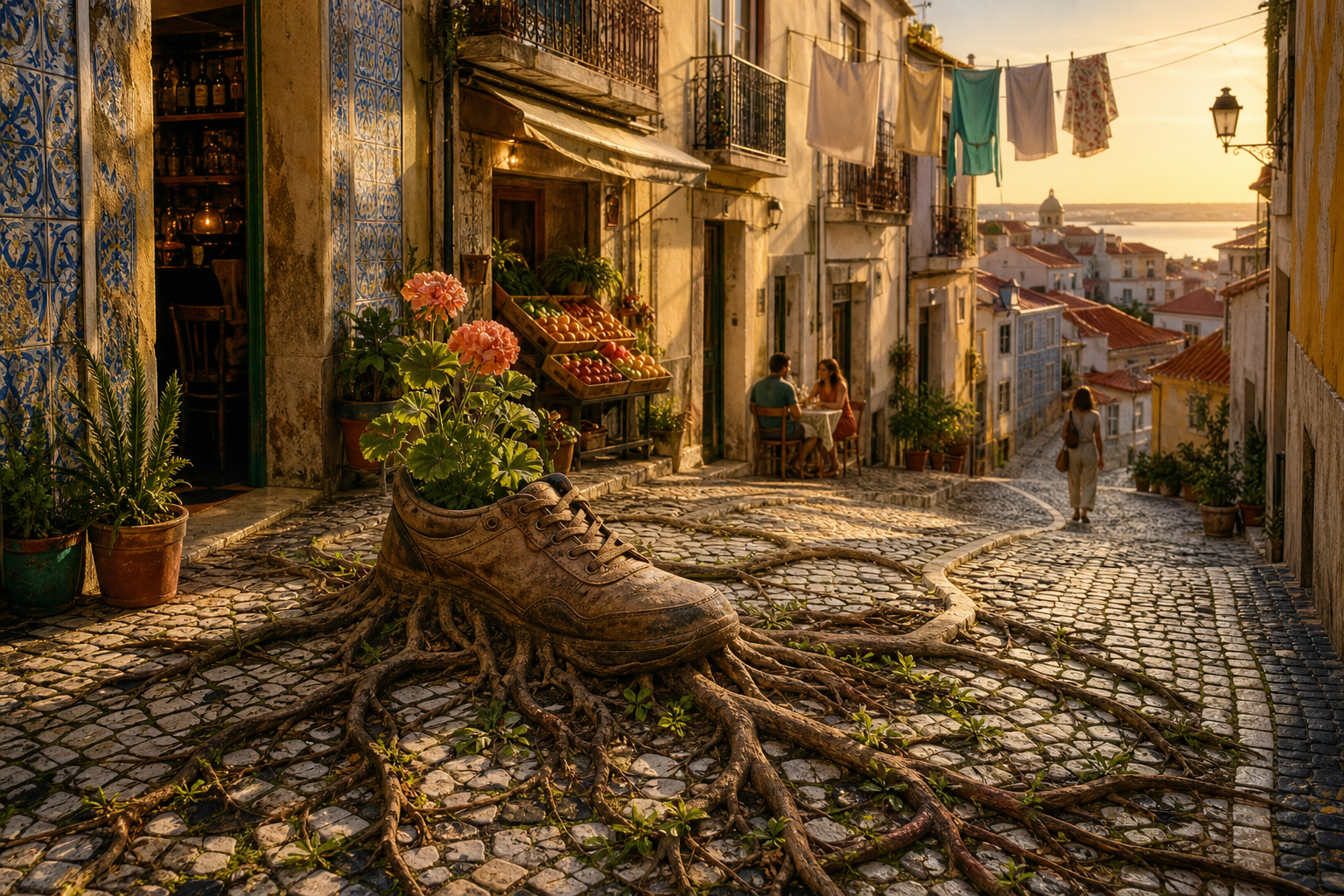
Lisbon has a viewpoint problem. Not that the miradouros are bad — Graça and Santa Catarina are genuinely worth the climb — but the standard tourist loop has collapsed into: tram 28, viewpoint, viewpoint, pastéis de nata, viewpoint, done. Most visitors leave having seen the skyline four times and the actual city almost not at all.
View larger map | Map data © OpenStreetMap contributors
Pick One Hill Neighborhood and Stay in It
The city’s topography means you’re going to be walking up and down regardless, so there’s no efficiency argument for trying to cover Alfama and Mouraria and Bairro Alto in a single day. You’ll spend the whole time in transit and mistake motion for experience.
Alfama is the one you’ve seen in every photo — the terracotta rooftops, the tangle of alleys, the fado spilling out of a doorway at 10pm. It earns its reputation and it earns its crowds. If you go, go early on a weekday and walk up from the São Jorge Castle side rather than the riverfront, where the tuk-tuks are lined up four deep before 9am.
Mouraria, directly adjacent, is denser and less curated and considerably more interesting as a place where people actually live. The Intendente square has been through a rough gentrification cycle over the past decade but it’s stabilized into something genuinely mixed — a few good restaurants, a decent market on Saturdays, and almost no one who arrived on a cruise ship. That’s not a small thing in central Lisbon right now.
The Fado Question
You should hear fado in Lisbon. But the formal tourist houses — the ones with fixed menus and cover charges and a printed schedule — are not where the music is good. They’re where the music is reliable, which is a different thing. A fado house where you book two weeks in advance and pay €45 for dinner has figured out that the money comes from turnover, not from the performance.
The alternative isn’t some hidden secret: it’s showing up at a smaller adega in Mouraria or Alfama after 9pm on a Thursday or Friday, having a glass of wine, and waiting. Some nights nothing happens. Some nights someone starts playing and the whole room shifts. That variability is the actual experience — the tourist houses have engineered it out of existence.
Two spots that have maintained consistently good informal music without becoming the kind of place that puts itself on a list: Tasca do Chico in Bairro Alto (small, book ahead, but not a formal house), and a handful of places on Rua do Capelão in Mouraria that don’t have much English-language web presence by design. Walk the street in the early evening and check what’s chalked on the boards.
LX Factory and Belém: Be Honest About What You Want
LX Factory is a converted industrial complex in Alcântara that does a Sunday market. It’s good. It’s also extremely crowded on Sundays and the vendors have adjusted their prices accordingly. If you’re going for the atmosphere and a coffee and a browse, fine — just don’t mistake it for an authentic market the way some guides frame it. It’s a well-executed design market in a photogenic space, and there’s nothing wrong with that once you know what you’re walking into.
Belém is a 20-minute tram ride west and contains three things worth the trip: the Jerónimos Monastery, the Tower of Belém, and the original Pastéis de Belém bakery. The monastery is legitimately extraordinary — the Manueline stonework on the south portal is some of the most intricate late-Gothic carving you’ll see anywhere in Europe, and most people walk past it quickly to get inside, which is the wrong order of operations. Spend ten minutes on the exterior before you queue for entry.
The Tower is picturesque and takes about 25 minutes to see properly. Book tickets online in advance; the walk-up queue in summer can run 90 minutes for a site that doesn’t require 90 additional minutes of your life to justify.
The pastéis at Pastéis de Belém are genuinely better than most copies in the city. The recipe is legally protected and the custard texture is different — slightly looser, with a more pronounced caramelized top. Worth the queue, which moves faster than it looks.
Eating Without Getting Steered Wrong
The waterfront near Cais do Sodré has improved considerably over the past few years. Time Out Market is there and works well if you want variety without committing to a restaurant, though the prices are tourist-market prices and you should know that going in. The fish restaurants on the Ribeira side of the market building are better and cheaper if you walk past the market entrance rather than through it.
For a proper sit-down meal, the Príncipe Real neighborhood above Bairro Alto has the highest concentration of restaurants that are both good and not completely overrun. Taberna da Rua das Flores keeps coming up for traditional Portuguese cooking — the bacalhau preparations in particular — and it keeps coming up because it’s earned it. Book ahead.
One genuine caveat on petiscos (Portuguese small plates, roughly analogous to tapas): many restaurants marketing themselves as petiscos spots have figured out that tourists expect the Spanish tapas format and have adapted accordingly — small portions, high turnover, mediocre food. A real petiscos meal is slower and more generous than that. The most reliable filter is asking locals where they actually eat rather than where they take visitors.
Getting Around Without Losing Your Mind
The historic trams — lines 28 and 15E — are real public transit, not tourist attractions, and they run full. In peak summer, line 28 through Alfama can take 40 minutes to board because the cars are at capacity at every stop. Walking the same route takes about 30 minutes and you see more. This is not a close call.
The metro is underused by visitors and covers enough of the city to be your default for anything beyond the immediate historic center. Taxis and Uber are both functional and not expensive by Northern European standards — use them at night or when your feet have given up.
The hills are real. Comfortable shoes is advice everyone ignores until they’re limping by day two. The cobblestones — calçada portuguesa — are beautiful and genuinely treacherous when wet. June through September is dry, so this is mainly a shoulder-season concern, but worth knowing if you’re going in October or March.
When to Go
Peak summer (July–August) is genuinely too hot and too crowded for comfortable sightseeing. Temperatures regularly hit 35–38°C and the city wasn’t built for air conditioning the way newer tourist destinations are. May, June, and September are the practical sweet spot — warm enough, light late, manageable crowds.
The Festas de Lisboa in June, particularly the nights around the 12th–13th (Santo António), are worth timing a visit around if you can — the Alfama streets fill with sardines grilling on every corner and the whole neighborhood turns into a block party that actually involves Lisboetas and not just visitors. It’s one of the few moments in high season where the city feels like it belongs to itself.
If you’re deciding between Lisbon and Porto for a first Portugal trip, the comparison is mostly a distraction. Lisbon is bigger, louder, more coastal in feel, with a monumentality Porto doesn’t have. Porto is denser in character, easier to absorb in three days, and has the Douro. The real question is how much time you actually have: Lisbon rewards five days, Porto rewards three, and trying to do both properly in a week is the itinerary that leaves you feeling like you did neither.