
Berat Keeps Getting Treated as a Day Trip — It Shouldn’t Be
View larger map | Map data © OpenStreetMap contributors
Most Balkans itineraries that include Albania funnel everyone through Tirana for a night, then Shkodër or the Riviera. Berat shows up as a sidebar — a half-day excursion on the way south, quick photos of the hillside houses, then back on the road. That’s backwards. Berat is one of the genuinely intact Ottoman-era towns left in the southern Balkans, a UNESCO World Heritage site since 2008, and it rewards two nights more cleanly than almost anywhere else in the country.
What Makes It Visually Distinctive (and Why the Name Fits)
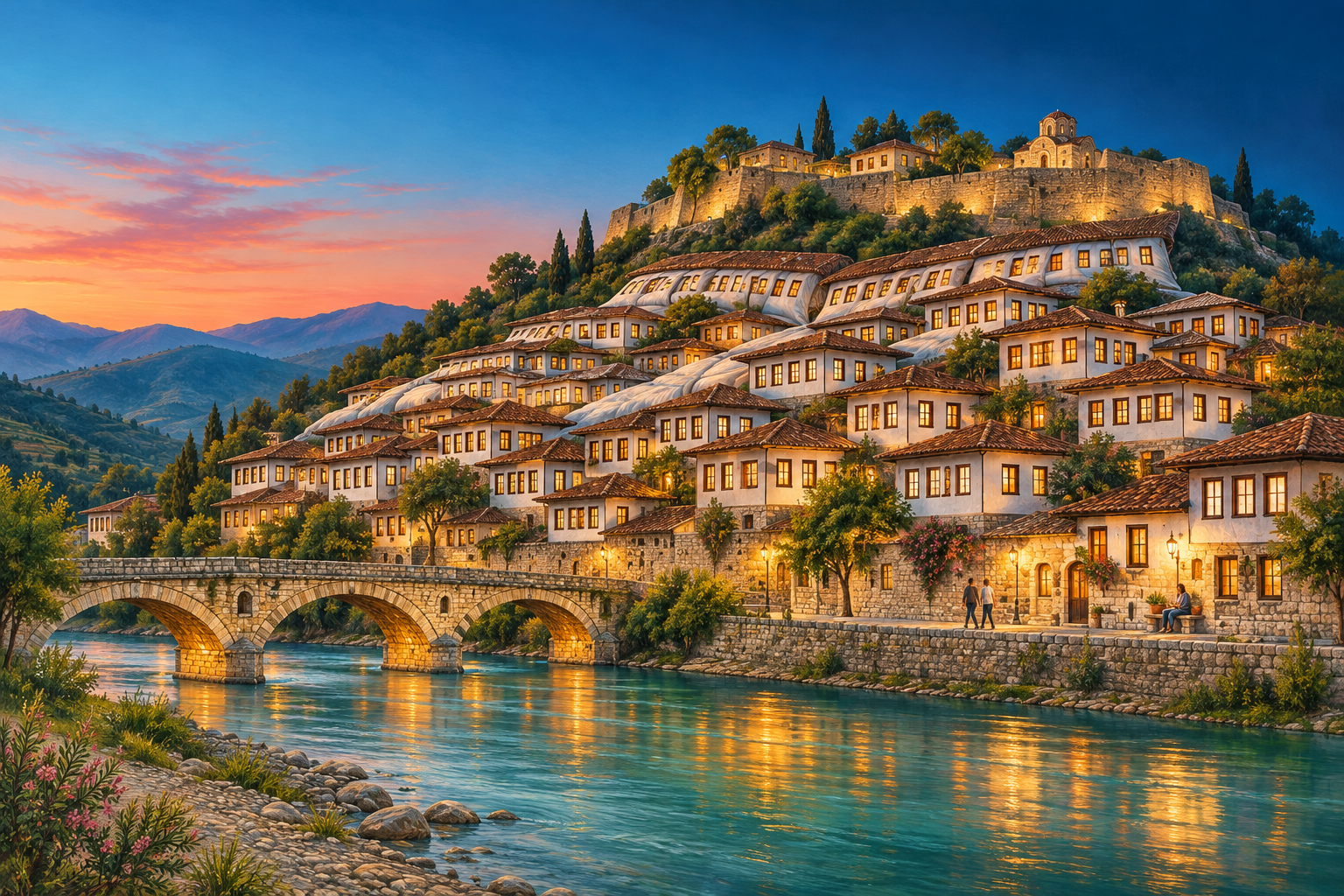
The “city of a thousand windows” label sounds like marketing until you actually stand across the Osum River and look up at the Mangalem quarter. The Ottoman houses stacked up the hillside have an unusually high window-to-wall ratio — large double windows cascading down the slope in overlapping rows — because they were built to look down onto the valley, not inward. The effect from street level is genuinely striking in a way photos don’t capture; they flatten the topography and lose the sense of the whole slope tilting toward you.
There are two main residential quarters: Mangalem on the west slope, which is the classic image, and Gorica across the river, connected by the low stone Gorica Bridge. Walk it rather than just photograph it. The two neighborhoods developed in parallel under Ottoman rule with slightly different characters — Mangalem predominantly Muslim, Gorica predominantly Christian — and you can still read that in the streets: mosque minarets and Orthodox church towers are both visible from almost anywhere in the lower town.
The Kala and What’s Actually Up There
The castle above Mangalem is inhabited — this is the part people don’t expect. Around 200 families still live inside the fortress walls, which means the “castle” is a functioning village with a school, a few guesthouses, vegetable plots, and chickens. It’s one of the last continuously inhabited citadels of its kind in Europe, and walking into it feels nothing like walking into a ruin.
Inside the walls, several Byzantine-era churches are worth the climb, including the Church of the Holy Trinity (Kisha e Shën Trinisë), which dates to the 13th century and has fragmentary fresco work that’s held up remarkably well given what it’s been through. The Onufri Museum, housed in the Cathedral of Saint Mary, holds some of the best-preserved Byzantine iconography in Albania. Onufri was a 16th-century Albanian painter whose use of a vivid red pigment — apparently derived from a mercury sulfide compound — made his work immediately identifiable across the region. The museum is small and low-key, which makes it easy to actually look at the paintings rather than shuffle past them.
The views from the castle walls over the Osum valley are the other reason to go up. The river bends sharply below town, and from the highest points you can see the Mangalem quarter dropping away below you and the flat agricultural plain stretching toward the coast. Go in the morning before the heat builds — the climb from the lower town takes 20 to 30 minutes depending on which path you take, and the upper sections have no shade.
The Lower Town and What’s Worth Your Time
Shën Mëhill (Church of St. Michael) perches on a rock spur halfway between the castle and the lower town — it’s the building that photographs best from the Gorica side of the river. It’s usually locked, but the exterior and the position justify the detour.
The main boulevard is lined with cafes and restaurants that are cheap by any European standard, though the menu range is limited. Lamb and grilled meats dominate. There’s a local wine worth trying: Shesh i Zi, a red variety grown almost exclusively in the Berat region that rarely makes it outside Albania. Quality varies by producer, but it’s the right place to try it.
The National Ethnographic Museum in the lower town is housed in an 18th-century Ottoman mansion and gives a clearer sense of how the merchant class actually lived here than anything up in the castle. It’s underfunded in the presentation, but the building itself is doing half the work.
Getting There and When to Go
Berat is about 120km south of Tirana on reasonable road — roughly two hours by furgon, the shared minivan system that handles most intercity transport in Albania, departing from the Kombinat area of Tirana. There’s no direct connection from Shkodër; you route through Tirana. From the Albanian Riviera you can come through Fier, which adds time but means you don’t have to backtrack north.
April through May and September through October are the cleaner windows. Summer is genuinely hot — the Osum valley traps heat — and July and August bring enough Albanian domestic tourists to change the character of the quieter streets. Winter goes very quiet, and valley fog can sit for days on end; that either appeals to you or it doesn’t.
Where to Stay
If you can get it, stay in one of the small guesthouses inside the castle walls. Being up top means you have the lanes to yourself in the early morning and evening after day visitors clear out — the difference between 7am and 10am is not subtle. Expect basic rooms, variable wifi, and owners who are practiced at navigating the gap between what guests expect and what a medieval fortified village can actually deliver. Book directly if you can track down a contact; availability on major platforms is inconsistent and sometimes just wrong.
There are solid options in Mangalem too — restored Ottoman houses with the high-window rooms facing the valley, more comfortable and with better infrastructure, but you trade the castle atmosphere for reliable breakfast and hot water.
A Few Honest Caveats
Berat is not a place with a dense activity list. The castle, the churches, the museums, the river walks — you can cover the material in a full day if you move with purpose. The case for two nights is about pace, not volume: eating slowly, walking the streets in different light, sitting at a café in the evening after the tour groups from Tirana have gone. If you need a packed schedule to feel like a trip is working, one night is probably the honest call. If you can slow down, two nights is right.
The road signage inside the castle quarter is minimal and the paths fork in ways that aren’t obvious from below. Getting slightly lost is part of it — the area is small enough that you’ll find your way out — but don’t rely on a maps app to navigate the upper lanes with any precision. Coverage is poor and the lane data is incomplete enough to send you into dead ends.
Book the castle accommodation earlier than feels necessary, especially for May and September weekends. There are only a handful of rooms up there, and Albanian domestic tourism has grown enough in recent years to fill them before most international visitors think to look.