
Why Popayán Gets Skipped and Why That’s a Mistake
View larger map | Map data © OpenStreetMap contributors
Most Colombia itineraries look roughly the same: Bogotá, Medellín, Cartagena, maybe the coffee region. Push south and you might add Cali before crossing into Ecuador. Popayán sits almost exactly on that southern route — four hours by bus from Cali, three hours north of the Ecuadorian border at Ipiales — and it gets treated as a bathroom break, not a destination.
That’s genuinely baffling once you’ve actually spent time there.
The city is called the Ciudad Blanca because every building in the historic center is painted the same uniform colonial white. It’s not a tourist-board nickname — it’s a preservation ordinance, and walking through the colonial grid on a clear morning when the light hits those whitewashed facades is one of the more quietly striking urban experiences in South America. Not dramatic. Just very, very good.
What the Colonial Center Actually Contains
The historic core is compact enough to cover on foot in a few hours, but that’s not an argument for spending less time there — it’s an argument for slowing down. The Catedral de Nuestra Señora de la Asunción anchors the main plaza and has been destroyed and rebuilt multiple times, most recently after the 1983 earthquake that leveled much of the center. The current structure is a faithful reconstruction, which some people find anticlimactic. Worth pushing back on that: a city that rebuilds its own center to exactly the same spec is telling you something about what it actually values.
The Iglesia de San Francisco, a few blocks south, is the building worth more time. The facade is Baroque and detailed in ways the cathedral’s plainer reconstructed front isn’t, and the interior has gilded altarpieces that survived the earthquake better than most. It’s rarely crowded even during peak hours.
Museo Nacional Guillermo Valencia is worth an hour if you have any interest in Colombian history from the colonial period forward. Skip the natural history section and go straight to the colonial-era religious art collection. The scale of some of the pieces — full-size paintings that never got famous enough to end up in Bogotá’s bigger museums — is unexpected in the best way.
The Food Situation, Which Is Genuinely the Best Reason to Be Here
Popayán was named a UNESCO Creative City of Gastronomy in 2005, the first city in Latin America to receive that designation. This isn’t a certificate on a wall. It reflects something real about how food functions in daily life here, and you notice it within the first meal.
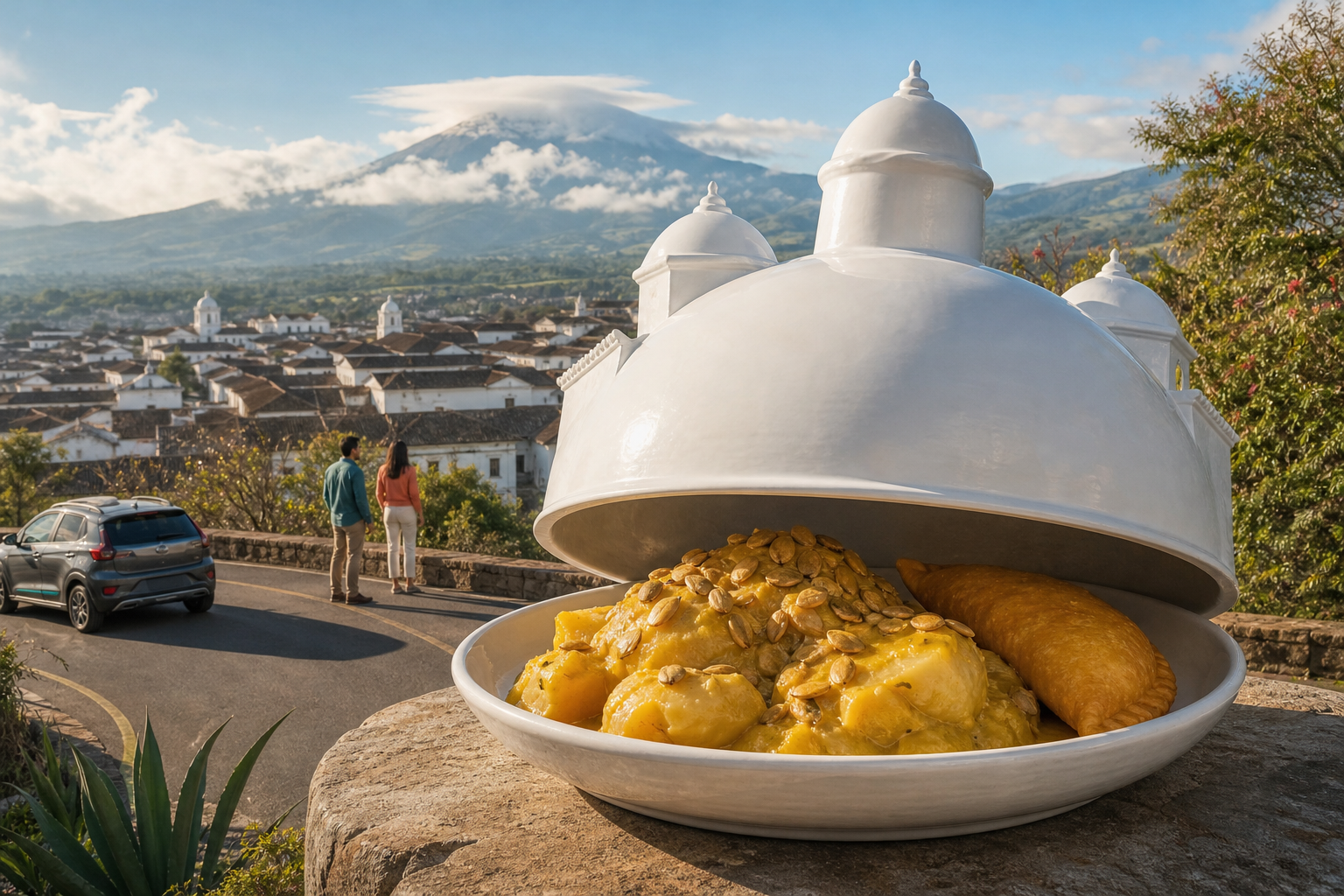
The local cuisine draws from both Andean highland traditions and Pacific coastal influences, which gives it a character distinct from either Bogotá or Cali. Pipián is the dish to understand: a sauce made from toasted squash seeds, hogao, and chile, served over potatoes and sometimes guinea pig or pork. It doesn’t look like much. It’s exceptional.
Empanadas de pipián are sold from street stalls around the market and the university district for almost nothing. The sancocho de gallina — slow-cooked hen broth — served in the market halls on weekend mornings is the kind of thing that makes you reconsider every airport empanada you’ve ever eaten.
The Galería Alameda market is where to do this properly. It’s a working municipal market, not a food hall designed for tourists, and the stalls cooking traditional Caucano food are mixed in with produce vendors and hardware sellers. Go before noon.
El Morro de Tulcán and Getting Above the City
At the northern edge of the historic center, a pre-Columbian pyramid mound called El Morro de Tulcán has a statue of Belalcázar — the Spanish conquistador who founded the city — on top of it. The irony of a Spanish monument sitting on an indigenous burial site is not subtle, and there’s ongoing local debate about the statue. For now it’s still there, and the mound is worth climbing for the view over the white rooftops toward the Andes to the east. Fifteen minutes, no admission charge.
The Puracé Area and Whether It’s Worth the Logistics
About 25km east of the city, Puracé National Park contains an active volcano (Volcán Puracé, 4,650m), thermal hot springs at Pilimbala, and páramo landscape above 3,500m. The hot springs are the accessible option — reachable by collectivo from the terminal, genuinely hot, genuinely in the middle of dramatic highland scenery.
The volcano summit is a different question. It’s not a technical climb but it’s a serious altitude hike, and the numbers matter: Popayán sits at 1,700m, which gives you a head start on acclimatization, but the summit is nearly 3,000m above the city. Come directly from Cartagena at sea level and you’ll want a full day in Popayán before attempting it. The trail is not well-signed, and hiring a local guide is the right call — not because anyone’s requiring it, but because the route genuinely warrants it.
Puracé earns a third day if you have genuine interest in high-altitude landscape. If you’re choosing between it and more time eating and walking the colonial center, the city wins unless you’ve already seen it thoroughly.
Semana Santa and When to Actually Go
Popayán’s Holy Week processions have been running continuously since the 16th century and carry UNESCO Intangible Cultural Heritage status. The nighttime processions through the lit colonial streets are, by most accounts, extraordinary.
They’re also when the city hits maximum capacity. Hotels book out months ahead, prices spike, and the normally relaxed historic center becomes genuinely difficult to move through. Worth timing around if you plan well ahead. Worth avoiding entirely if you’re the type to book two weeks out.
February, March outside Holy Week, and October through November give you the same city with manageable crowds. The climate here is mild year-round — Popayán averages around 18°C — but the Andes wet seasons, running roughly April through June and again in October and November, bring reliable afternoon rain. Not a deal-breaker for the city, but worth factoring in if you’re planning the Puracé hike.
Getting There and Where to Stay
Guillermo León Valencia Airport has direct flights from Bogotá on Avianca and LATAM, usually under 45 minutes. The bus from Cali on Expreso Bolivariano or similar takes around four hours depending on mountain traffic and costs a fraction of flying.
Stay in the historic center. The guesthouses in converted colonial buildings are the right way to experience the city, and the neighborhoods outside the center don’t offer much reason to be there. The area around the main plaza has the highest concentration of options across most price points, and boutique hostels in colonial buildings fill fast during Colombian public holidays — book at least a week ahead if your dates overlap with any of them.
Two nights is the minimum that makes the stop feel complete rather than rushed. Three lets you do market mornings and the Puracé springs without choosing between them.
If you’re already routing through Cali on the way to Ecuador, the question isn’t whether to stop in Popayán — it’s whether you’re giving it enough days to make the stop mean anything. One night doesn’t.