
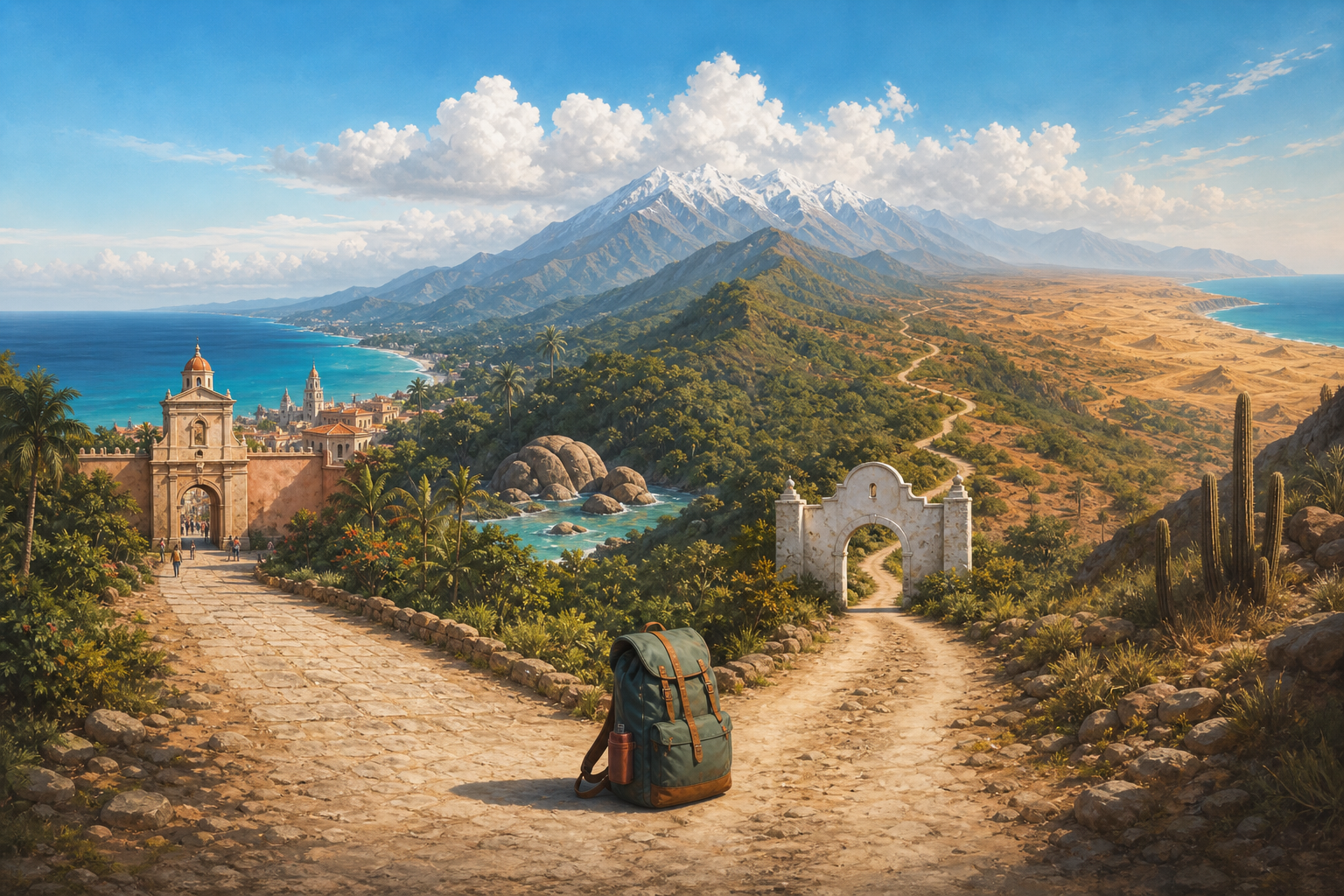
The default Colombia itinerary is basically fixed by now: Bogotá, Medellín, Cartagena. Fly into one, out of another, see the cable car and the walled city and call it done. Nothing wrong with that route. But there’s a better one for anyone willing to trade the convenience of two major airports for a coastline that hasn’t been itinerary-optimized to death.
View larger map | Map data © OpenStreetMap contributors
Santa Marta is the move — not as a Cartagena alternative exactly, more as the anchor for a completely different version of the Caribbean Colombia trip, one that actually gets you to the Sierra Nevada, the Tayrona coast, and if you push far enough, into the Guajira Peninsula.
Why Santa Marta First
Santa Marta was founded in 1525, which beats Cartagena by a decade and makes it one of the oldest continuously inhabited European-founded cities in South America. You’d barely know it from most travel writing about Colombia, which treats the city as a logistics hub rather than a destination. That undersell works in your favor. The historic center around Parque de los Novios is genuinely pleasant without being performatively curated, accommodation is cheaper than Cartagena across every price bracket, and the geography does something Cartagena’s flat coastal position can’t: the Sierra Nevada rises sharply inland, and on a clear day you can see permanent snowcaps from sea level. The mountains and the Caribbean in the same frame is a specific thing that takes some adjustment to accept as real.
Practically: direct flights from Bogotá (El Dorado to Simón Bolívar) run about an hour fifteen. Direct Medellín connections exist but are less frequent — check Avianca and LATAM, and book at least a week out during Semana Santa or the December–January peak when seats go fast. The airport is small, which works in your favor on exit.
Tayrona: Book Before You Travel, Not When You Arrive
Parque Nacional Natural Tayrona begins about 35 kilometers east of Santa Marta and is one of those places where the photography undersells rather than oversells. Dense jungle, a short hike, then a bay with boulders the size of houses. The problem is access, which tightens fast during peak season.
Entry requires pre-booking through Colombia’s national parks reservation portal (Sistema de Información para la Reserva de Áreas Protegidas) — walk-up entry isn’t reliably available during holiday periods, and the park closes for several weeks each year, usually in February, for environmental recovery. Check the closure calendar before you build your dates around Tayrona. The Ecohabs accommodations inside the park book out months in advance; camping at Arrecifes or Cabo San Juan is easier to secure and genuinely not a downgrade.
The hike from the El Zaino entrance to Cabo San Juan de Guía takes roughly two hours each way in moderate heat. Go early — the trail stays in jungle canopy for most of it, but by 10am the humidity becomes its own problem. The beaches between Arrecifes and La Piscina are swimmable; the ones right at Arrecifes have dangerous currents, the signage says so clearly, and tourists ignore it regularly anyway.
The Ciudad Perdida Trek: What It Actually Is
This is the other reason to base yourself in Santa Marta rather than Cartagena. The Lost City — Teyuna, to the Kogui, Arhuaco, and Wiwa peoples who still consider it a living sacred site — requires a multi-day guided trek and is one of the more demanding things you can do in Colombia without technical mountaineering experience.
The standard route is four days round trip, though five and six-day versions exist. The trail covers roughly 44 kilometers through jungle and river crossings, finishing on a 1,200-step stone staircase cut into the mountainside by the Tairona civilization around 800 CE. The site itself predates Machu Picchu by several centuries.
Independent access isn’t permitted. The only operators allowed in are a fixed group approved by Colombia’s Indigenous authorities and the national parks system — Magic Tour and Wiwa Tour are the two most commonly used. Prices among licensed operators are regulated and run close to each other; the real differences are group size and support staff ratios. Book at least a week ahead in high season, since daily trekker numbers are capped.
One honest caveat: this is a genuinely physical trip. Rain turns the clay trail seriously slippery, and it rains here. The dry season runs roughly December through March, then again July through August — more reliable, not guaranteed. If your travel window falls outside those months, go anyway, just pack lighter and expect to be muddy by day two.
Push Further: Guajira Peninsula
Most itineraries stop at Tayrona. The Guajira Peninsula, stretching north into the Caribbean at Colombia’s northeastern tip, is where the landscape stops being recognizable as the Colombia of travel photos and starts looking like a different continent. Red desert, flamingos at Santuario de Fauna y Flora Los Flamencos, Wayuu communities operating on their own schedule and terms.
Punta Gallinas — the northernmost point of South America — is roughly seven hours from Santa Marta by road and then boat or 4×4 depending on how dry the crossing is. This isn’t a day trip. Two nights is the minimum that makes the journey worth the effort, and you need to arrange a Wayuu guide through a community-run operation — both because GPS navigation doesn’t work reliably out there and because independent tourism in indigenous territory isn’t culturally appropriate or the point.
This is the part of the trip that’s genuinely hard to plan from abroad. Booking through an operator based in Santa Marta or Riohacha with existing relationships with specific communities is the practical move, not because piecing it together independently is impossible, but because the payoff for going through someone who actually knows the road conditions and the right community contacts is high enough that it’s not worth skipping.
The Cartagena Question
Cartagena is beautiful and worth seeing. The walled city at night, the color, the heat — it earns its reputation. It’s also expensive relative to the rest of Colombia, packed with cruise ship traffic during the day, and a bit exhausting to navigate if you’ve already spent time in Santa Marta’s quieter center. The better move is ending the trip in Cartagena rather than anchoring to it: fly into Santa Marta, work east toward Tayrona and Guajira, then take the bus back west to Cartagena for two nights before your international departure. Berlinas del Fonce runs direct service between the two cities, frequency is high, the ride takes three to four hours along the coast, and it’s a genuinely nice one.
Doing it in reverse — starting in Cartagena and pushing east — is possible but means you’re fighting the logistical flow. Most international departures from Colombia route through Bogotá or Medellín anyway, so the return-to-Cartagena move usually works without adding a domestic flight leg.
The real trade-off is upfront planning. Guajira in particular doesn’t have the tourism infrastructure that makes Tayrona feel manageable on short notice, and that’s exactly why it’s worth it. The Colombia most people see is good. The part that takes more effort to reach is something else entirely.
Start your planning with the Ciudad Perdida booking — that’s the constraint with the longest lead time, and everything else can flex around it.