
The Default Nara Itinerary Is Wrong
View larger map | Map data © OpenStreetMap contributors
Almost every Kansai itinerary structures Nara as a half-day from Osaka or Kyoto: Kintetsu train in the morning, deer park photos, Todai-ji, lunch, back by 3pm. It’s not that this is a bad visit — Todai-ji is genuinely staggering and the deer are genuinely strange — it’s that this loop captures maybe 30% of what Nara is worth and leaves the best parts completely untouched.
Nara was Japan’s capital from 710 to 784. Seventy-four years as the center of the country left a density of Buddhist and Shinto sites that doesn’t compress into four hours, and the geography means the best stuff is literally uphill from where the tour buses stop.
The Deer Park Is the Introduction, Not the Main Event
Nara Park and its famously pushy sika deer are real and worth experiencing — but they’re the entry point. Todai-ji’s Great Buddha Hall is one of the largest wooden structures on earth and houses a bronze Buddha nearly 15 meters tall. It earns the visit. But the temple complex empties into a stream of souvenir stalls, and most day-trippers follow that stream back toward the station.
Don’t. Turn east instead.
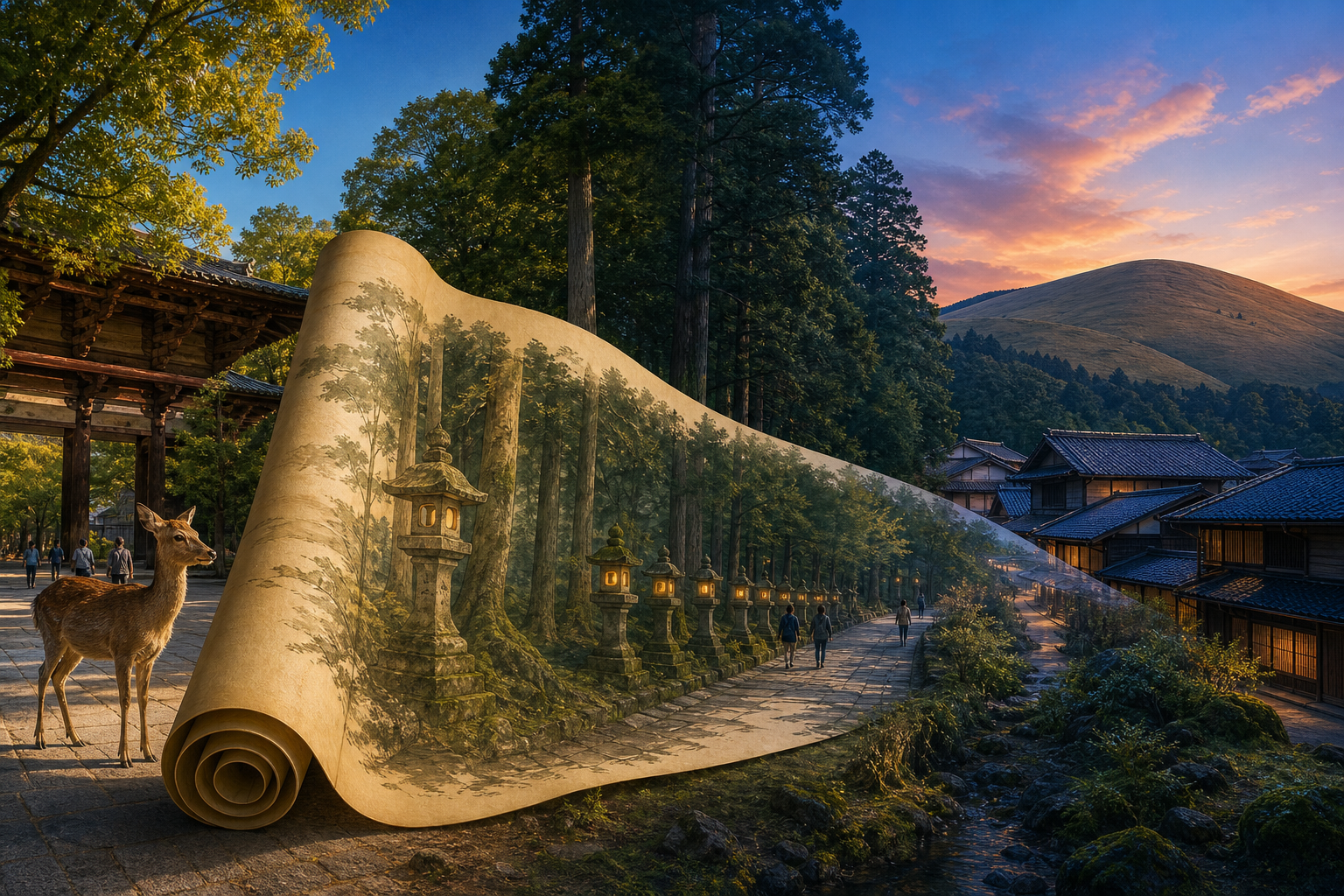
Kasuga Taisha, the Shinto shrine about 20 minutes on foot from Todai-ji, is older than Todai-ji by nearly a century and set inside Kasugayama Primeval Forest — a patch of old-growth woodland that has been off-limits to logging since the 8th century. The result is a forest inside a modern city that feels like a complete atmospheric shift. The shrine’s 3,000 stone and bronze lanterns are lit twice a year (Setsubun in early February and Obon in mid-August), and the crowds for those events are significant. On an ordinary afternoon, though, it’s genuinely quiet in a way the deer park never is.
Why an Overnight Changes Everything
Nara’s day-tripper crowd moves almost entirely within a tight loop: station, deer park, Todai-ji, Kasuga, station. By 5pm, most of them are gone. By 6pm, the park belongs to the deer and a handful of people with somewhere to sleep.
Walking through Nara Park at dusk without a tour group within 50 meters in every direction is a different experience than the same walk at noon. The deer don’t change, but the context does entirely.
Ryokan options in Nara are fewer than Kyoto’s, and not as cheap. But there are good options in the neighborhoods between the park and Naramachi, the preserved Edo-period merchant district to the south, and staying there specifically gives you walkable access to early-morning Kasuga and Naramachi before either one fills with people.
Naramachi Gets Overlooked Almost Completely
Naramachi is the part of the city almost nobody in the day-tripper loop reaches, which is strange given it’s only a 15-minute walk south of the main shrine area. It’s a neighborhood of machiya townhouses — some converted to cafes and craft shops, some still residential — on a street grid that hasn’t changed much since the Edo period.
It’s not a theme park reconstruction of old Japan. People live here. The shops are small and specific: one selling nothing but brushes, one doing traditional indigo dyeing. The comparison to Gion in Kyoto is tempting but slightly off — Gion has been aggressively touristed and partially restricted with photography fines. Naramachi just hasn’t been discovered at that level yet.
Gangoji temple sits within Naramachi — one of Japan’s oldest Buddhist temples, a UNESCO World Heritage site — and receives a fraction of Todai-ji’s foot traffic despite being in the same city and on the same UNESCO list.
The Mount Wakakusa Climb Is the One Thing Most Guides Underrate
East of the main shrine and temple cluster, Mount Wakakusa is a grassy hill — 342 meters — that you can walk up in about 45 minutes from the base. There’s a small entry fee and the trail is straightforward. What you get at the top is a clear view west over the city toward Osaka on good days, and almost no one on the summit itself. It’s one of the more satisfying short climbs in the Kansai region and it barely appears in standard Nara itineraries.
Yamayaki, the annual burning of the mountain in late January, is a significant event — the entire hillside is deliberately set alight on a fixed date and draws large crowds. If your trip coincides with it, the crowd logistics are worth thinking through in advance. If it doesn’t, the mountain is a quiet half-day addition most visitors skip entirely.
Practical Notes Worth Knowing
Nara has two train stations — JR Nara and Kintetsu Nara — and Kintetsu Nara is meaningfully closer to the park and temple cluster. Coming from Osaka or Kyoto, the Kintetsu line is generally the better call for proximity to the sights, though both are under an hour from central Osaka.
The deer are wild animals, not a petting zoo, and they’ve learned to bow for shika senbei (deer crackers) sold by vendors throughout the park. They also bite, headbutt, and have no concept of personal space. Buy the crackers once for the experience — just don’t hold them visibly for more than about 30 seconds unless you want a small mob. Children and anyone nervous around animals should know the deer are genuinely assertive, not decorative.
Spring (late March to April) and autumn (November) push the park experience toward uncomfortable. June and September aren’t the most dramatic weather, but the difference in crowd density at Kasuga or on Wakakusa is substantial enough to be worth considering if your dates are flexible.
One Honest Caveat
Nara works fine as a day trip. If your Kansai time is limited to four days and you’re choosing between one more day in Kyoto versus an overnight in Nara, Kyoto almost certainly wins — it has more depth at the higher-time-investment end. The argument for staying in Nara isn’t that it beats Kyoto; it’s that if you’re already spending time in the region and treating Nara as a half-day deer-photo stop, you’re leaving a different and considerably quieter version of the city entirely unvisited.
The version after the tour buses leave is worth planning around — and that planning really just means booking one night’s accommodation before you assume you don’t need it.