
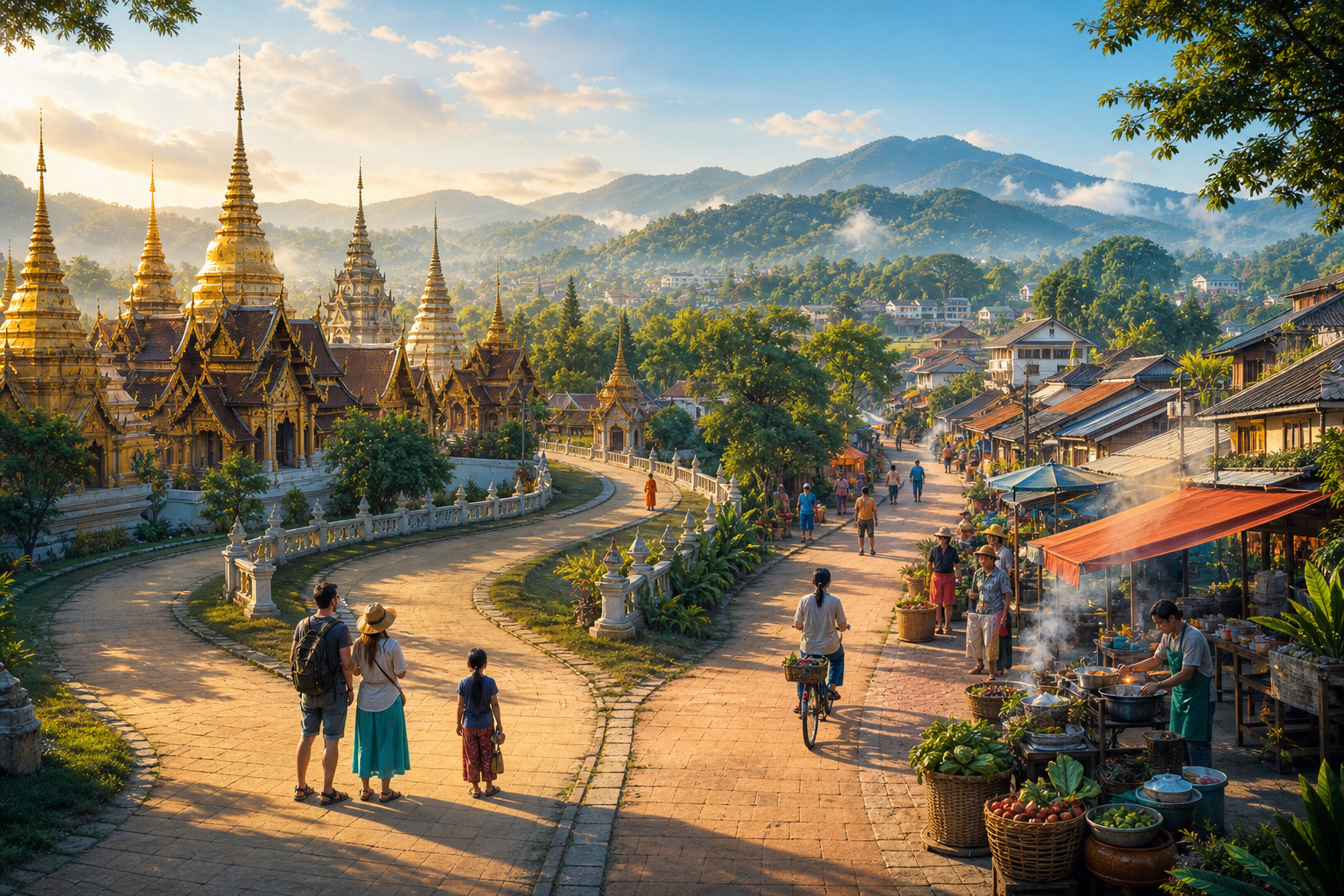
Chiang Mai has somewhere north of 300 temples, which creates the same planning failure mode as Kyoto: visitors spend three days crossing famous wats off a list and leave without understanding what makes the city actually interesting. The temples are real and some are genuinely worth your time — but they’re not the whole story, and if you’ve come from Bangkok you’ve already seen a lot of temple architecture. The question worth asking earlier is: what does Chiang Mai have that nowhere else in Thailand does?
View larger map | Map data © OpenStreetMap contributors
The Old City: What’s Worth It and What Isn’t
The walled Old City is a 1.5km square and walkable in an afternoon. Doi Suthep — the hilltop temple visible from almost anywhere in the city — is worth the trip up, both for the temple itself and for the view over the valley. Go before 8am and you’ll share it with monks making rounds rather than tour buses. The cable car entrance is faster than the 306-step naga staircase if crowds are the concern.
Wat Phra Singh and Wat Chedi Luang are both architecturally significant — Wat Chedi Luang has a partially ruined 15th-century chedi that’s more striking than most intact ones — but you can cover both in two hours and move on. The impulse to keep adding temples after that rarely pays off.
Skip the Sunday Walking Street on Wualai Road if you’re hoping for anything resembling a local market. It’s trinkets and it’s packed. The Saturday version is marginally less chaotic, but the same caveat applies. Neither is worth reorganizing your schedule around.
The Cooking Class Question
Every Chiang Mai guide recommends a cooking class, and the recommendation is correct — but there’s a real gap between the tourist-priced class near the Old City that runs 25 students through the same five dishes and the smaller outfits that take you to a market first, actually explain technique, and leave room for questions. The difference in cost is usually 300–500 baht. Spend it.
The ingredient that rewards attention in northern Thai cooking specifically is nam phrik num — a roasted green chili dip that’s ubiquitous in Chiang Mai and nearly invisible in Bangkok. Understanding how it’s built (roasted rather than fresh, blended with shallots and garlic, then adjusted to taste) tells you something about the whole cooking tradition up here. A class that doesn’t touch it is skipping what makes northern food distinct from what you’ve already eaten in the south.
Nimman and the University Area: Not Just for Digital Nomads
The Nimmanhaemin neighborhood (everyone calls it Nimman) gets written off as expat-gentrified, which is partly true and partly lazy shorthand. Yes, there’s specialty coffee and coworking spaces. There’s also the best concentration of northern Thai food outside the actual northern countryside, because Chiang Mai University next door has kept the neighborhood economically grounded in a way most heavily touristed Asian city neighborhoods haven’t managed.
The JJ Market (Jing Jai Market) runs on weekend mornings on the north edge of Nimman — organic produce, northern snacks, a lot of Chiang Mai residents actually shopping rather than watching tourists shop. Get there by 8am before the heat kicks in. By 10am, half the food stalls have sold out.
The Elephant Question
You will be confronted with elephant tourism options, and the range is enormous. The baseline rule used by most animal welfare organizations: no riding, no performances. Beyond that, distinguishing a genuinely ethical sanctuary from one that uses the branding while continuing problematic practices requires actual research, not just a quick Google. Elephant Nature Park north of the city is the most frequently cited and independently verified operation in the region. It books out weeks in advance — reserve before you book your flights, not after you land.
One honest caveat: even well-run sanctuaries involve elephants in a human-managed environment, and what that means for the animals is genuinely contested among wildlife biologists. You’re not observing wild elephant behavior and shouldn’t expect to. What a well-run sanctuary offers is elephants that aren’t being actively harmed for tourist income — which is a meaningful distinction in the context of northern Thailand’s elephant tourism industry, even if it’s not a perfect one.
Chiang Rai as a Day Trip (and Why It’s Better Overnight)
Chiang Rai is about 200km north and usually treated as a day trip from Chiang Mai. The White Temple (Wat Rong Khun) and the Blue Temple (Wat Rong Suea Ten) are both legitimately extraordinary — the White Temple is a contemporary Buddhist temple built in stages since 1997 and genuinely unlike anything else in Thailand. But the day-trip math is brutal: three hours each way by road, two temples at peak tourist volume, back to Chiang Mai exhausted.
One night in Chiang Rai changes it entirely. You can reach the White Temple at opening before the crowds arrive, catch the night market in the evening, and visit Baan Dam (the Black House — an artist’s sprawling collection of dark wood structures and animal relics) the following morning. Accommodation in Chiang Rai is cheap. Run the numbers before you default to the day-trip version.
When to Go
November through February is peak season for obvious reasons: comfortable temperatures, clear skies, none of the humidity Bangkok runs on year-round. March and April are increasingly difficult — agricultural burning in the surrounding region creates haze that in bad years pushes PM2.5 readings into ranges that make outdoor plans genuinely worth reconsidering. Thailand’s Pollution Control Department publishes AQI data for Chiang Mai and it’s worth checking if your dates fall in that window. Some years March is fine; some years it isn’t.
Rainy season (June–October) is underrated. Prices drop, the surrounding countryside is at its greenest, and tourist volume is lower. Chiang Mai doesn’t flood the way Bangkok can, so the practical downside is mostly just afternoon rain — which is manageable if you plan around it.
Getting There and Getting Around
Chiang Mai Airport (CNX) has direct connections from both Bangkok airports — Suvarnabhumi and Don Mueang — on multiple carriers including Thai AirAsia and Thai Lion Air. Flight time is just over an hour. The overnight train from Hua Lamphong station in Bangkok is a legitimate alternative if you want to roll a night’s accommodation into your transit time; the sleeper cars are comfortable enough, and the route through central Thailand at dawn is genuinely scenic. Prices spike around Songkran (mid-April) regardless of how you’re traveling.
Within the city, red songthaews — shared pickup trucks — are the standard local transport and cheaper than tuk-tuks for most trips. Grab works reliably in Chiang Mai and is the practical choice for anything outside the Old City. Renting a motorbike is useful for reaching Doi Suthep and the countryside, but be straight with yourself about your comfort level with Thai traffic before committing to it.
If you’re staying more than four days, the Mae Sa Valley loop to the northwest — waterfalls, elephant sanctuaries, an orchid farm — is worth a half day. But do it after you’ve actually spent time in the city. Too many itineraries turn Chiang Mai into a logistics hub for day trips before the place has had a real chance to land.