
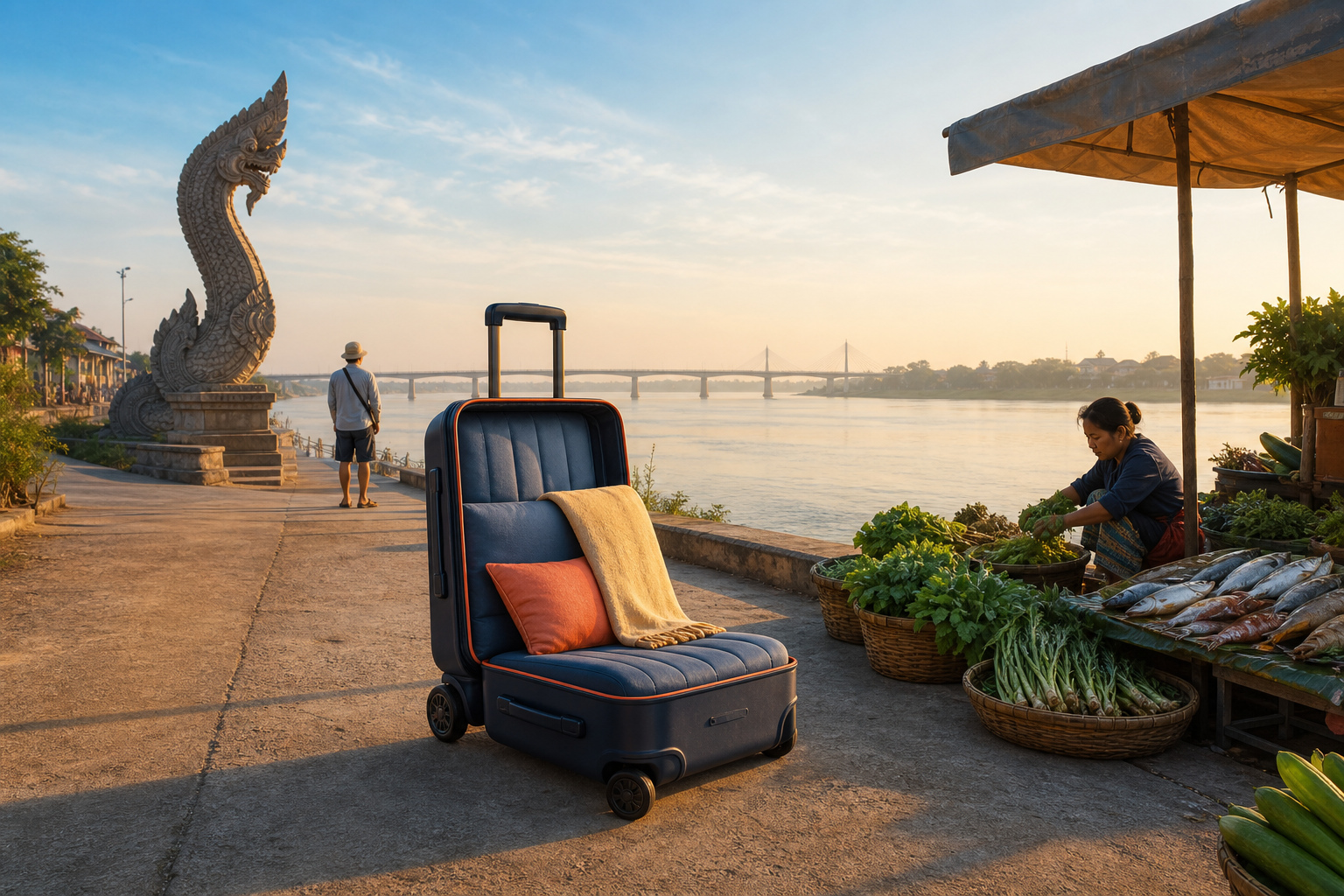
Nong Khai, Thailand: The Mekong Town Most People Cross Without Stopping
View larger map | Map data © OpenStreetMap contributors
Nong Khai exists, in most traveler mental models, as the place you cross the Friendship Bridge to get into Laos. You clear Thai immigration, sit in a shuttle bus, cross the river, and that’s it — Nong Khai was just a formality. That’s wrong, and it costs people a genuinely good place.
The town sits on the northern bank of the Mekong in Thailand’s Isaan region, directly across from Vientiane. It has a riverside promenade, one of the stranger temple complexes in the country, a morning market that actually sells food to locals rather than trinkets to tourists, and a pace so unhurried it borders on therapeutic. Most Isaan towns don’t get much foreign traffic because the food and culture skew heavily toward Lao influence and don’t fit the Thai-beach-and-temple narrative that most international itineraries run on. That’s precisely what makes Nong Khai worth stopping for.
What Sala Kaew Ku Actually Is
Sala Kaew Ku — sometimes listed as Wat Khaek — is a sculpture garden on the edge of town built by a shaman named Luang Pu Bunleua Sulilat starting in the 1970s. He’d previously built a similar park in Laos before the revolution forced him across the river. What he left behind is several acres of enormous concrete sculptures depicting Hindu and Buddhist mythology, human figures, demons, gods, and scenes that don’t sit cleanly inside either tradition. The centerpiece is a seven-story structure you can climb through increasingly strange interior chambers to reach a view over the grounds.
It’s one of the most unusual religious sites in Southeast Asia and gets almost no coverage relative to Chiang Mai’s temples or the Plain of Jars across the border. Give it two hours minimum. The scale only becomes clear when you’re standing next to these things — photographs consistently fail to convey it, and that’s not a cliché in this case, it’s a practical warning about expectations.
The Riverside and the Morning Market
The promenade along the Mekong is genuinely pleasant in a way that Chiang Khong’s isn’t quite, partly because Nong Khai is a real working town rather than a transit village. In the early morning, before the heat sets in properly, walk the length of it from the Friendship Bridge end west toward the old part of town. You’ll pass guesthouses that have been operating since backpackers discovered the Laos crossing in the 1990s, small restaurants with plastic chairs aimed at the river, and the kind of low-key foot traffic that signals a place where people actually live rather than pass through.
The Tha Sadet Market runs along the river in the mornings and skews heavily toward fresh produce, dried fish, and goods brought across from Laos. It’s not a tourist market — there are a few stalls selling textiles and Buddha images, but the majority is food. Isaan cuisine here means proper som tam made with local crab, larb with offal if you want it, and grilled river fish that are a different thing entirely from what you get in Bangkok. Get there before 9am and you have the pick of it.
Crossing to Vientiane: How It Actually Works
The Thai-Lao Friendship Bridge is the main crossing, and the logistics are straightforward but not instant. Tuk-tuk or songthaew to Thai immigration on the Nong Khai side, clear out, then board a shuttle bus across the bridge to Lao immigration — walking across is not permitted. The shuttle runs roughly every twenty minutes during business hours. Budget ninety minutes to two hours if you’re doing it with luggage on a busy morning.
Lao visas on arrival are available at the bridge for most nationalities, though sorting an e-visa in advance is faster. Vientiane is about twenty minutes by tuk-tuk from the Lao side. If you’re only doing a day trip, make sure you’re back at Lao immigration by mid-afternoon — the crossing closes in the evening and the last shuttle back isn’t as late as people assume. That assumption has stranded more than a few day-trippers.
How Long to Stay
Two nights is the right amount. One night is too rushed to actually settle — you spend most of it logistically sorting the next move. Three nights is probably more than most itineraries can absorb unless you’re genuinely moving slowly through Isaan as a region, which is a legitimate choice but a different kind of trip.
Two nights lets you arrive and walk the promenade in the evening, do the morning market and Sala Kaew Ku the next day with a proper riverside lunch in between, and then either cross to Vientiane for a day trip or catch the overnight train south toward Bangkok or Udon Thani with time to spare. The overnight train from Nong Khai station — a short ride from the town center — runs down to Bangkok and is one of the more comfortable ways to cover that distance if you book a sleeper berth ahead of time.
When to Go
November through February is the most comfortable — temperatures in the low 20s Celsius, manageable humidity, clear skies. March and April push into the mid-to-high 30s and the air gets hazy from agricultural burning across the region. The wet season from May through October brings genuine heat and afternoon downpours, though the Mekong swells impressively and the surrounding rice country turns vivid green if that’s worth something to you.
One practical caveat: Nong Khai’s guesthouse stock is thin at the higher end. The town has solid mid-range options and some genuinely good budget guesthouses that have been around long enough to be reliable, but it’s not a place with much in the way of boutique hotels. If you need reliable air conditioning and a proper breakfast, check reviews carefully and book ahead — the good rooms in the better places fill up even though Nong Khai never feels crowded.
Getting There
From Bangkok, the overnight train from Hua Lamphong or Krung Thep Aphiwat takes around eleven hours to Nong Khai station. Book sleeper berths through the State Railway of Thailand’s website — the booking system is slightly painful but works. From Chiang Mai, the most direct route goes via Udon Thani by short flight or bus, then onward to Nong Khai by local bus or songthaew, about an hour.
Flying into Udon Thani is faster if you’re coming from Bangkok and not interested in the train. Nok Air and AirAsia both serve the route frequently, and the Udon-to-Nong Khai leg is easy and cheap regardless of how you do it.
If you’re building an Isaan loop — Nong Khai, Nakhon Phanom, Mukdahan, Ubon Ratchathani — Nong Khai makes the most logical northern entry or exit point. That loop, done slowly with local buses between towns and a night or two in each, is one of the more underused itinerary structures in mainland Southeast Asia and worth doing before everyone figures that out.
The question worth sitting with before you book: are you actually using Nong Khai to cross into Laos, or could it be the point where you stop crossing and start staying?