
What Salento Actually Is (and Isn’t)
View larger map | Map data © OpenStreetMap contributors
Salento is a small colonial town in the Eje Cafetero — Colombia’s coffee-growing heartland — sitting at around 1,895 meters in the Andes. About 7,000 people live here permanently. On a busy weekend, something close to that number again shows up as visitors. The tourist pressure is real and it concentrates hard: most people arrive Saturday, walk Calle Real, take a jeep to the Cocora Valley, and leave by Sunday afternoon.
Two nights changes this completely. The crowds thin after Sunday checkout. The coffee farms are better in the morning light anyway. And the valley hike on a weekday isn’t quieter by a little — it’s quieter by an order of magnitude.
Cocora Valley: Get the Logistics Right First
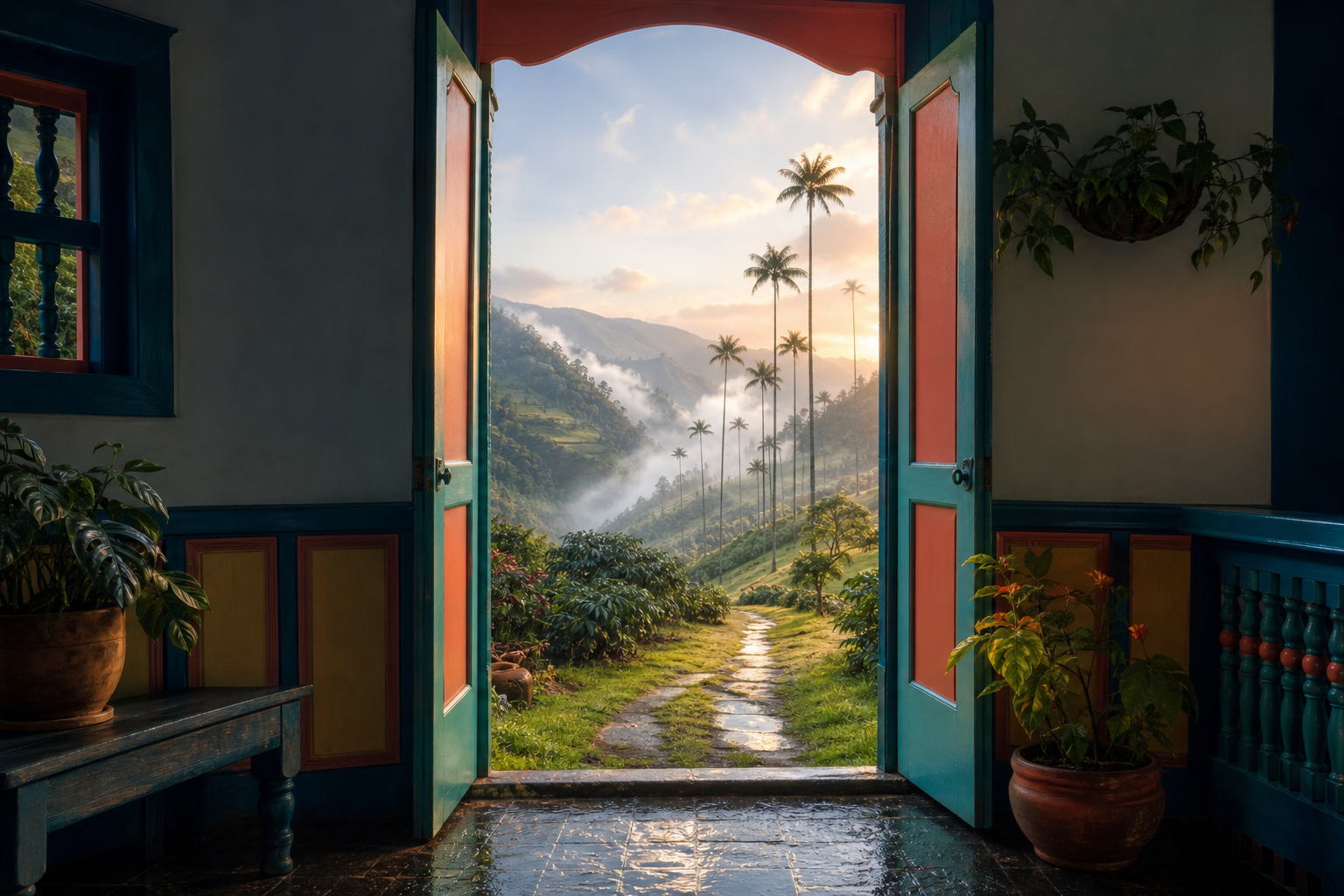
The wax palms are what most people come for, and they earn it. Ceroxylon quindiuense is the world’s tallest palm species and Colombia’s national tree — the ones in Cocora reach 60 meters, rising out of misty Andean grassland exactly the way the photos suggest. The image isn’t oversold.
The hike is longer than it gets billed, though. The full loop — out through the valley floor, up into cloud forest, past the hummingbird sanctuaries, back down — takes four to five hours at a realistic pace, not the two hours some operators quote. The cloud forest section has river crossings on narrow bridges and steep, slippery stretches. Hiking boots, not sneakers.
Jeeps from Salento’s main plaza leave when full, roughly every 20 to 30 minutes from around 7am, cost a few thousand pesos each way, and take about 15 minutes to the trailhead. Leaving first thing means you’re starting the loop before the day-tripper wave arrives. If you have flexibility, a weekday is worth picking over a weekend.
One real caveat: the weather here is genuinely unpredictable. The Cocora Valley sits where Andean microclimates converge, and a clear morning can become heavy rain by early afternoon with almost no warning. Bring a light waterproof layer regardless of what the sky looks like at departure.
The Coffee Farm Visit: Do This Properly or Skip It
Dozens of fincas around Salento run tours. Most are fine. A handful are genuinely good. The difference is whether the farm walks you through the full process — identifying ripe cherries, explaining the wet-versus-dry processing split, tasting coffee at different roast levels with actual context — or whether it’s a 45-minute walk followed by a cup of whatever’s convenient.
Finca El Ocaso is the name that comes up consistently among people who’ve done more than one farm visit. It’s about 20 minutes from town, runs small groups, and covers the growing and processing side with enough depth that you leave understanding why altitude and variety matter to flavor. The short version: higher elevation means slower cherry development, which concentrates sugars; Colombia’s Arabica-dominant production skews toward washed processing, which preserves more brightness than natural drying does. That’s the mechanism behind why Salento-area coffee tastes the way it does, not just marketing. Worth booking a day ahead — groups do fill.
After you’ve been to a farm, don’t buy coffee at the airport. The price-to-quality gap will bother you.
Salento Town: What’s Worth Your Time
Calle Real is the obvious starting point — colorful balconies, craft shops, trout restaurants, the kind of colonial streetscape that earned the Eje Cafetero its 2011 UNESCO Cultural Landscape designation. It’s genuinely pretty, and it’s also the part that gets overcrowded fastest on weekends.
The mirador above the main plaza, reached by 253 steps, is worth climbing for the view over the valley and surrounding coffee-covered hills. Go at dusk if you can. The light on the Andes at that elevation and humidity is specific enough that it doesn’t photograph well, which is almost a point in its favor.
The local specialty is trucha — rainbow trout farmed in the cold mountain streams nearby. It’s everywhere and it’s consistently good, grilled or in garlic butter or with a patacón. The simpler family-run spots on the side streets off Calle Real are cheaper and more reliably worth eating at than anything with a picture menu aimed at tourists.
If you have a second full day, Filandia is about 25 kilometers away and worth a half-day trip. It’s what Salento looked like before the visitor numbers climbed — smaller, quieter, similar architecture, and a mirador with arguably better views. You’ll need your own transport or a local bus; there’s no tourist connection running there.
Getting There and When to Go
The closest hub is Armenia (AXM), with direct flights from Bogotá and Medellín. From the airport it’s roughly 35 to 40 minutes by taxi or shared van to Salento. Pereira (PEI) is also nearby and sometimes has cheaper fares — about 50 kilometers away with similar travel time depending on traffic.
The coffee region has two dry seasons: December through February and June through August. Those months give you the best conditions for the Cocora hike and farm visits. The rainy months — roughly April through May and October through November — aren’t impossible, but the valley trail gets genuinely muddy and some higher sections close. This is cloud forest country regardless of season; some mist is always on the table.
Semana Santa and the last week of December are when Salento hits capacity. The hotel stock is small enough that good options sell out well in advance during those windows. Outside them, a same-day booking is usually fine.
Where to Stay
The range runs from colonial-house hostels with shared hammock areas to small boutique hotels with private balconies over the valley. The center is compact enough that location barely matters — almost everything is walkable. What matters more is whether you want the hostel common-room atmosphere (useful if you’re trying to find hiking partners for Cocora) or a quieter stay. There’s almost nothing in the global luxury bracket here, which is part of the point.
Stay in town rather than on the road toward the valley. You want to walk to the jeep plaza at 7am, not arrange a ride to get there.
Two nights in Salento rather than one is already a more complete trip than most people give it credit for. If you’re routing through the Eje Cafetero more broadly, pairing it with Manizales or Pereira adds useful cultural context — but Salento stands on its own if you stop treating it as a single-day checkbox and actually let the second morning happen.