
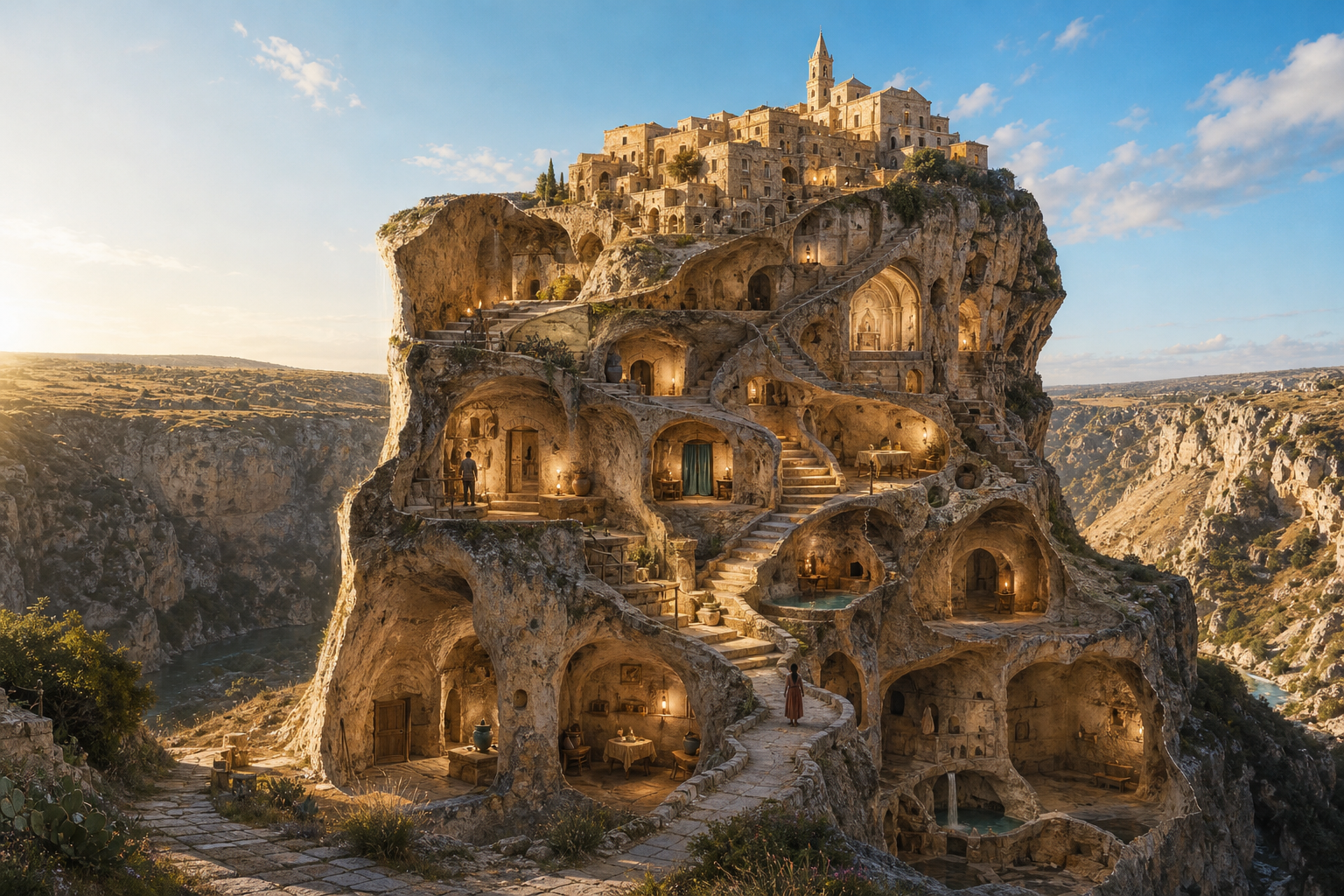
The City That Lived Underground
View larger map | Map data © OpenStreetMap contributors
Matera is one of the oldest continuously inhabited settlements on earth — people have been living in these caves since the Paleolithic, which means the sassi (the cave districts carved into two ravines flanking the city center) aren’t a museum reconstruction. They’re the actual city. That distinction matters when you’re planning your time here, because it changes what you’re looking at: not ruins, not a theme park, but a living urban form that was inhabited until the 1950s when the Italian government forcibly relocated the residents for public health reasons, then slowly recolonized by the people who’d been moved out, and eventually transformed into the hotels, restaurants, and churches you can stay in and eat at today.
Most visitors come from Naples or Bari for a single day. That’s enough to walk the main viewpoint above the Sasso Caveoso, take the photographs, and feel like you’ve seen it. It isn’t enough to understand what you’re actually looking at.
How to Orient Yourself Fast
Matera splits into three distinct zones that feel very different on the ground. The Città Alta — the newer upper town — has the cathedral, the main piazza, and most of the restaurants aimed at visitors. The Sasso Barisano is the larger of the two cave ravines and the more restored one; the upmarket cave hotels sit here and the streets are easiest to navigate. The Sasso Caveoso is steeper, less polished, and more interesting for wandering — fewer signs, more dead ends, a better sense of what the original settlement felt like before the restoration money arrived.
The standard tourist move is to walk the main ridge path between the two sassi, stop at the Belvedere viewpoint on the Via Buozzi side, take photos, and leave. That path is worth doing. Do it at 7am before the tour buses, not at noon. The light on the Sasso Caveoso from the opposite ridge in early morning is genuinely extraordinary — soft, raking, picking out every terrace and cave opening — and by 10am the same view is washed out and crowded.
What Actually Rewards Your Time
The Rupestrian Churches
Around 150 rock-cut churches survive in and around Matera, carved directly into the tufa — the soft local limestone that made cave-living possible in the first place. Most visitors see the facade of Santa Maria de Idris perched on a cone of rock in the Sasso Caveoso and move on. The interior is worth the small entrance fee: Byzantine frescoes painted directly onto cave walls, faded but legible, depicting saints in a style that owes more to Constantinople than to Rome. The church complex at Madonna delle Virtù and San Nicola dei Greci, nearby, gives you two connected cave levels and a clearer sense of how religious and domestic space overlapped in the sassi.
The Cripta del Peccato Originale — the Crypt of Original Sin — is about 15km outside town but worth the drive or taxi if you have any interest in early medieval art. The frescoes there, dating to around the 8th century, include a depiction of the Garden of Eden that art historians sometimes call the Sistine Chapel of rupestrian art. That’s probably overselling it, but it’s the best-preserved example of this style anywhere in the region and gets a fraction of the visitors that the city churches do. Booking ahead is required — the site runs timed entry through the managing foundation, and slots fill up.
Walking the Gravina
The Gravina di Matera is the deep ravine that flanks the Sasso Caveoso. Most visitors look at it from the top. Fewer walk down into it. The path descends from near the ancient bridge at the south end of the city and follows the riverbed — mostly dry in summer — past cave entrances, abandoned cisterns, and rupestrian churches carved into the canyon walls. The full circuit back up the opposite side and along the ridge takes about two hours at a reasonable pace. Not technical hiking, but the path is rough and unmarked in places, so bring water and shoes with grip. The reward is the view back up at the sassi from the valley floor — this is where those photographs that make Matera look structurally impossible are actually taken from, and it looks equally impossible in person.
The MUSMA
The Museum of Contemporary Sculpture Matera is housed in a restored palazzo with cave extensions cut directly into the rock beneath it, and it’s better than it has any right to be for a city this size. The transition between the above-ground baroque rooms and the cave galleries below makes the space itself part of the experience. It’s not large, but it’s curated thoughtfully and rarely crowded.
Eating Here
Cucina lucana — the regional cooking of Basilicata — hasn’t been flattened by tourist demand the way Neapolitan or Sicilian food has. Peperoni cruschi, sun-dried sweet red peppers fried until crisp and papery, turn up in pasta, on top of salt cod, crumbled over eggs. The local bread, pane di Matera, has IGP protected status and a dense, slightly sour crumb that holds up in a way supermarket bread doesn’t — buy a loaf from a bakery and eat it with local cheeses. Lamb features heavily, usually braised with local herbs rather than grilled.
The restaurants directly on the main tourist path through the Sasso Barisano tend to be fine but priced for people who arrived on a day trip from Bari. Walk five minutes uphill into the Città Alta and the ratio of locals to visitors shifts noticeably. The places worth finding near the cathedral square don’t have menus printed in four languages or cave-themed decor — that’s basically the filter.
Practical Notes
Matera is not easy to reach without a car. The closest major rail hub is Bari, roughly 65km away — from there, a combination of regional train and FAL narrow-gauge railway (terminating at Matera Sud station) takes around 90 minutes total and requires a change at Altamura or Ferrandina-Matera depending on the service. The station sits at the edge of the city, not the center, and is a steep walk from the sassi. Taxis exist but can be hard to find outside peak season. For most people coming from elsewhere in Italy, renting a car in Bari and driving is the cleaner option — parking is available on the edge of the upper town.
Two nights is the minimum that actually works. One night means you arrive, walk the ridge in the evening, and leave before you’ve had time to go down into the Gravina or find a rupestrian church that isn’t on the main circuit. Three nights makes sense if you plan to drive to the Cripta del Peccato Originale and spend time in the surrounding Basilicata countryside, which is genuinely empty in a way that most of southern Italy isn’t anymore.
June through September brings heat and tour groups from cruise ships docked at Taranto. The city is still worth it then — the early mornings clear out fast — but late April, May, and October are better. November can be cold and grey but the sassi under low cloud have their own atmosphere, and the crowds essentially disappear.
One genuine caveat on the cave hotels: the experience ranges wildly in quality. Some converted cave hotels are excellent; others charge premium rates for a damp room with bad lighting that happens to have tufa walls. Read recent reviews carefully and check whether the room has natural light — many don’t, which is historically authentic and genuinely miserable to sleep in for two nights running.
The Thing Worth Sitting With
Matera was a source of national shame in Italy until very recently. Carlo Levi described the sassi as a circle of hell in Christ Stopped at Eboli in 1945, and the Italian government used that framing to justify the forced relocations in the 1950s. The city that was once a national embarrassment became a European Capital of Culture in 2019. That reversal is interesting not just as a story about tourism economics, but because it raises a real question about what preservation actually means for a place like this — the aesthetic remains, the poverty that created it doesn’t, which is probably inevitable. It’s worth being clear-eyed about that when you’re paying to sleep in someone’s former home.