
Palermo doesn’t work the way most Italian cities do, and guides written for those cities tend to steer you wrong here. The standard itinerary — Palatine Chapel, Quattro Canti, a quick market visit — isn’t wrong exactly, but it skips the texture of the place entirely and leaves you wondering what all the fuss was about.
View larger map | Map data © OpenStreetMap contributors
Here’s how the city actually rewards attention, and where most first-timers waste their time.
Start with the Palatine Chapel — but slow down inside it
The Palatine Chapel (Cappella Palatina) inside the Norman Palace is, without much competition, the single finest room in Sicily. Byzantine mosaics covering nearly every surface, twelfth-century craftsmanship that still reads as astonishing by any modern standard. Most visitors spend twenty minutes inside, which is long enough to confirm it exists and not much else.
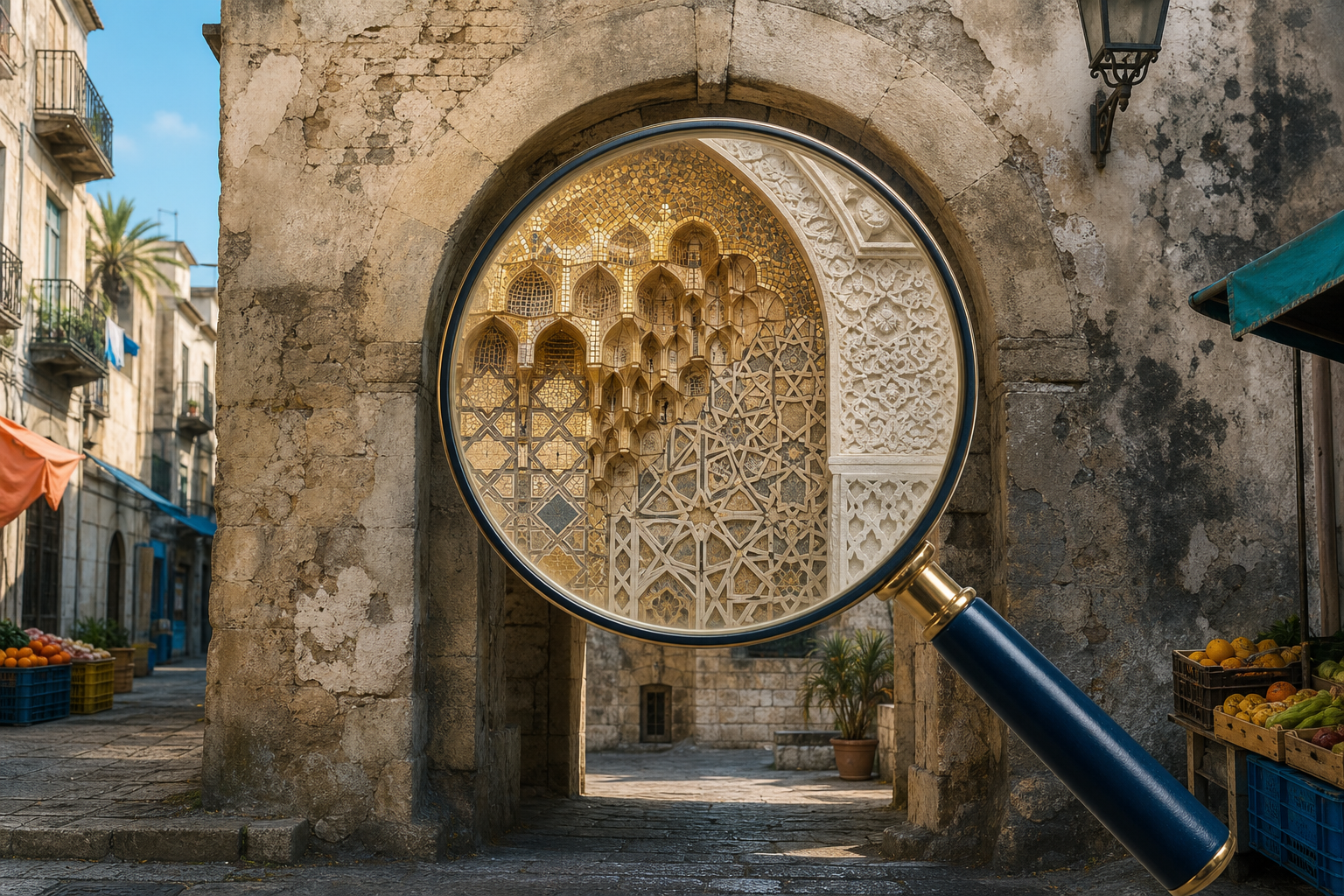
Look at the ceiling: Arabic-Norman muqarnas — carved honeycomb woodwork — running directly above a full program of Christian iconography. That combination isn’t decorative accident; it’s the whole argument for why Palermo is more interesting than other medieval Italian cities. Norman rulers commissioning Arab craftsmen to build Christian chapels produced something that no single tradition would have generated alone. Take at least an hour if you can. Book entry online before you arrive; morning queues aren’t Rome-level but they’re not nothing, especially May through September.
The Ballarò market: don’t treat it as a tourist activity
Every guide mentions Ballarò. Most of them frame it as something to photograph. The better approach is to eat breakfast there, then wander for an hour once the food stalls are fully set up — roughly 8am onwards.
Street food worth going out of your way for: pane ca’ meusa, spleen sandwich, exactly as confrontational as it sounds, sold from stands rather than restaurants. Genuinely good if you can get past the description. Arancine here run larger and cheaper than anywhere else in the city. The difference between Ballarò and the more photogenic Vucciria market a few minutes north is that Ballarò is still a functioning neighborhood food market rather than a bar district that happens to sell some produce. Go to Vucciria in the evening for drinks; go to Ballarò in the morning if you want to eat well cheaply.
The Cathedral exterior is the point; the interior is not
Palermo’s Cathedral is architecturally peculiar — centuries of additions layered onto a Norman-era structure, including a dome grafted on in the 1700s that most architectural historians consider a mistake, proportionally and stylistically. The exterior, particularly the southern flank with its Gothic arches and Islamic geometric decorations, is genuinely strange and worth examining closely. Walk the full perimeter before going in.
The interior was stripped in the eighteenth century and replaced with neoclassical decoration that competes poorly with just about everything else in the city. The royal tombs in the right transept are the one reason to enter — Roger II, Frederick II, both buried here — but be honest with yourself about whether that’s actually your interest before paying the entry fee.
What most itineraries skip: the Oratorio di Santa Cita
Giacomo Serpotta’s stucco work in the small private oratories around Palermo’s old center is extraordinary, and almost nobody outside architecture circles mentions it. The Oratorio di Santa Cita, near the church of the same name north of the Quattro Canti, has walls covered in elaborate relief scenes Serpotta worked on across several years in the early 1700s — the kind of accumulated detail that stops you mid-stride and makes you backtrack.
Modest entry fee, limited hours — check current times before building your day around it, since opening hours shift seasonally and a single school group can make the small space feel impossible. On a quiet morning, though, it’s the kind of place that retroactively justifies the whole trip.
Getting to Monreale: don’t trade this for a day in the city
Monreale is a twenty-minute bus ride uphill from Palermo’s central bus terminus, and the cathedral there contains the most complete cycle of Byzantine-Norman mosaics anywhere — a larger program than the Palatine Chapel, different in character, equally worth your time. The city-versus-Monreale framing is a false choice; you can do both in one day without rushing.
Take the 389 bus from Piazza Indipendenza, which stops right by the Norman Palace — meaning you can do the Palatine Chapel in the morning and Monreale in the afternoon in a single logical sequence. The bus runs regularly and takes around 25 minutes. Try to arrive at Monreale before noon; the afternoon light through the apse mosaics is better but the crowds are heavier, and that trade-off doesn’t always resolve in the light’s favor.
Neighborhood to actually stay in
The Kalsa district, southeast of Ballarò, is where a lot of the better small hotels and B&Bs sit, and it puts you within walking distance of most things without dropping you directly into the main tourist circuit. It was heavily bombed in 1943 and the rebuilding was patchy — some blocks still visibly half-finished — which gives it an odd layered quality that reads as either depressing or fascinating depending on your disposition. The Villa Giulia park at the Kalsa’s edge is worth an evening walk once the heat drops.
Staying near Quattro Canti is convenient but noisier, and the accommodation pricing reflects location rather than quality.
Timing and one caveat that doesn’t get said enough
Palermo in July and August is hot in a way that makes midday street markets actively unpleasant and the cathedral sites crowded enough to feel like logistics problems. April, May, and October are the months that actually work. October in Sicily specifically tends to be quiet in a way that feels unearned — good weather, thin crowds, lower prices across the board.
The thing most itineraries don’t bother to flag: driving in Palermo’s center is a genuinely bad idea for anyone not already accustomed to its traffic logic. A rental car makes sense if you’re planning to reach western Sicily — the temples at Selinunte, the salt pans near Trapani — but park it on arrival and leave it until you’re heading out of the city.
Book the Palatine Chapel first, before anything else on your list. Everything else here can flex around that slot; that one fills up and doesn’t forgive leaving it to the last minute.