
Naples Gets a Bad Reputation It Only Partially Deserves
View larger map | Map data © OpenStreetMap contributors
Most people who “don’t like Naples” spent their first two hours getting honked at, ate mediocre pizza near the port, and then left for the Amalfi Coast. That’s not Naples — that’s a bad arrival. The city genuinely rewards about 36 focused hours more than almost anywhere else in southern Italy, but only if you stop trying to tick the standard boxes.
Here’s how we’d actually spend those 36 hours.
Morning: The Archaeological Museum Before Anyone Else Arrives
The Museo Archeologico Nazionale di Napoli (MANN) is one of the best museums in Europe and most visitors either skip it entirely in favor of driving straight to Pompeii, or bolt through it in 40 minutes. Don’t do either. The Pompeii and Herculaneum artifacts here — mosaics, frescoes, the Secret Cabinet of erotic Roman objects — are more illuminating than standing in the actual ruins, because the context is intact. Budget 2.5 to 3 hours minimum.
Get there at opening (9am). By 11am the tour groups have arrived in force and the main mosaic hall gets genuinely crowded. Tickets run around €20 and can be booked online; there’s rarely the queue problem you’ll hit at the Uffizi, but buying ahead skips the ticket desk entirely.
Fair warning: the room signage inside is inconsistent and the audio guide is mediocre. Download the MANN app before you go. It’s free, and it’s the only navigation tool that actually makes sense of the collection’s layout.
The Pizza Question — and Why You Should Go to Two Places
Yes, you are going to eat pizza in Naples. The debate about which pizzeria is the right one is mostly a distraction. The more useful frame: eat one pizza at lunch, one at dinner, at two different places, and accept that both will be excellent in ways that are slightly different.
For lunch, go to Sorbillo on Via dei Tribunali. It’s famous, there will be a queue, the queue moves fast. The margherita is the benchmark — San Marzano tomatoes, fior di latte, the cornicione (the rim) properly charred and airy. Don’t arrive expecting a relaxed sit-down; it’s quick, it’s loud, it’s correct.
For dinner, try Concettina ai Tre Santi in the Rione Sanità neighborhood — a more interesting part of the city than the tourist center, and the pizza is more inventive without tipping into the gimmicky territory some of the newer Neapolitan places have drifted toward. Book ahead; they fill up by 8pm.
The Quartieri Spagnoli: Walk It, Don’t Rush It
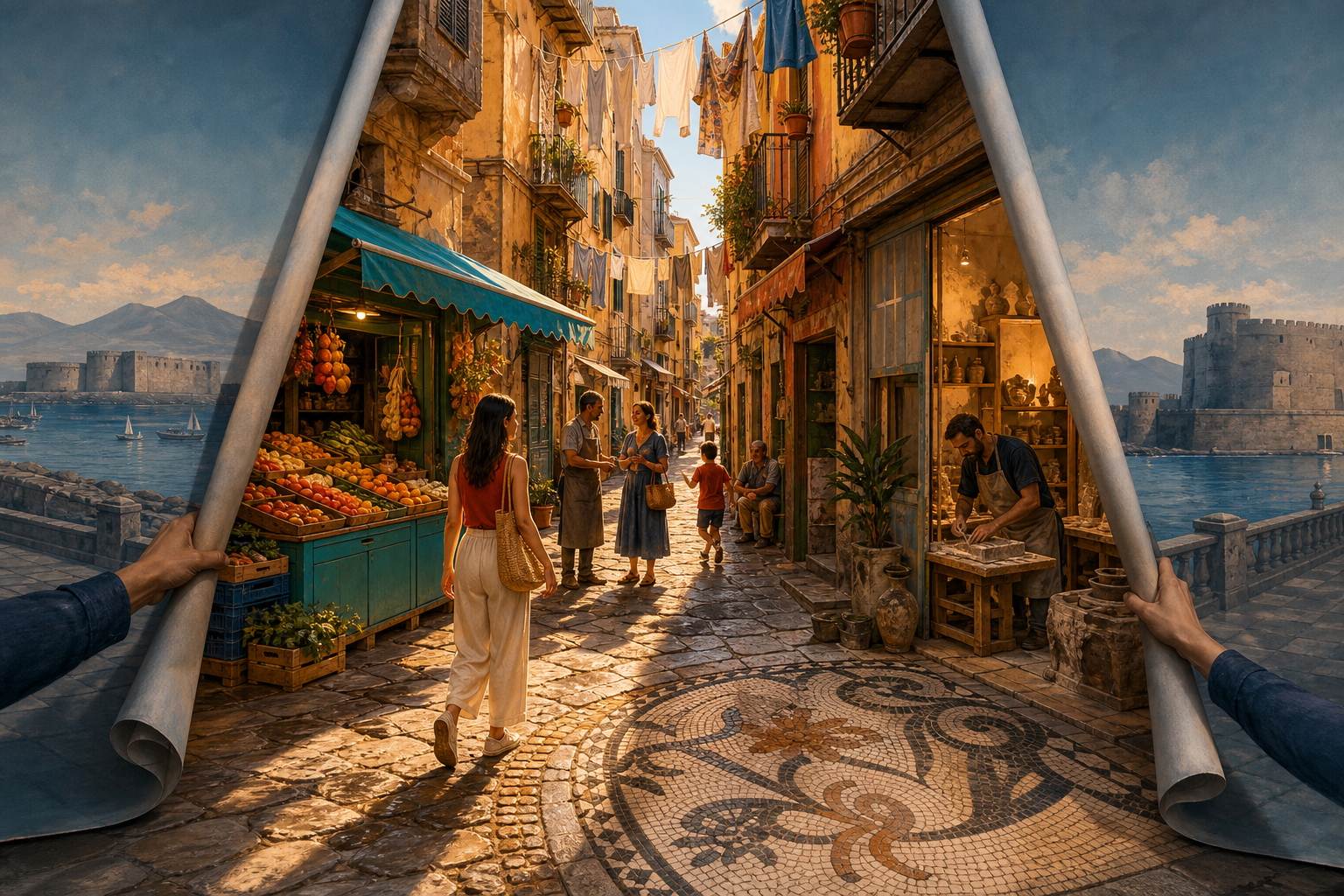
The Spanish Quarter gets described as “gritty” in a way that’s half accurate and half condescending. It’s a working neighborhood with dense housing, laundry lines overhead, Maradona shrines on corners, and some of the best street food in the city. Walk in from Via Toledo around 5pm, when the light is low and the streets are busy with locals doing actual afternoon life.
Eat frittura — fried dough, fried anchovies, cuoppo (a paper cone of mixed fried things) — from one of the street stalls. It costs almost nothing and it is very good. That’s not a romantic embellishment; fried food eaten standing on a Naples street corner is one of the more purely enjoyable things you can do in Italy.
Skip the tourist shops selling Maradona merchandise unless you actually want one. The shrine itself, tucked into an alley near Via Emanuele De Deo, is worth two minutes of your time even if you have no particular feelings about football.
Rione Sanità: The Neighborhood Worth the Slight Detour
Most first-time visitors never make it here. It sits north of the archaeological museum, slightly off the standard tourist circuit — which is exactly why it’s interesting. The Catacombe di San Gennaro run guided tours (book via their official site, around €9) that are genuinely worth it: early Christian frescoes that are well-preserved, and guides who actually know the material. Tours run most mornings; check the schedule before you go because they don’t run continuously through the day.
The neighborhood itself has gone through a deliberate revitalization effort over the past decade, and the result is a mix of good small food shops, craft workshops, and the kind of street life the more heavily touristed centro storico can feel like it’s performing rather than actually living. It’s a 20-minute walk from MANN or a short cab ride.
What to Skip (Or at Least Deprioritize)
The Castel dell’Ovo on the waterfront looks good in photos and is underwhelming in person. Free to enter, worth 20 minutes if you’re already walking past, not worth building a chunk of your day around. The rampart views are fine but not dramatically better than the waterfront promenade below.
Spaccanapoli — the long straight street cutting through the old city — is worth walking once, but the souvenir density has gotten high enough that it reads as a theme park stretch by midday. Walk it before 10am, when it still belongs more to the people who live there.
Getting Around and Where to Stay
Naples is walkable for the most part. The cab situation is better than its reputation — fixed-rate fares to the airport and train station are posted officially, so you’re not negotiating blind. Line 1 of the metro is actually excellent, and the station design at the Toledo and Università stops is legitimately worth a ride just to see — the kind of public infrastructure that should be more widely known outside Italy.
Stay in the centro storico or Chiaia rather than near the port or the train station. The price difference is usually small; the walkability difference is not. Hotels in the historic center put you 10 minutes on foot from everything in this guide. Staying near Piazza Garibaldi means an extra cab ride every time you want to do anything on this list.
Timing: When to Go and When Not To
August in Naples is genuinely brutal — heat, humidity, and a lot of locals gone to the coast. May, June, and October are the practical sweet spots: warm enough, not punishing, and the city feels more like itself. If you’re routing through on the way to the Amalfi Coast or Cilento, May is probably the single best month: the coast is accessible before peak crowds hit, accommodation prices haven’t reached summer rates, and the pizza is exactly as good as it is in August.
One thing worth going in with: Naples will probably be louder, more chaotic, and more demanding than wherever you came from. That’s the same quality that makes 36 hours here feel like more than three days almost anywhere else in the country. Arrive ready to let it be what it is.