
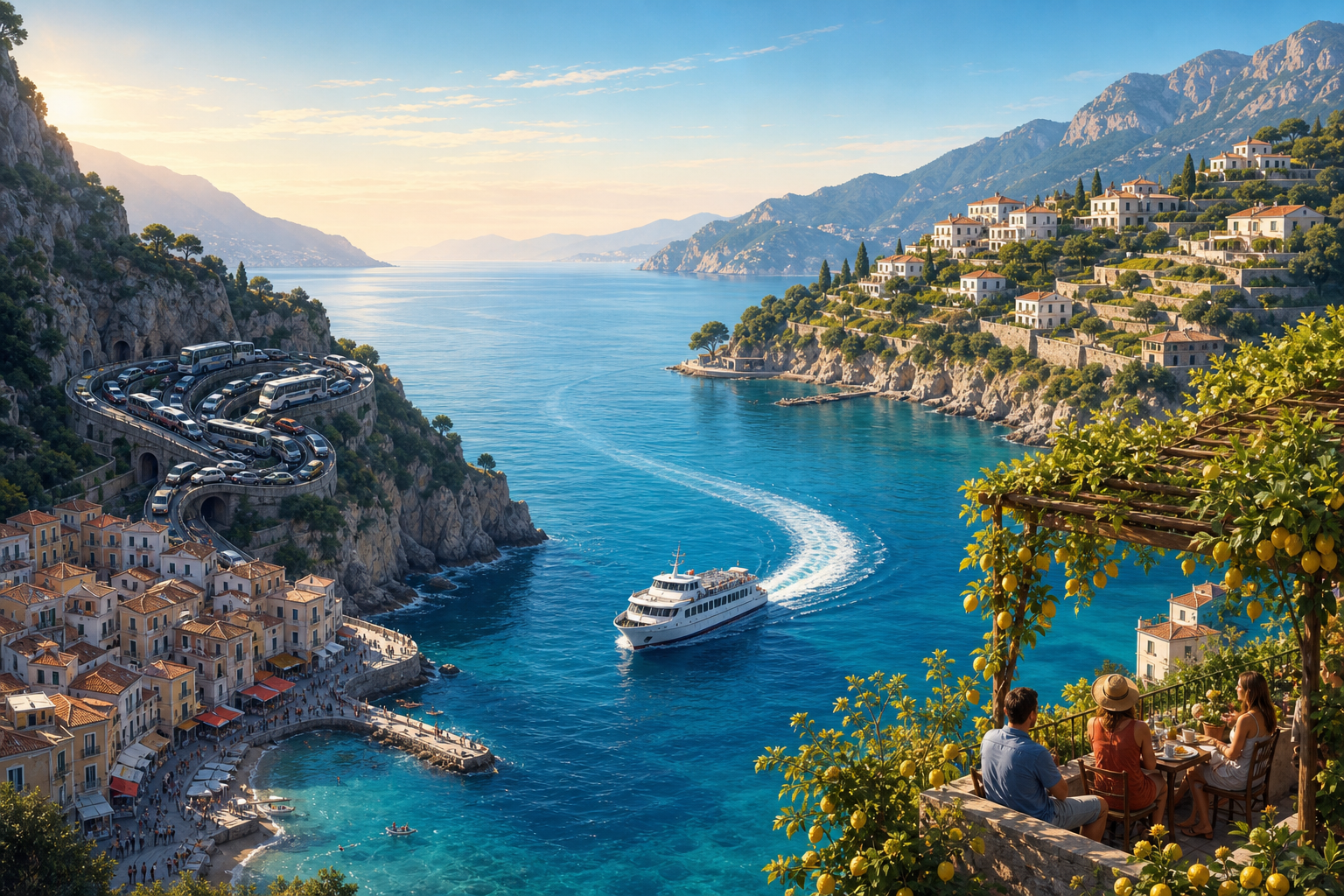
The Amalfi Coast is genuinely spectacular and genuinely unpleasant if you visit it the way most people do. July and August on the SS163 — the coastal road connecting Positano, Amalfi, and Ravello — means gridlocked buses, an hour to travel four kilometers, and hotels charging Rome prices for rooms the size of a closet. None of that is a secret. The question is whether you can route around it without giving up the parts that make the trip worth it.
You can, but it requires making a few decisions before you arrive that most people leave until they’re already there.
Base Yourself Somewhere That Isn’t Positano
Positano is the photograph — the stacked white and terracotta houses cascading to the sea, the beach, the boats. It’s all real and genuinely beautiful. It’s also priced accordingly, and the village itself has maybe three narrow streets. There’s nothing wrong with spending a morning there, but staying the night is mostly paying a premium to be on the pretty side of the coast road’s chaos.
Praiano sits about ten minutes east of Positano and almost nobody is staying there. The hotels are smaller, the prices are lower, and you have the same coastline. Atrani — technically a separate village from Amalfi but connected by a footpath that takes about seven minutes to walk — is another worth knowing. It has its own small beach, a piazza that functions like an actual local piazza rather than a tourist staging area, and accommodation that doesn’t require a credit limit increase.
The logic: you’re on the coast, you can still take the ferry or bus to Positano for the morning and leave before the afternoon traffic calcifies, and you’re not paying the location premium every night.
Ferries Over Buses, Almost Always
The SITA Sud bus network connects the coastal towns and is theoretically sensible. In practice in summer, the buses are overcrowded, the road is narrow enough that two-bus passes require one to reverse into a passing place, and Amalfi to Positano can take well over an hour when it should take twenty minutes.
The ferry network — several competing operators run it, including Travelmar and Alilauro — covers the same route in roughly half the time with considerably better views. Amalfi to Positano runs about 35 minutes by ferry on a calm day. Buy tickets at the dock; they don’t sell out the way museum slots do. The ferries stop running early evening, which is a real constraint: if you want to be in Ravello for sunset, you’re coming back by road or taxi. But for daytime movement between the main towns, the ferry is almost always the better call.
Ravello Deserves More Than a Day Trip
Most visitors treat Ravello as a half-day excursion — bus up from Amalfi, walk through Villa Rufolo’s gardens, look at the view, come back down. That’s defensible but it misses what makes Ravello different from the rest of the coast.
Ravello sits around 350 meters above sea level. That means two things: the air is noticeably cooler than on the coast in July and August, and once the day-trippers leave in the late afternoon, the town goes quiet in a way that nowhere on the SS163 actually does. The gardens at Villa Cimbrone — less visited than Villa Rufolo partly because they’re attached to a hotel, though the gardens are open to the public — end at a belvedere looking out over the Tyrrhenian Sea. The light there in the hour before sunset is one of those views that sounds like overstatement until you’re standing in it.
If the budget allows, staying in Ravello for a night or two is worth considering. You trade direct beach access for altitude, cooler temperatures, and the village after the tour groups leave.
The Beach Question
The Amalfi Coast is not a great beach destination the way Sicily or Puglia are. Most of the shoreline is rocky, pebbled, or occupied by private beach clubs charging by the sunbed. This is fine as long as you’re not coming primarily for the beach.
The best publicly accessible stretch on the coast road is probably Marina di Praia, near Praiano — a small cove reached by a steep path, with a couple of restaurants at the bottom. Not undiscovered, but genuinely more usable than the main Amalfi beach, which is cramped and backed directly onto the town square.
If beach time matters a lot to your trip, Capri is a 40-minute hydrofoil from Sorrento or about an hour by ferry from Amalfi. The water around the island is cleaner and clearer than most of the coastal towns. Capri’s center in August is a genuine crush, but the quieter coves are accessible by small boat and an afternoon out there is a different experience from anything on the coast road.
Timing Within the Day Matters as Much as the Season
The coastal towns get their day-trip traffic arriving mid-morning and peaking around lunch. The same places at 8am, before the tour buses have come down from Naples, are noticeably different — the Amalfi cathedral steps are walkable, the backstreets of Positano are navigable, and you can see the architecture rather than the backs of other people’s phones.
This requires committing to an early alarm on holiday, which is why most people don’t do it. The payoff is real. An hour in Positano before 9am is worth more than three hours there at noon.
A Caveat About September
If your dates are flexible, the first two weeks of September are materially better than July or August for almost everything above: shorter ferry queues, cooler afternoons, and accommodation prices that are slightly less punishing. The sea is still warm. The trade-off is that some smaller boat operators scale back their schedules from mid-September, and a handful of beach clubs start closing. But for anyone whose goal is to actually enjoy the coast rather than endure it, early September is where I’d be looking.
Sort out where you’re staying, which towns you’re moving between, and how you’re getting there before you leave home — that’s the whole game here. Get those three things right and the scenery handles itself.