
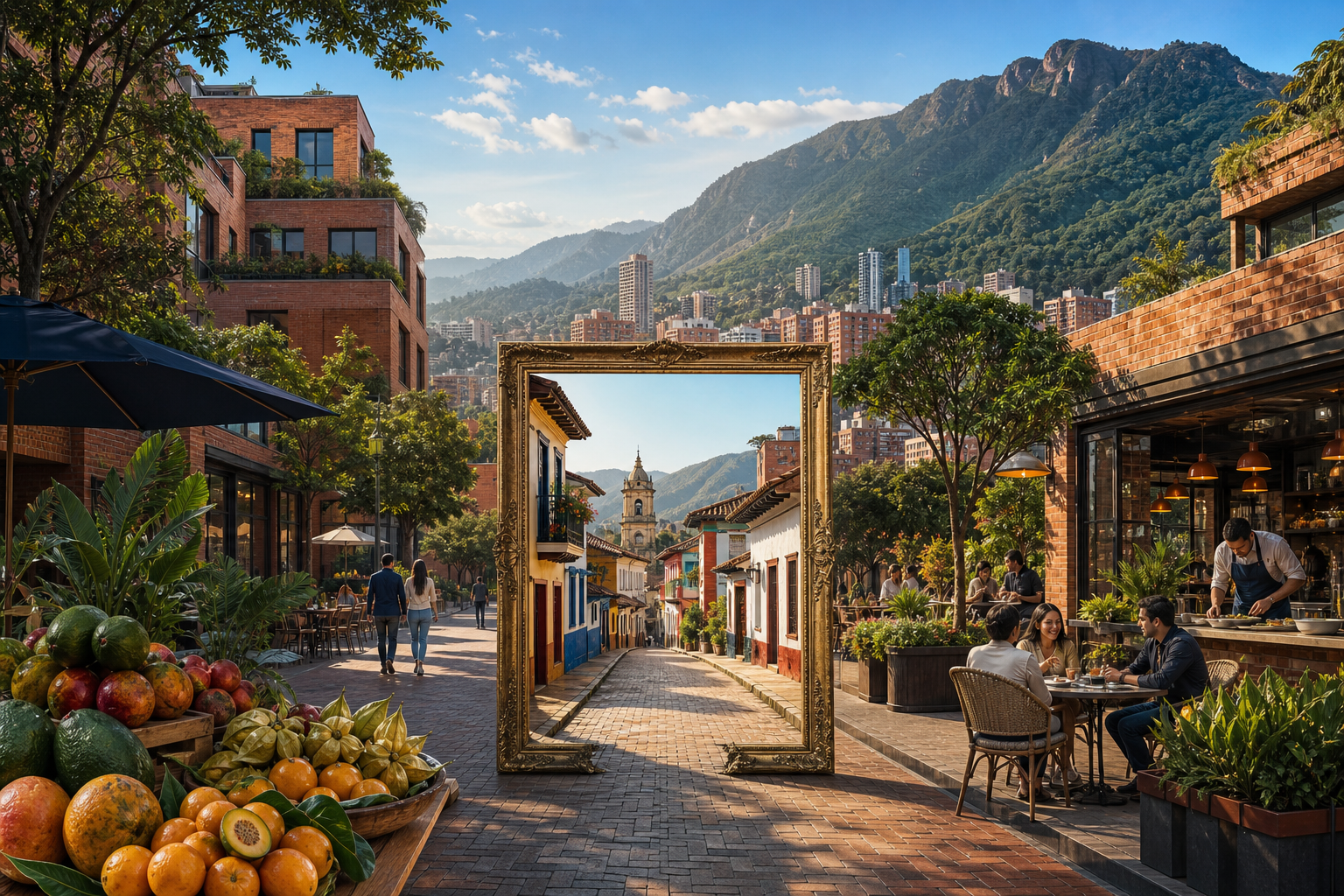
Bogotá Beyond El Centro: What the City Actually Rewards
View larger map | Map data © OpenStreetMap contributors
Most people land in Bogotá, do the Gold Museum and La Candelaria in a morning, eat a bandeja paisa somewhere with an English menu, and then spend the rest of the trip anxious about altitude and petty theft warnings. That’s a waste of a city that has, over the past decade, become one of the more genuinely interesting places to spend a week in South America.
The altitude concern is real — Bogotá sits at around 2,600 metres, and if you’re coming from sea level, the first day will slow you down. Not dangerously so for most people, but enough that a packed first-day itinerary is just ambition you’ll abandon by noon. Build in a slow morning. Drink water rather than coffee in that first 24-hour window, whatever the local café culture is telling you to do.
La Candelaria: Do It, But Do It Right
La Candelaria is worth a morning. The Museo del Oro is one of the better museum experiences on the continent — the pre-Columbian goldwork collection is genuinely extraordinary, not in a “well, it’s famous” way, but in the sense that the objects themselves are strange and beautiful and the curation actually explains what you’re looking at. Go around opening time (9am) before tour groups arrive. An hour inside is usually enough; two if you go slow.
The neighbourhood itself is photogenic in a patchy way — some streets are well-maintained colonial architecture, others are rough. Don’t pull your camera out constantly and don’t check your phone while walking. That advice applies across Bogotá, but La Candelaria more than Chapinero or Usaquén. The Bolivar Plaza is fine. The Botero Museum, free entry, earns 45 minutes for the sheer strangeness of it: Botero’s own work alongside pieces he donated — Picasso, Monet — all inside one colonial building with no queue.
Where You Should Actually Be Spending Time
Chapinero and its sub-neighbourhood Chapinero Alto are where the city’s food and bar scene actually lives. The stretch along Calle 69 and the surrounding blocks has restaurants ranging from serious Colombian tasting menus to very good Japanese, and the density is high enough that you can walk until something looks right. Andrés Carne de Res out in Chía gets all the press as a spectacle, but for a real meal rather than a themed restaurant theme park, the smaller places in Chapinero are more rewarding.
Usaquén, in the north, is the neighbourhood that feels most like a transplanted European village — cobbled streets, Sunday market, brunch-heavy, a little precious. Skip it midweek when it’s quiet to the point of boring. On a Sunday the market is genuinely good: plants, antiques, street food, and a crowd that’s mostly bogotanos rather than tourists. Worth a Sunday afternoon.
Zona Rosa (around Parque 93 and the T-Zone) is where the money shows. The restaurants are good, the security is noticeable, and the bars are loud. Worth knowing about if you want a night out without navigating too much unfamiliarity; skip it if you want anything that feels like the actual city.
Monserrate and Why You Should Go on a Weekday
The cable car up to Monserrate — the peak that looks down over the entire Bogotá basin — is one of the better urban viewpoints I’ve encountered in the region. At 3,152 metres it’s noticeably higher than the city itself, so if you’re already struggling with the altitude, save this for day two or three. On weekends it fills with local families, which is charming but means a long cable car queue and a shoulder-to-shoulder summit path. Weekday mornings are a different trip — same view, fraction of the people.
The church at the top is an active pilgrimage site, not a tourist attraction that happens to have a cross at the summit. Worth knowing before you photograph indiscriminately.
The Food Scene Is Not What Most Guides Say It Is
Standard guidance points you toward arepas, bandeja paisa, ajiaco. All of those exist and ajiaco — a chicken and potato soup made with guascas herb, served with heavy cream on the side — is one of the better things to eat in Colombia. But Bogotá’s food scene has moved well past the traditional canon. The city has had a genuine creative-cuisine moment over the past several years, driven in part by chefs working with Colombia’s extraordinary ingredient range across altitude bands. Places doing something less predictable are common enough now that you don’t need to book weeks ahead to get into something good.
The Paloquemao wholesale market is worth an early-morning visit purely for the fruit. Colombia’s climate range produces varieties that aren’t common even elsewhere in South America — granadilla, lulo, tomate de árbol, feijoa. Buy and eat on the spot. The market is most alive between 5am and 9am, which lines up well with that slow first morning before the altitude has fully settled.
Day Trips Worth Taking and One That Isn’t
Zipaquirá’s Salt Cathedral earns its place on every list — a working cathedral built 180 metres underground inside a former salt mine, with fourteen chapels representing the Stations of the Cross. The engineering is genuinely strange in a way that photos don’t capture. It’s about an hour north by bus or taxi and takes a half-day. Don’t let it eat a full day; there’s not enough in Zipaquirá itself to fill the rest of one.
Villa de Leyva is the better full-day or overnight trip — a colonial town preserved almost entirely in white-painted stone, with one of the larger town squares in South America and a surrounding landscape of near-desert terrain that’s disorienting after the green highland city. It’s about three hours from Bogotá, which makes it a long day trip and a more sensible overnight. A shared minibus from the Terminal del Norte is cheaper and often faster than a private transfer.
The Guatavita lagoon — linked to the El Dorado legend — is closer to the city and often bundled with the Salt Cathedral into one day. That’s doable. The lagoon itself is peaceful and the backstory (Muisca chiefs coating themselves in gold dust and wading out from the shore as an offering — the origin of the whole El Dorado myth) is more interesting than the site is visually dramatic. Temper expectations accordingly.
Getting Around
TransMilenio covers most of the city and is cheap, but during peak hours it’s extraordinarily crowded and pickpocketing is common enough that a bag with zippers facing outward or a visible phone is a bad idea. For most journeys between neighbourhoods, an app-based ride — InDriver and Cabify both operate in Bogotá — is the practical call. Not because TransMilenio is unsafe exactly, but because journey times are genuinely shorter and the cost difference isn’t dramatic enough to matter.
Don’t hail taxis off the street. This is the one piece of advice where security guidance, local guidance, and common sense all say the same thing.
When to Go
Bogotá’s seasons don’t follow typical tropical logic because of the altitude. There are two drier periods — roughly December to March and July to August — with wetter stretches in between. The wet season is workable: rain tends to come hard in the afternoon for an hour or two, then clear. Plan outdoor activities for mornings, carry something waterproof, and the weather mostly works around you. One thing worth flagging about December specifically: Bogotá’s Alumbrados, the city-wide Christmas light installations, are a genuine event rather than a tourist overlay — they fill the streets with locals from early in the month and are worth timing a trip around if you have flexibility.
If your Colombia itinerary also includes the coast — Cartagena or Santa Marta — doing Bogotá first and then descending to sea level is easier on your body than the reverse. Acclimatization going down is faster than going up, and arriving at altitude after days at sea level is where most people run into trouble.