
Maputo Doesn’t Get Enough Credit
View larger map | Map data © OpenStreetMap contributors
Most southern Africa itineraries treat Mozambique as a beach destination and Maputo as a layover on the way to Tofo or the Bazaruto Archipelago. That’s a real miss. Maputo is one of the more interesting capitals on the continent — architecturally layered, historically strange, and genuinely easy to spend a few days in before you head north to the coast.
The city sits at the southern tip of the country, right on Maputo Bay, which puts it closer to Johannesburg than to most of Mozambique itself. That geography shapes everything: the food, the population mix, the transport links, and the reason the city feels so different from the rest of the country.
The Architecture Is the First Thing to Understand
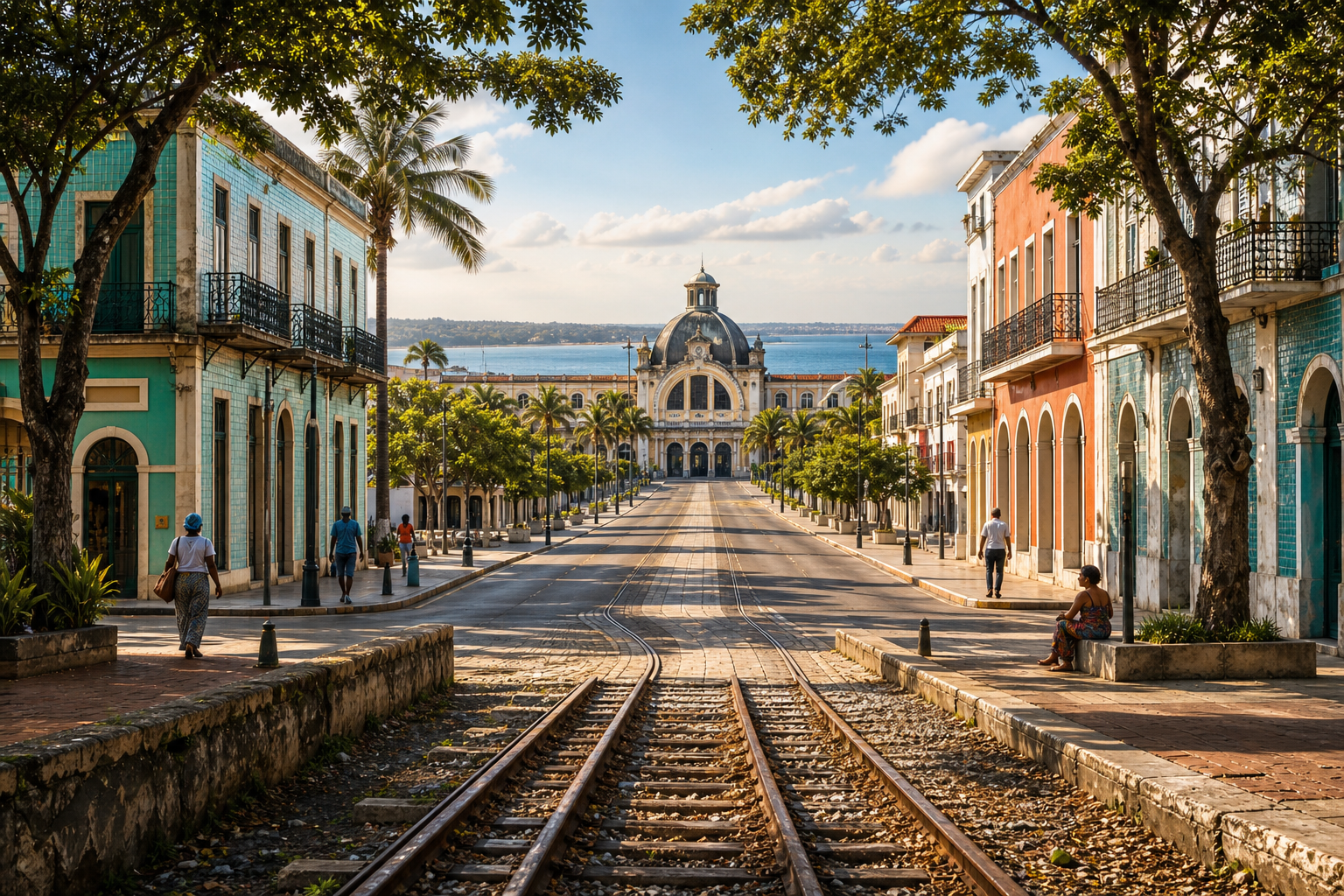
Maputo was Lourenço Marques until 1976, and the Portuguese colonial period left behind a built environment that’s genuinely unusual for sub-Saharan Africa. The low-rise downtown — Baixa — has wide tree-lined avenues, tile-fronted buildings, wrought iron balconies, and an almost Lusophone-Mediterranean quality that doesn’t slot into any obvious category.
The Central Market is the most honest version of the city: loud, crowded, practical, not curated for tourists. You’re in the way of actual commerce, which is exactly the point. The chaos of the fish section alone tells you more about what Maputo actually eats than any restaurant recommendation will.
The old railway station — Estação de Caminhos de Ferro — is worth going out of your way for. It was designed in part to specifications from Gustave Eiffel’s firm (accounts differ on exactly how much involvement there was), and the dome and ironwork are in better shape than you’d expect given everything the country went through post-independence. Trains still run from here to South Africa, though schedules are unreliable enough that you’d want to verify current operations before building any plans around them.
The Seafood Is Not Optional
Maputo’s piri-piri prawns have a specific reputation in southern Africa, and it’s deserved. The Mozambican preparation — split, grilled, heavy on the piri-piri butter — is different from the South African or Zimbabwean versions that borrowed from it. The Feira Popular, a slightly worn outdoor eating complex near the seafront, is where most locals point you. It’s not glamorous. The tables are plastic. None of that matters.
The seafood quality in general reflects the bay access — this isn’t the frozen-and-shipped situation you get in inland capitals. Crab, prawns, grilled fish sold by weight: the market stalls near the waterfront have the raw version of most of what you’ll order in restaurants later.
For something more sit-down, the Polana Caniço area north of the center has a better restaurant scene than downtown, and a few places there have been consistent for years. Don’t overthink the research — walk the strip, look at what’s on neighboring tables, and make a decision. Menu photos are your enemy here, not your friend.
What the Museums Are Actually Worth
The Natural History Museum has a taxidermy collection that’s been there since the colonial era and hasn’t been updated much since. Some people find that depressing; it’s also part of the interest — a time capsule of a specific scientific and political moment. The building itself, with its high ceilings and tiled floors, is worth the admission price regardless of the exhibits.
The Museum of the Revolution is more politically engaging than most visitors expect. It covers the independence struggle and FRELIMO’s history in a way that assumes you know some context, which is worth acquiring before you go rather than trying to absorb on the spot. Read a short history of Mozambican independence — the liberation war ran from 1964 to 1975, followed by a civil war that didn’t end until 1992 — and the museum shifts from confusing to genuinely illuminating.
Practical Logistics That Actually Matter
Getting to Maputo from Johannesburg is straightforward: the flight is about an hour, with multiple carriers. Overland via the Lebombo/Ressano Garcia border crossing is also common for people coming from Jo’burg or Kruger, though the crossing runs slow on weekends — budget an extra two hours if you’re going that route on a Friday or Sunday.
The metical (MZN) is the local currency. US dollars are accepted in hotels and some restaurants, but you’ll get worse rates and the street economy runs on meticais. ATMs exist in Baixa and near the Polana Hotel, though card infrastructure is spottier than you’d expect from a capital city. Carry more cash than you think you need.
Uber operates in Maputo and works reliably. Yellow taxis exist but agree on a price before getting in. The city is more driveable than walkable — distances between neighborhoods are enough that the heat makes a full day on foot impractical, especially February through April when the humidity is serious.
When to Go
The dry season runs roughly May through October, with July and August the most comfortable — lower humidity, temperatures in the low-to-mid 20s Celsius, no rain to speak of. November through March brings heat, humidity, and cyclone-season risk for northern Mozambique specifically. Maputo itself is less exposed than the coast further north, but weather in the south still gets rough in January and February.
If you’re combining Maputo with beach time further north, May through August is when you want to do it. The Bazaruto Archipelago and Tofo are both better in the dry season for visibility and sea conditions, and the internal flights from Maputo to Vilankulo or Inhambane are short enough that the logistics aren’t complicated.
The Honest Caveat
Maputo has real infrastructure limitations. Power cuts — load shedding, largely tied to supply from South Africa — can affect anything from restaurant kitchens to hotel elevators. Water pressure is inconsistent in older buildings. Street lighting outside the main areas is sparse. None of this makes the city unsafe or unvisitable, but a budget-focused trip requires more tolerance for variability than in, say, Nairobi or Accra. That’s not a reason to skip it; it’s just the accurate version of what you’re walking into.
Petty theft around the waterfront and Baixa exists at the level you’d expect in any dense urban area. The usual calculus applies: don’t carry more than you need, stay aware at markets, don’t treat it as more threatening than it is. Most visitors have no problems.
Two Days Is the Minimum That Makes Sense
One day in Maputo is a rushed blur. Two gives you the downtown architecture and Central Market in the morning of day one, the Natural History Museum and a proper seafood dinner that evening, then the Feira Popular and the waterfront on day two with time to actually sit somewhere. Three days and you can add a half-day trip to the Reserva Especial de Maputo — elephant sanctuary land about 70km south of the city, accessible by 4WD — which is one of the stranger wildlife experiences in southern Africa given how close it sits to a major capital.
If you’re already running a southern Africa circuit that includes Kruger and Victoria Falls, Maputo adds almost no extra flying and gives you something genuinely different from either. The beach extensions further north are easy from here. The reason most itineraries skip it is inertia, not logic — so if you’re already in the region, the question worth sitting with is what you’re actually optimizing for by skipping it.