
Harare Doesn’t Get the Credit It Deserves
View larger map | Map data © OpenStreetMap contributors
Most Zimbabwe itineraries treat Harare as the place you land and immediately flee — straight to Victoria Falls or Hwange National Park. That instinct isn’t entirely wrong, but it does write off a city that has more going on than its reputation, and its occasionally difficult logistics, would suggest.
We’ve been building out Where To Holiday with an eye toward destinations that genuinely reward time rather than just appearing on itineraries by default. Harare is interesting precisely because it’s not obvious. It doesn’t have a single unmissable landmark that everyone photographs from the same angle. What it has is a particular energy worth understanding before you parachute into the national parks.
The Practical Baseline First
Zimbabwe operates almost entirely in USD. The Zimbabwe Gold (ZiG) currency introduced in 2024 is in circulation, but USD is still widely preferred and accepted everywhere. ATMs in Harare can be unreliable for foreign cards, so carry more cash than you think you’ll need. Card terminals exist in bigger hotels and some restaurants, but don’t count on them.
Getting around the CBD on foot is realistic, but beyond a few blocks the distances get awkward and the roads aren’t built for pedestrians. Ride-hailing via InDriver works reasonably well and is cheaper than negotiating with roadside taxis — worth having the app set up before you arrive.
Harare sits at about 1,480 meters above sea level, which gives it a genuinely pleasant climate compared to lower-lying parts of Southern Africa. The rainy season runs roughly November through March: not a reason to avoid it, but afternoon thunderstorms are reliable in that window and some roads flood briefly. June through August are the most comfortable months, with cool mornings and warm afternoons.
What’s Actually Worth Your Time
The National Gallery of Zimbabwe
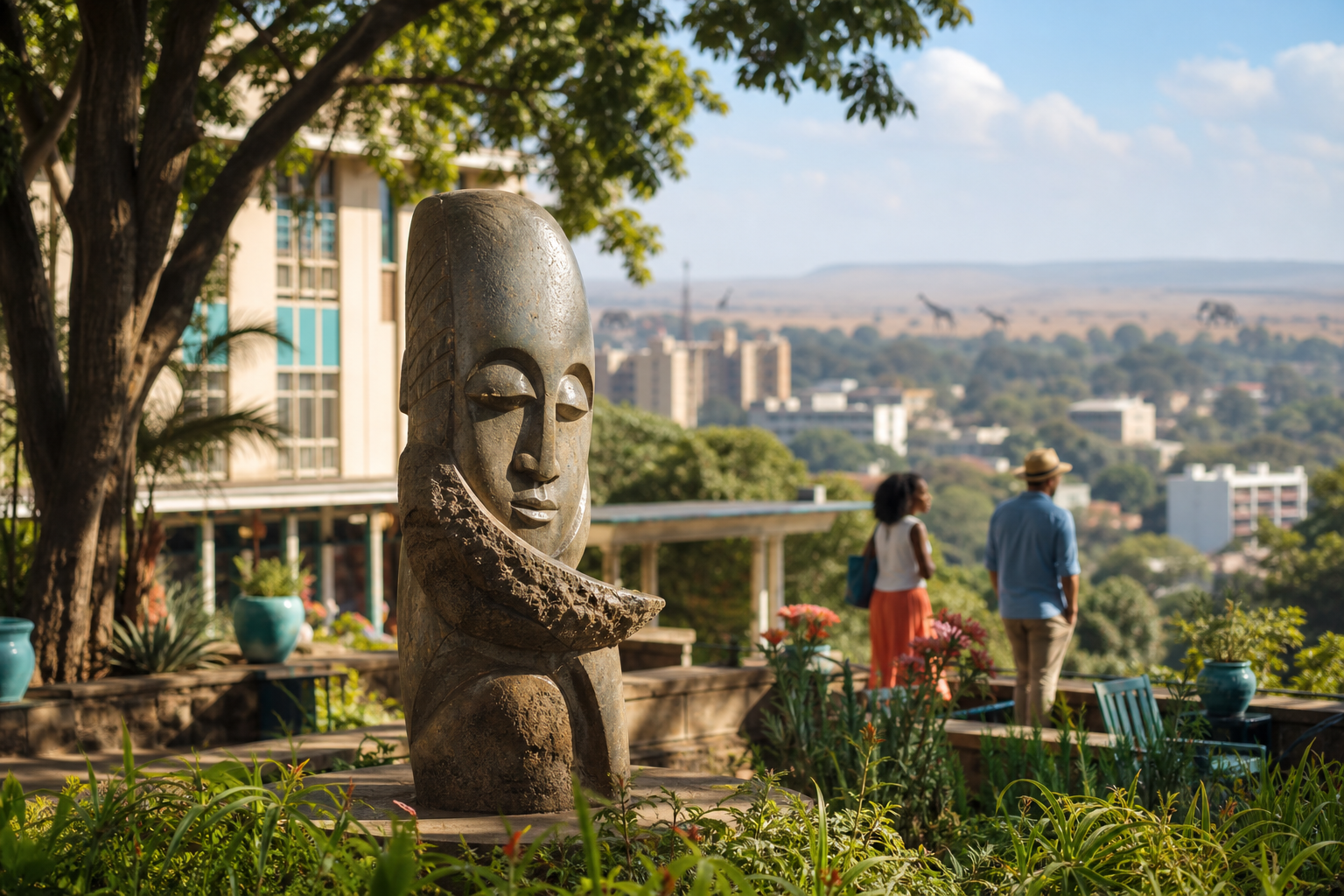
The most underrated thing in the city, full stop. The permanent collection of Shona sculpture is genuinely exceptional — the tradition dates back centuries, and the carving technique of working directly with serpentinite and springstone produces pieces that have nothing to do with the airport-souvenir version of “African art” you might be expecting. The gallery sits in a colonial-era building on Julius Nyerere Way and rarely feels crowded. Budget two hours rather than forty-five minutes.
The gallery also rotates contemporary Zimbabwean work, which is worth checking for its own reasons. The contemporary art scene in Harare is real, not a tourist construct, and the gallery is one of the better entry points into it.
Mbare Musika
The largest market in Zimbabwe and one that actually functions as a working market rather than a display for visitors. Fresh produce, secondhand clothes, hardware, traditional medicines, live chickens — it’s dense and chaotic and not set up for easy tourist navigation. Go with someone who knows it if possible, or at minimum go with a local contact rather than alone on your first day in the city. The produce section is the most accessible part and gives you a more accurate read on what Harare actually eats than any restaurant menu will.
Mbare is about 5km from the CBD. The neighborhood has a rough reputation that’s somewhat exaggerated but not entirely without basis — petty theft happens. Don’t carry your passport, keep your phone in a pocket rather than visibly in hand, and don’t treat it as a photography opportunity. It’s an actual place where people work.
Avondale and the Flea Market
The Avondale Flea Market runs on weekends and is the more manageable counterpart to Mbare: crafts, clothing, food stalls, and a noticeably more relaxed atmosphere. The surrounding suburb has the better concentration of restaurants and coffee spots, which matters when you’re piecing together meals in a city where food options in the CBD proper are thin.
Sam Levy’s Village in Borrowdale is the upscale mall end of things. It’s fine for a coffee or a supermarket run, but it’s not why you’re in Harare.
The Harare Gardens and City Center Architecture
The gardens at the center of the city are genuinely pleasant in the morning and give you a way to calibrate the scale of the CBD without committing to a full walking tour. The colonial-era architecture around the Parliament building and along the main avenues is interesting if you have any eye for the period — a particular flavor of 1950s–60s British settler design you’ll recognize from Nairobi or Lusaka, but with its own Harare variation.
The city has aged unevenly since the economic crises of the 2000s, and parts of it look significantly more neglected than others. That’s not something to pretend isn’t true, and it does affect which blocks are worth walking. The area around First Street Mall has improved; further east toward the bus terminus, less so.
Where to Eat
Harare’s restaurant scene has recovered more than most visitors expect. Amanzi Restaurant in Borrowdale is reliably good and the garden setting works well for a longer lunch. The Avondale food market on weekends has stalls worth eating at — sadza with nyama (maize porridge with meat) is the thing to order rather than the international menu options that most tourist-facing restaurants default to.
Several independent roasters have opened in the last few years, mostly in the northern suburbs around Borrowdale and Avondale. The coffee culture here is more developed than the city’s international profile would lead you to expect.
One Night or Three?
One night in Harare is genuinely not enough to do more than sleep and leave. Two nights gives you time for the National Gallery properly, one market visit, and a meal that isn’t hotel food. Three nights starts to let the city register as a place rather than a transit corridor.
The higher-end hotels — Meikles, the Monomotapa — are large, functional, and priced in USD. They’re not cheap, but they’re reliable. Guesthouses in the northern suburbs like Borrowdale or Mount Pleasant are the more interesting option if you’re comfortable being further from the CBD: quieter, often more personal, and better positioned for the restaurants that are actually worth going to.
What to Know Before You Go
Harare has real practical complications that shouldn’t be hand-waved away. The political and economic environment shifts, occasionally quickly, and things that worked fine six months ago sometimes don’t now. Power cuts (load-shedding) are a fact of life — better hotels have generators, but ask before you book. Internet connectivity is inconsistent in ways that matter if you’re trying to coordinate anything time-sensitive.
None of this makes Harare a bad destination. It makes it one that rewards preparation and a flexible attitude when logistics don’t go exactly as planned. The travelers who find it worthwhile tend to show up curious rather than expecting everything to run smoothly — which is the right disposition for most of Southern Africa, honestly.
If you’re building a Zimbabwe trip, two or three days in Harare before the parks changes how the rest of the country makes sense. The question worth sitting with before you book is whether you want Zimbabwe to be a series of nature set-pieces, or whether you also want to understand something about the place those parks exist inside.