
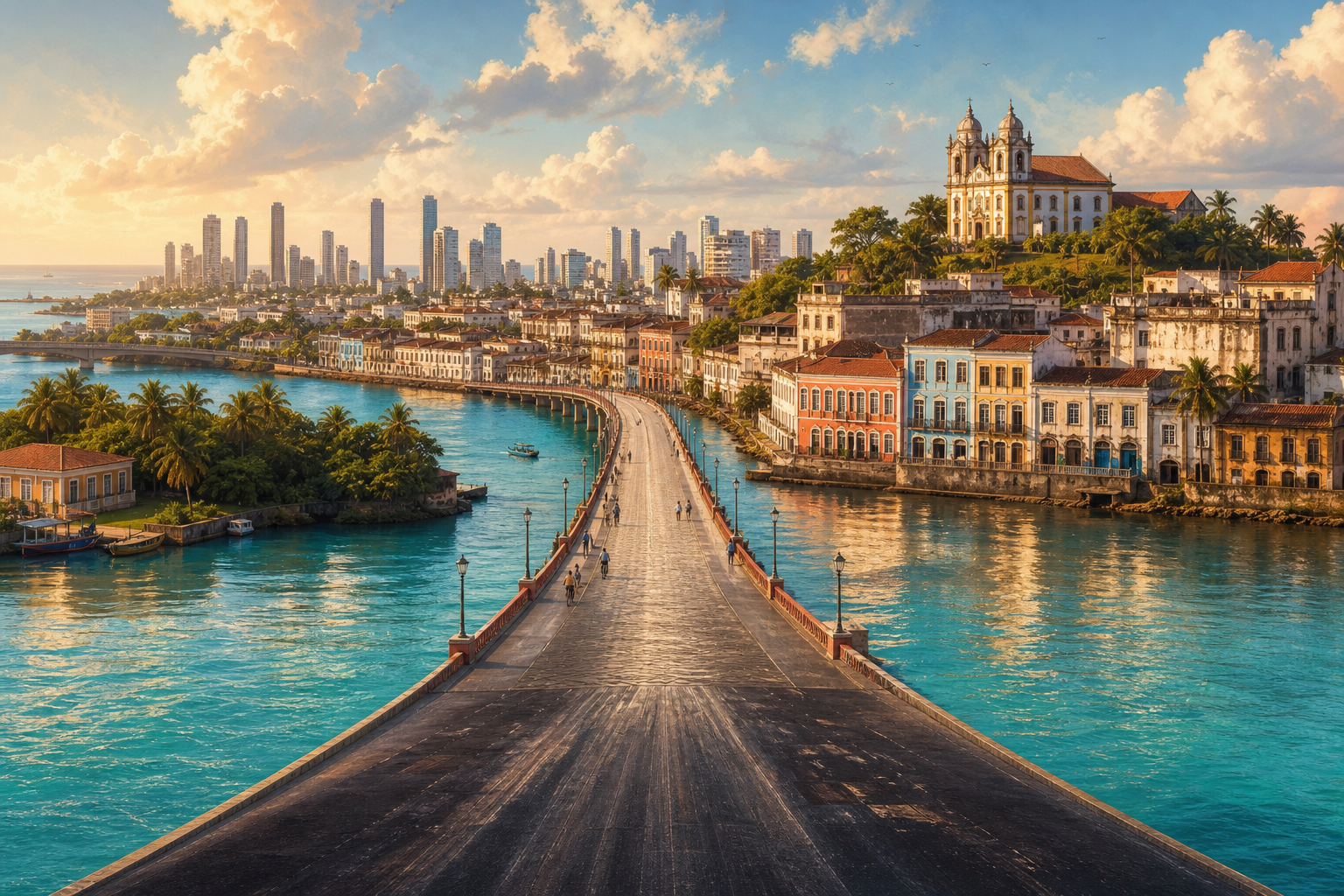
Recife Isn’t a Layover
View larger map | Map data © OpenStreetMap contributors
Most Brazil itineraries route through Recife Guararapes–Gilberto Freyre International (REC) and leave the same day, headed for Fernando de Noronha or Salvador. Both are genuinely worth going to. But it means Recife itself — one of the largest cities in Brazil’s northeast and one of the most architecturally strange places on the continent — gets about as much attention as the airport lounge.
Recife is built on a cluster of islands and peninsulas where the Capibaribe and Beberibe rivers empty into the Atlantic. There are 67 bridges inside the city limits. It’s sometimes called the Venice of Brazil, which sounds like a tourist board invented it — except in this case the water genuinely defines how the place moves, not just how it looks.
Start with Recife Antigo, But Don’t Stay Long
The old port district is the obvious first stop and it’s worth a morning. Marco Zero square sits at the official geographic center of the city and looks directly out onto the Atlantic. The Paço Alfândega, a restored 19th-century customs house, runs cultural events and has a ground-floor food court that skews local rather than touristy. The Cais do Sertão museum nearby covers the culture of Brazil’s sertão interior — the xylography print tradition, forró music, the whole semi-arid hinterland that Recife historically served as a port for — and it’s one of the better-constructed regional museums in the country. An hour there is time well spent.
By midday, though, Recife Antigo gets crowded and a bit hollowed-out in the way of colonial heritage districts that have been pedestrianized for tourism. The rest of the city is more interesting.
Olinda Is Not Optional
Olinda sits 6 kilometers north of Recife’s center and is technically a separate municipality, though the cities have grown together. UNESCO listed Olinda’s historic center as a World Heritage Site in 1982, and unlike some sites on that list it justifies the designation on arrival rather than in retrospect.
The town climbs a steep hill above the coast. From the Alto da Sé viewpoint at the top you get a view back over Recife’s skyline — 17th-century Portuguese colonial architecture in the foreground, high-rises behind it. It’s genuinely striking, not in a postcard way but in a dissonant, this-is-a-real-city way. The Benedictine monastery of São Bento, founded in 1586, is still active and usually open for visits in the morning. The church interior is Baroque without being overdone, which is rarer in Brazil than you’d expect.
Olinda also has a serious visual arts scene concentrated around ateliers that sell work directly. Prices are lower than what the same work fetches in São Paulo galleries, and the quality range is wide in both directions — it rewards spending time rather than quick browsing.
Get there on the 981 bus from Avenida Dantas Barreto, which runs frequently, or take a rideshare. Skip the guided walking tour unless you have a specific reason for one; the historic center is small enough to navigate independently in an afternoon.
The Food Logic in Recife
Northeastern Brazilian cooking is genuinely different from what you get in Rio or São Paulo, and Recife is a reasonable place to understand why. The regional staples — tapioca flatbreads made from manioc starch, carne de sol (salt-dried beef, distinct from the harder-dried charque), coalho cheese grilled on skewers, cuscuz made from cornmeal rather than the North African wheat version — show up in market stalls and local restaurants at prices that make the southeast feel expensive by comparison.
The Mercado de São José, built in 1875 and one of the oldest iron-structure markets in Brazil, is the practical place to buy regional ingredients and eat cheaply. It’s a working market, not a food hall retrofit — the stalls sell medicinal herbs, lace, dried goods, religious items, and street food in roughly equal measure. Go in the morning when it’s active; mid-afternoon it quiets down considerably.
For sit-down meals, the Boa Viagem neighborhood has a dense restaurant strip that covers a wide quality range. The neighborhood runs along a long urban beach — fine for an evening walk, but not the place to swim. Water quality near the city is one issue; the more serious one is the reef running offshore, which creates conditions that have made this stretch of coast one of the more shark-incident-prone in Brazil. This is documented by the state’s shark monitoring program (CEMIT-PE), and the beach has posted restrictions accordingly. The reef is the attraction for experienced divers going out with a local operator — not for wading in from the shore.
The Instituto Ricardo Brennand
Visitors who spend real time in Recife consistently name this the best thing they saw. It’s a private museum built by a local industrialist on the city’s western edge, holding the largest collection of Frans Post paintings outside Europe. Post was a Dutch painter who documented Brazil during the 17th-century Dutch colonial period, and his northeastern landscapes are the closest thing to a primary visual record of what the region looked like before large-scale sugar agriculture reshaped it. The collection alone justifies the trip out. The building itself is a fantasy castle constructed in the early 2000s that looks transplanted from the Rhine valley, which in context feels entirely appropriate for something celebrating Dutch colonial history.
There’s a separate gallery on the grounds focused on European arms and armor that’s more thorough than you’d expect. The whole complex sits in a botanical garden. It’s a long rideshare from the center, the entrance fee is low relative to what it contains, and capacity is managed — book ahead online, because walk-up availability varies.
Practical Logistics
Recife has the infrastructure of a large city (roughly 1.7 million in the municipality, more than 4 million in the metro area), so the standard Brazil urban travel approach applies: use apps for transport, don’t display expensive gear in unfamiliar neighborhoods, and be clear-eyed about which areas are fine to walk at night and which aren’t. Boa Viagem and Recife Antigo on busy evenings are fine; isolated streets in the Centro after dark are not.
The rainy season runs roughly March through July. The northeast’s wet season is inverted relative to most of Brazil because it’s driven by the Intertropical Convergence Zone shifting south — so July through December is the drier window, though Recife is humid year-round. Carnival here is frevo music (fast, brass-heavy, built around parasol-twirling street dancing) and maracatu rather than samba schools, and participation is street-level rather than stadium-seated. That’s a real difference in experience, not a regional pride claim.
Two full days covers Recife Antigo, Olinda, the Mercado de São José, and the Brennand without rushing. Three days lets you be slower about it, which in Olinda specifically is the better approach.
If you’ve already booked a Brazil trip that routes through REC with zero days allocated to the city itself, look at that booking again. It’s worth at least one extra night — and Olinda alone is reason enough to add it.