
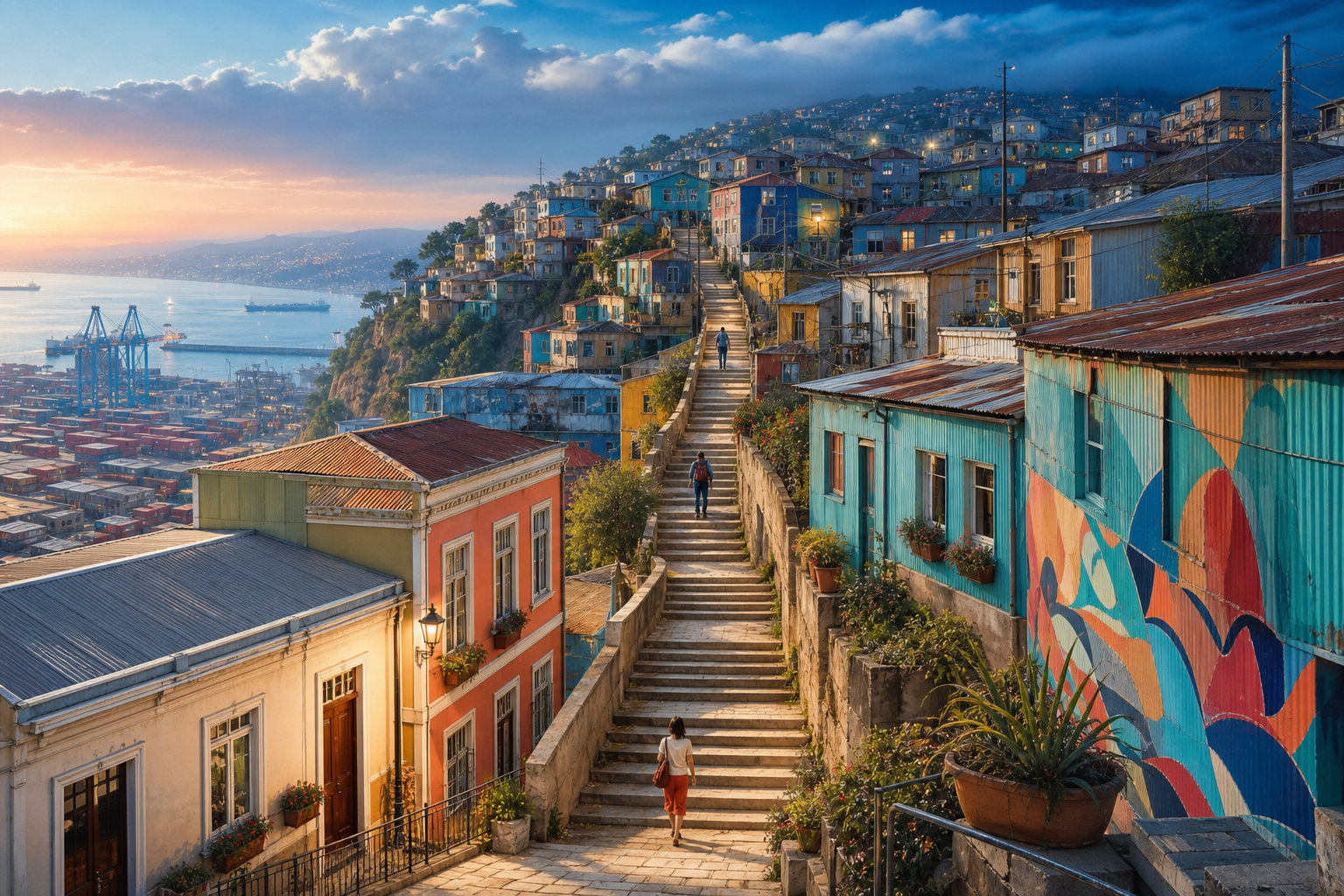
Most people who visit Valparaíso do it wrong — not because they choose the wrong hills or miss the right murals, but because they only give it four hours. Santiago to Valparaíso is about 75 minutes by bus from the Alameda terminal, and that convenience has turned a genuinely strange, layered port city into a day-trip checkbox on half the Chile itineraries you’ll find online. Staying one or two nights changes the whole calculation.
View larger map | Map data © OpenStreetMap contributors
What Valparaíso Actually Is
The city is built on 42 named hills (cerros) cascading down to a flat port district called the Plan. The ascensores — funicular elevators, most built between 1883 and 1916 — connect the two. Only a handful are still operational and even fewer run reliably, so don’t structure your day around them as transport. Plan on walking uphill. It’s not optional.
The visual identity of the city — the layered tin-roofed houses in contradicting colors, the staircase streets, the street art that predates the Instagram-era street-art tourism circuit by a long stretch — is real, not manufactured for visitors. It’s also a city with genuine poverty and infrastructure that’s been underfunded for decades. Both things are true at once, and Valparaíso doesn’t resolve that tension for you.
Which Hills Are Worth Your Time
Cerro Alegre and Cerro Concepción are the most visited for good reason — they have the highest concentration of restaurants, boutique guesthouses, and preserved Victorian-era architecture. But treating them as the whole city is the most common mistake first-time visitors make. They’re the gentrified hills. Beautiful, yes. Representative, not entirely.
Cerro Bellavista is worth an afternoon specifically for La Sebastiana, one of Pablo Neruda’s three houses in Chile, now operated as a museum by the Fundación Neruda. Book ahead, especially January through March. What makes it worth going beyond the literary connection is the building itself: Neruda designed it across five floors stacked into the hillside, and his specific obsessions — ships, maps, carousel horses, colored glass — make it feel inhabited rather than curated. It doesn’t read like a museum. It reads like someone just stepped out.
Cerro Cordillera, just uphill from the port district, has almost no tourist infrastructure and is worth an hour of wandering for exactly that reason. The view down to the container port and across the bay toward Viña del Mar is better from here than from the more famous viewpoints on Alegre.
Eating and Drinking Without Defaulting to the Obvious
The restaurant scene on Cerro Alegre is solid but increasingly priced for tourism. For a real meal at local prices, come down to the Plan and find one of the restaurant clusters near the Mercado Puerto. The fish comes directly off boats docking at the adjacent terminal — that’s logistics, not marketing. Chilean ceviche is also meaningfully different from the Peruvian version: less citrus-forward, often served with pebre (a cilantro and tomato relish) rather than leche de tigre. Worth knowing before you order expecting something else.
Bar Cinzano on Plaza Aníbal Pinto has been open in some form since 1896. It’s not a curated vintage experience — it’s genuinely old, occasionally chaotic, and often has live music in the evenings that spills out onto the plaza. Go for a pisco sour and stay longer than you planned.
The Street Art Question
Valparaíso’s murals are extensively photographed and occasionally reduced to a walking-tour commodity. The honest answer is that the best ones are not on the tourist-marked routes — they’re on the escaleras connecting the upper and lower sections of the less-visited hills. There’s no map that reliably gets you there; you find them by walking up a staircase because it exists and you’re curious. That’s a genuinely different experience from following a printed mural tour, and most day-trippers don’t have time to discover it.
How Long to Stay and When to Go
One night is the minimum to actually feel the city rather than just skim it. Two nights is better: the first afternoon for Alegre and Concepción and getting oriented, the second day for La Sebastiana and less-mapped territory, the second evening for the port district. Three nights works if you want to use Valparaíso as a base for the coast — Quintay, a small fishing village about 40 minutes south, has an old whale processing station converted into a museum and a beach that sees almost no international visitors.
January and February are busy because Chileans are on summer holiday — accommodation prices climb and La Sebastiana books up further in advance. April through early June and September through November are genuinely better: mild, less crowded, and the city looks different under overcast coastal light than in full summer sun. The marine layer that rolls in from the Pacific most mornings isn’t a weather problem; it’s part of what makes the place look the way it does in every photograph you’ve seen of it.
The city also hosts an outdoor New Year’s Eve fireworks display visible from the hills that draws enormous crowds from across Chile. Worth knowing either because you want to be there or very specifically don’t.
Getting There and Around
Turbus and Pullman Bus both run frequent departures from Santiago’s Alameda terminal directly to Valparaíso’s port bus terminal. Book online rather than walking up — not because it sells out, but because the online price is sometimes meaningfully lower. The bus drops you at the Plan, a short walk from the ascensores and the start of the hill neighborhoods.
Don’t rent a car unless you specifically need one for the coast. The hills aren’t navigable by car in any practical sense, parking is a non-starter, and the walking is the point.
One real caveat: petty theft is a genuine issue on the less-populated hill staircases, particularly after dark. That’s not a reason to avoid those areas — it’s a reason to go in the afternoon rather than alone at night, and to keep a camera out of obvious display. The city’s tourism board doesn’t emphasize this, but locals will.
If you’re already building a Chile trip around Santiago, the question isn’t whether to go to Valparaíso — it’s whether you can shift your thinking from “day trip with a bus back by 6pm” to “place that needs a night or two to actually open up.” Those are different trips.