
Montevideo gets treated as the lesser Buenos Aires — same river, cheaper prices, not quite as much going on. Most visitors to the Río de la Plata region fly into Buenos Aires, spend a week there, maybe take the Buquebus ferry across for a day, and conclude they’ve seen Uruguay. They haven’t, really. A single afternoon in the Ciudad Vieja barely scratches the surface of what makes Montevideo worth staying in properly.
View larger map | Map data © OpenStreetMap contributors
The Case for Actually Staying
The ferry from Buenos Aires takes about two hours and costs somewhere in the range of $60–80 USD each way depending on season and how far ahead you book. That’s enough that most people frame the trip as a day excursion — they arrive, walk the Rambla briefly, eat at one overpriced restaurant near the port, and leave. The city is genuinely different from Buenos Aires: quieter, smaller in scale, less architecturally bombastic. But those qualities only become assets if you slow down enough to notice them.
Three nights is the minimum that makes sense. Two full days to actually move around the city, one to breathe.
Ciudad Vieja: More Depth Than the Day-Trippers Get
The old city is compact — you can walk end to end in twenty minutes — but it rewards more attention than that. The Mercado del Puerto is the famous one, and it deserves the reputation: a cast-iron market building from the 1860s with parrillas running continuously, smoke visible from outside. Go for lunch rather than dinner. The crowds are still real at lunch but the energy is better, and several of the traditional parrilleros pack up by early evening anyway.
The less-photographed half of Ciudad Vieja is southeast of Plaza Independencia, around Calle Pérez Castellano and the streets running down toward the water. The architecture is genuinely crumbling in places — not in a curated-decay way, just economically neglected — and mixed in are some of the better small restaurants and bars in the city, places without English menus that mostly serve office workers at lunch. That’s where you want to be eating.
The Palacio Salvo on Plaza Independencia was the tallest building in South America when it was completed in 1928. It looks slightly unhinged — part Gothic, part Art Deco, a couple of floors that seem to belong to a different building entirely. Know the history before you look at it rather than after. The building was designed by Italian architect Mario Palanti, who built a near-identical version in Buenos Aires (the Palacio Barolo). Same architect, same obsession with Dante’s Divine Comedy as an organizing metaphor for the structure — the building’s height in meters corresponds to the number of cantos, the floors map onto Hell, Purgatory, and Heaven. Once you know that, the building stops looking strange and starts looking deliberate.
The Rambla: What It’s Actually For
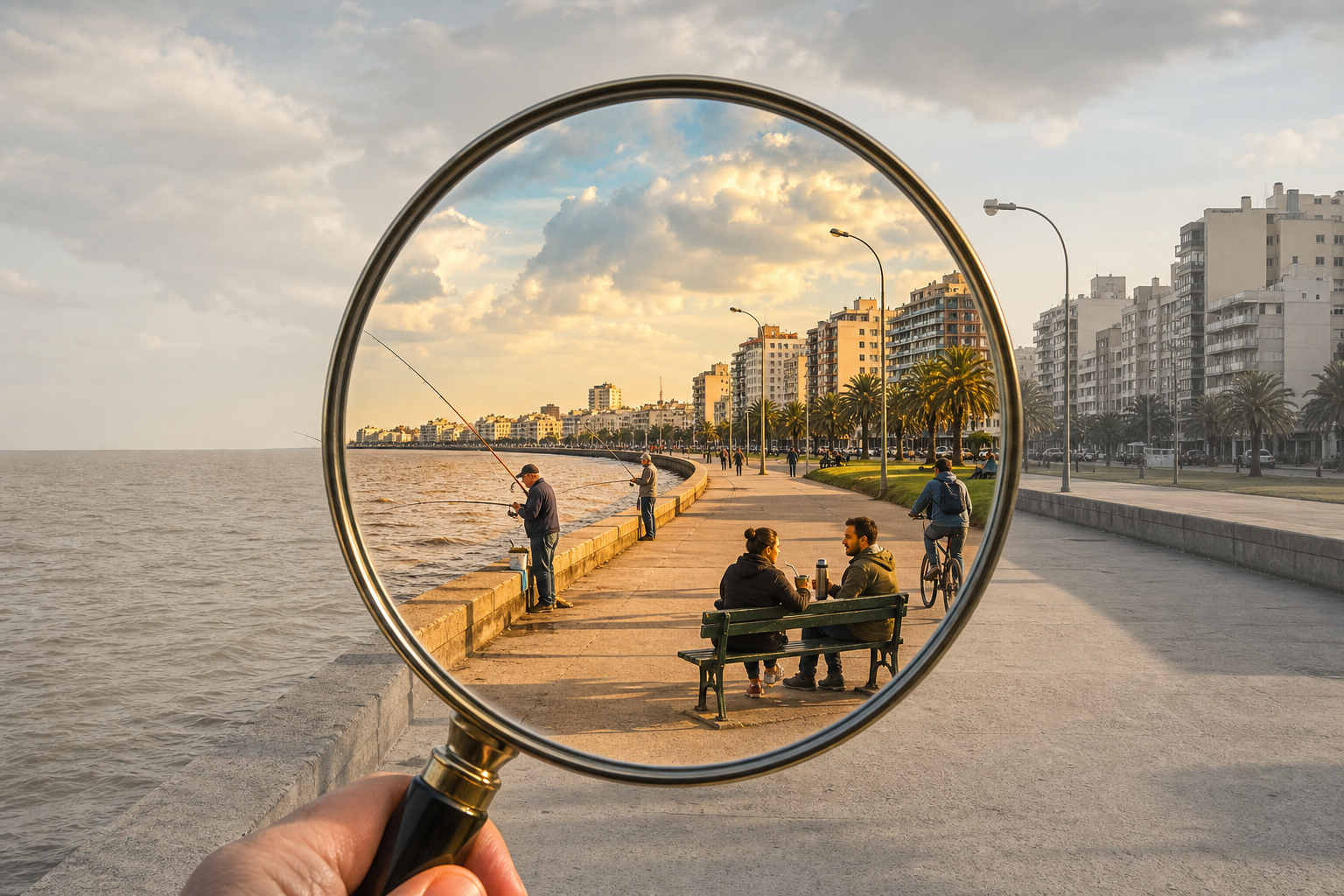
Montevideo’s Rambla is a coastal promenade running roughly 22 kilometers along the Río de la Plata. Every guide mentions it as a thing to walk, and technically that’s accurate, but what makes it worth your time isn’t the walking — it’s that the whole city uses it, all day, for everything. People fish from the seawall at sunrise. Families with mate thermoses take over the benches from mid-morning onward. Teenagers on bikes, old men playing cards, people working out on outdoor gym equipment that’s been bolted there long enough to look semi-permanent.
The stretch between Pocitos and Punta Carretas is where most of the life concentrates on weekday mornings. Skip the section immediately near the port — it’s fine, just less interesting than further east.
One thing worth saying directly: the river isn’t blue. The Río de la Plata is brown, murky, sediment-heavy — it gets its name from silver, not its color. This surprises people expecting a Mediterranean-style coastline and disappoints them unnecessarily. The Rambla’s appeal is entirely about the social texture of a city using its waterfront, not about scenic water views. Go in knowing that and it’s great. Go expecting a beach and you’ll be confused.
Mercado Agrícola de Montevideo
This is the place I’d push hardest for anyone who cooks or just likes watching food being sold properly. It’s a covered market — a cast-iron and glass structure from 1913, restored about a decade ago — now running as a functioning mix of produce vendors, butchers, specialty food stalls, and a few sit-down spots. Unlike the Mercado del Puerto, it isn’t set up for tourists. The prices reflect that.
The cheese selection alone is worth the trip across the city. Uruguay’s cattle-to-person ratio is among the highest in the world, and it shows in what’s available at a market like this. The hard cheeses aged locally aren’t something you’ll find easily outside the country, and at Mercado Agrícola you’re buying from the people who actually know what they’re selling.
Punta Carretas and Pocitos: Where to Actually Base Yourself
Ciudad Vieja is atmospheric but staying there means quiet streets at night and a slight disconnection from daily neighborhood life. Punta Carretas — named after the prison that’s now a shopping mall, which is exactly as strange as it sounds — and adjacent Pocitos are where most of the better mid-range accommodation sits. Both are walkable to the Rambla, have real grocery stores, and have the café density that makes mornings easy.
Hotels in Montevideo are cheaper than Buenos Aires by a meaningful margin. A decent four-star in Pocitos runs less than a comparable property in Palermo Soho. Book direct where possible — smaller Montevideo properties sometimes have better availability and pricing on their own sites than through the large OTAs.
Colonia del Sacramento Is Worth a Half-Day — But Only If You’re Already Here
Colonia gets recommended constantly as a day trip from Buenos Aires, but it works just as well as a detour from Montevideo. It’s about 2.5 hours west by bus (Turril and COT both run regular services). The historic quarter is genuinely old — Portuguese colonial from the late 1600s, UNESCO-listed — and small enough to cover in three or four hours without rushing.
The honest caveat: Colonia is charming but thin. One very photogenic cobblestone street, a lighthouse, and a lot of restaurants aimed at day-trippers from Argentina. Go in knowing it’s a half-day stop, not an overnight, and it delivers exactly what it promises.
When to Go
Southern hemisphere summer (December–February) is high season and Montevideo gets genuinely hot, with humidity off the river making it feel heavier than the temperature suggests. Carnival runs later than the Brazilian version — usually through February into March — and the candombe drumming processions are the real draw, distinct from anything you’d see in Rio. If your dates overlap with Carnival, structure around it rather than avoiding it.
April through June is probably the sweet spot: mild temperatures, no crowds, the Rambla still full of life without being packed. Avoid July and August if you’re weather-sensitive — the city goes genuinely grey and cold, and the wind off the river is unforgiving.
If you’re already building a week in Buenos Aires, adding three nights in Montevideo costs less than you’d expect and gives the whole trip a different register. The one thing to sort before you go: ferry timing. Buquebus books up fast in summer — reserve at least a week ahead. In shoulder season, last-minute is usually fine, but check the schedule, because crossings aren’t continuous throughout the day.