
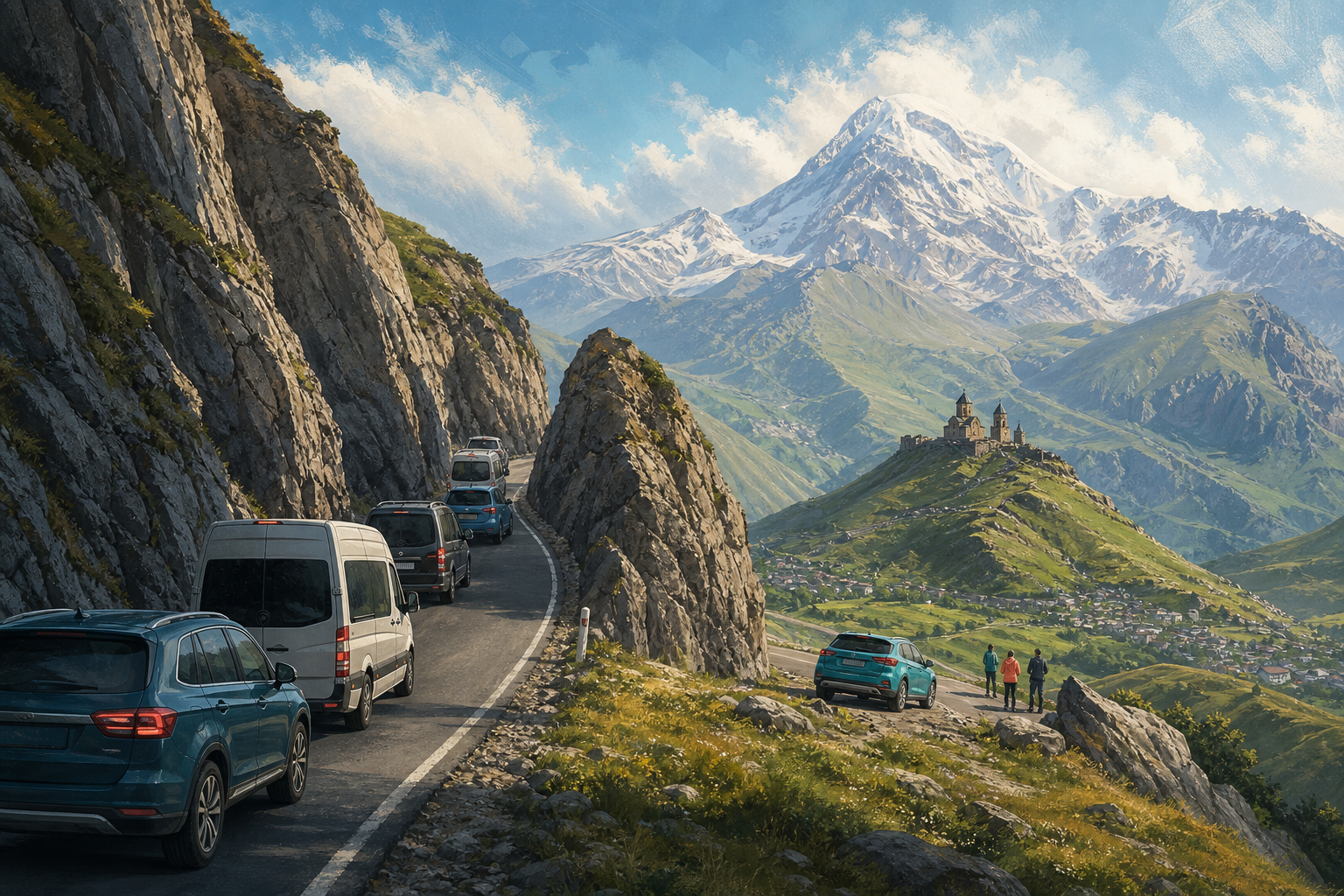
Gergeti Trinity Church on its ridge at 2,170 meters with Kazbek rising behind it is one of those images that saturates travel photography — and for once, the reality holds up. The problem isn’t the hype. It’s that most visitors underplan the logistics badly enough that they spend a meaningful chunk of their time stuck in a marshrutka queue, grinding through traffic at the Jvari Pass, or elbowing through 40 tourists at a viewpoint built for ten.
View larger map | Map data © OpenStreetMap contributors
Here’s what the trip actually involves.
The Route: Georgian Military Highway
Tbilisi to Stepantsminda — the town most people still call Kazbegi, its Soviet-era name — is about 157 kilometers. On paper, two hours. Budget three to four, because the road climbs to the Jvari Pass at 2,395 meters and the single carriageway narrows in ways that create genuine bottlenecks whenever two wide vehicles need to squeeze past each other. Summer weekends and Georgian public holidays aren’t slightly slower than weekday mornings — they’re meaningfully slower.
The road is paved and maintained. A standard sedan handles it without drama outside of winter, when the pass can close entirely after heavy snowfall. The Roads Department of Georgia clears it reasonably fast by mountain-highway standards, but closures from December through March are real and don’t give more than a day’s warning. Check the highway status through the Roads Department of Georgia before committing to a same-day return in winter.
Getting There: The Actual Options
Marshrutkas (shared minibuses) leave from Didube station in Tbilisi, cost under 15 GEL, and run several times daily — earliest departures around 9–10am are usually most reliable for seat availability. The journey runs the same road as everything else, so the timing difference versus a private car is about flexibility, not speed. You can’t ask a marshrutka to stop at Ananuri fortress on the way up, and you can’t leave Stepantsminda at 6am to beat the first tour groups to the church.
Hiring a driver from Tbilisi for a day trip runs roughly 100–150 USD depending on the driver and your negotiating. Ask your guesthouse to recommend someone they’ve used rather than booking through a walk-up tout at Rustaveli Metro. A private car gives you control over timing, stop choices, and the ability to reach the church before the first tour-group marshrutkas unload at the base of the hill.
Organized day tours from Tbilisi are cheaper than private hire but trade flexibility for savings. The convoy effect is real: multiple tour buses leaving the city together means multiple groups arriving at the church together.
Gergeti Trinity Church: The Logistics Actually Matter Here
The church dates from the 14th century and is still an active Georgian Orthodox site — not a museum, a functioning religious building. The monks who live there will close it to visitors during services without advance notice. Dress accordingly (shoulders and knees covered, headscarf if you want to enter the interior), and don’t assume access is guaranteed on any particular morning.
The hike from Stepantsminda to the church takes roughly 1.5 to 2 hours up, less coming down, on a well-worn trail. It’s steep — around 400 meters of elevation gain from town — and that registers more than expected when you’re already at 1,700 meters base elevation and haven’t acclimatized. There’s also a 4WD track that local taxis use, cutting the physical effort significantly for a few dollars. Neither option is wrong; they give you different versions of arriving at the same place.
The single most useful timing move: reach the trailhead or take the 4WD taxi before 8am. By 10am, and solidly by noon, the ridge is genuinely crowded. The church isn’t more impressive with more people at it.
Staying Overnight: Why One Day Isn’t Enough
A day trip is possible. It’s also a waste of what’s actually up there. The Truso Valley, about 20 kilometers east of Stepantsminda, has mineral springs, travertine formations, and a ruined medieval village that almost no day-tripper reaches. The Dariali Gorge, right at the Russian border, is accessible as a short drive and hike. And the late-afternoon light on Kazbek from the ridge above the church — after the day-trippers have left — is exactly why photographers book guesthouses rather than return buses.
Accommodation in Stepantsminda has expanded a lot over the past decade, with proper boutique guesthouses now alongside budget options. Book months ahead for July and August, not weeks — the town’s capacity is limited and high season fills fast. Late April through June and September through October hit a better balance between weather and crowds; summer has the most reliable conditions for higher hikes but is also when the place feels most strained.
What Else Is Along the Road
Ananuri fortress is about 70 kilometers north of Tbilisi, sitting above the Zhinvali reservoir. A 16th–17th century castle complex with a tower, two churches, and views over the water — it adds maybe 45 minutes and fits easily on either the outbound or return leg. Most day-trip drivers stop here by default; if yours doesn’t offer it, ask.
Gudauri, about 30 kilometers before Stepantsminda, is primarily a ski resort. Outside ski season (roughly November through April), it holds little of interest unless you want gondola access to the ridge. Not worth significant time in summer.
One Honest Caveat
Gergeti has gotten considerably busier in recent years, and some of what made it feel remote and contemplative a decade ago takes more deliberate effort to find now — earlier mornings, longer walks past the first viewpoint, time in the valley rather than just at the church. None of that makes it not worth going. The setting is genuinely extraordinary and the surrounding landscape rewards anyone who goes beyond the single iconic viewpoint. But if you arrive mid-morning in August expecting an isolated mountain experience, the Instagram image and the actual scene are going to be far apart.
Add two nights in Stepantsminda rather than treating it as a day trip. The drive is the same either way — you might as well actually be there when it’s worth being there.