
Asunción, Paraguay: The South American Capital That Nobody Puts on the Itinerary
View larger map | Map data © OpenStreetMap contributors
Paraguay almost never appears in South American itineraries, and when it does, Asunción is usually a 24-hour transit stop between Buenos Aires and somewhere that made the list for a better reason. That’s a misread. The city isn’t a hidden gem in the Instagram sense — it’s genuinely rough around the edges, infrastructure is patchy, and the tourist economy is thin enough that you’ll spend more time figuring things out yourself than being guided through a curated experience. That’s also exactly why it’s interesting.
It’s the oldest continuously inhabited city in South America’s Southern Cone, founded in 1537 — a fact that sounds like tourist board copy until you’re standing in the historic center watching colonial facades slowly delaminate in the subtropical heat. There’s no aggressive restoration project here. The history is just present, and sometimes crumbling.
The Historic Center: What’s Worth Your Time
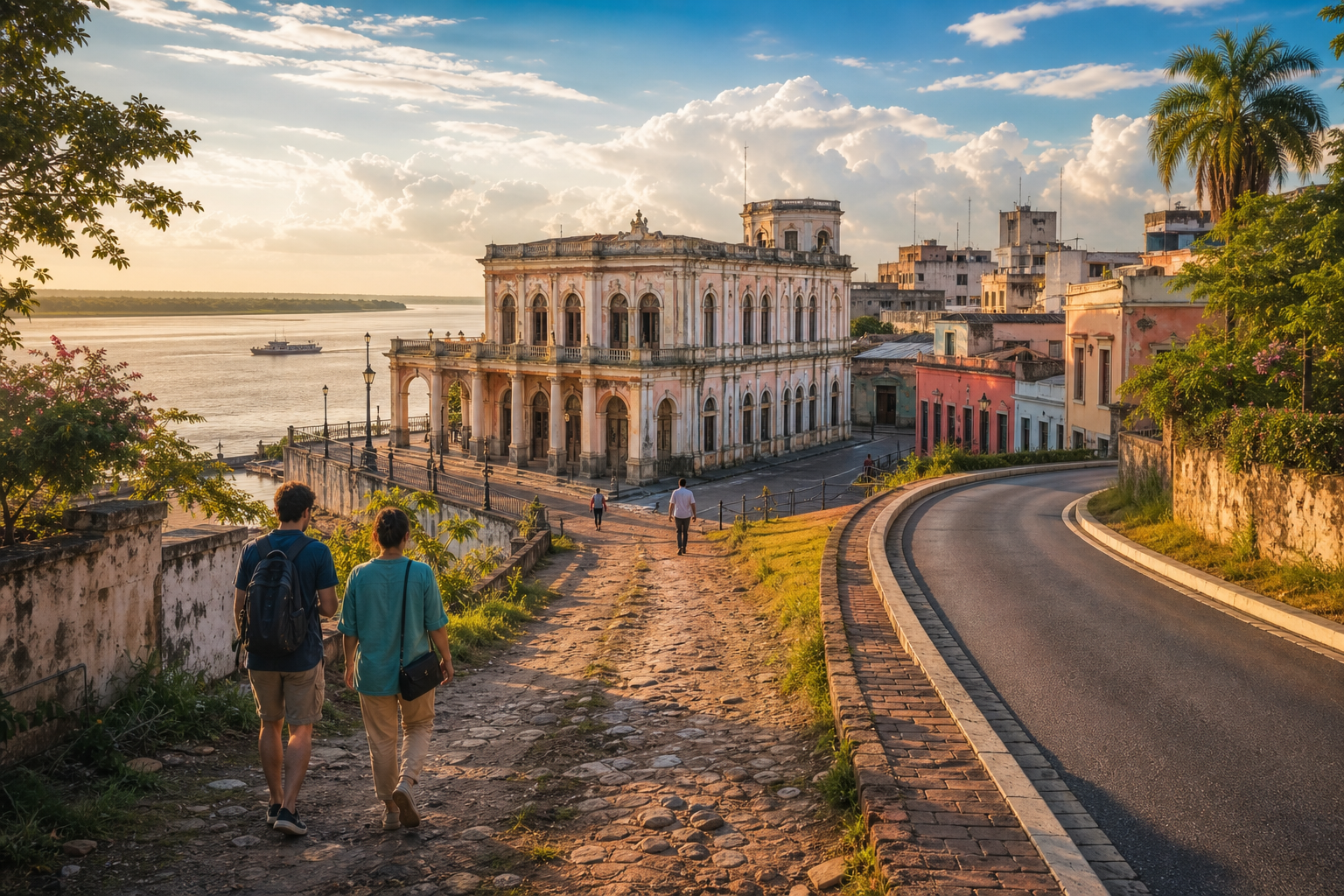
The Palacio de los López — Paraguay’s government palace, sitting directly on the Río Paraguay waterfront — is the architectural centerpiece. It’s not the most impressive building you’ll ever see, but the location is striking: a 19th-century French Renaissance pile at the edge of a wide, brown river with almost no tourist infrastructure around it. You can walk directly up to the exterior. Interior access is restricted, but the terrace gardens and river views justify the walk regardless.
Two blocks inland, the Panteón Nacional de los Héroes is the city’s most formally maintained landmark — a scaled-down Panthéon de Paris, which was its deliberate inspiration, housing the remains of several Paraguayan presidents and military figures including Mariscal Francisco Solano López. He led the country into the War of the Triple Alliance (1864–1870), a conflict that killed a significant portion of the Paraguayan population. The historical complexity of how Solano López is memorialized here versus how historians evaluate him is worth reading about before you go — it makes standing inside the building a genuinely different experience than it would be otherwise.
The Manzana de la Rivera is a cluster of eight historic houses along Avenida Ayolas that were preserved rather than demolished and now function as a cultural center and free museum. It’s one of the more useful stops in the center because the houses, spanning different centuries of the city’s growth, show you how Asunción’s architectural layers actually accumulated. A couple of them still have the smell of old wood and the slightly damp quality of buildings that have survived more than they were designed to.
Mercado 4: The Real One
Mercado 4 is not a tourist market. It’s one of the largest markets in South America by footprint — an overwhelming grid of stalls selling electronics, textiles, food, livestock equipment, pirated media, medicinal herbs, and things that resist easy categorization. Most visitors skip it because it’s not in the curated version of the city, and because it’s legitimately chaotic in a way that requires comfort with navigating by feel rather than signage.
Go in the morning, keep your phone in a front pocket, and don’t bring anything you’re not comfortable losing. But go. The food stalls in the interior sections have fresh chipa — the Paraguayan cheese bread made with cassava flour, considerably better than any packaged version you’ve encountered elsewhere — and bori-bori, a corn dumpling soup that is exactly what subtropical heat makes you want at 8am for reasons that only make sense once you’ve been here.
Getting Out of the Center
The Jardín Botánico y Zoológico is the city’s green exhale: a large park in the Trinidad neighborhood built around the former López family estate. The zoo is not well-resourced, and that’s worth stating plainly. But the botanical section and the parkland surrounding the colonial-era manor house are genuinely pleasant, and on weekdays it’s almost entirely locals — which is reason enough to visit.
Loma San Jerónimo is a neighborhood on a hill east of the center that doesn’t appear in most travel writing and probably should. It’s one of the older barrios in the city, with painted wooden houses on unpaved streets and a small community of artisans producing ñandutí, the Paraguayan lacework you’ll see in souvenir shops everywhere. Here you can sometimes watch it being made. The walk up from Avenida España takes about 20 minutes and is worth doing in the late afternoon when the light is better and the heat has dropped slightly.
Where to Eat, Without the Tourist-Board Shortlist
Asunción’s food scene is not Bogotá or Lima — there’s no buzzy restaurant moment happening here. But Paraguayan food itself is worth engaging with seriously rather than treating as a footnote. Sopa paraguaya appears everywhere and ranges from mediocre to excellent depending entirely on where you get it. It’s not soup — it’s a savory cornbread with cheese and onion, and the name mismatch is a well-documented historical accident. The best versions come from family-run restaurants in residential neighborhoods, not anywhere marketing itself to visitors.
Taberna del Chef in the Villa Morra district is a legitimate local institution: not a tourist trap, not a cliché, just a restaurant that’s been consistent long enough that locals trust it. Villa Morra in general is where Asunción’s middle-class dining and café scene is concentrated, and spending an evening there shows you a version of the city the historic center doesn’t.
Practical Notes Worth Stating Clearly
The heat is serious. Asunción sits at low elevation with a subtropical climate, and from November through March temperatures regularly exceed 38°C with high humidity. Most visitors who struggle here underestimated this. June through August is genuinely comfortable — lows around 14°C, dry enough to walk without effort.
Street safety varies by neighborhood in ways worth researching specifically rather than filtering through general South America cautions. The historic center after dark requires more situational awareness than the Villa Morra or Carmelitas districts. That’s not a reason to avoid it; it’s a reason to know which neighborhood you’re in at what time of day.
Getting between Buenos Aires and Asunción overland is a real option — bus services run the roughly 18-hour route regularly, and it’s a legitimate way to cross if you’re not in a hurry. The overland route through Clorinda and the Puente Internacional San Ignacio de Loyola is a genuinely different way to arrive than flying in, and worth considering if the trip has room for it.
There’s no airport train. Silvio Pettirossi International Airport is about 15km northeast of the center; taxis or remises are the practical options. Agree on a price before you get in.
Asunción rewards visitors who are comfortable making decisions without much scaffolding. If your travel style depends on a well-developed tourist infrastructure to feel oriented, this city will feel harder than it needs to. If you find that kind of independence more interesting than exhausting, it’s one of the more underused cities in the hemisphere — and the question worth sitting with before you finalize any Southern Cone itinerary is whether you’re routing toward places you’ve already mentally booked or places that would actually be new.