
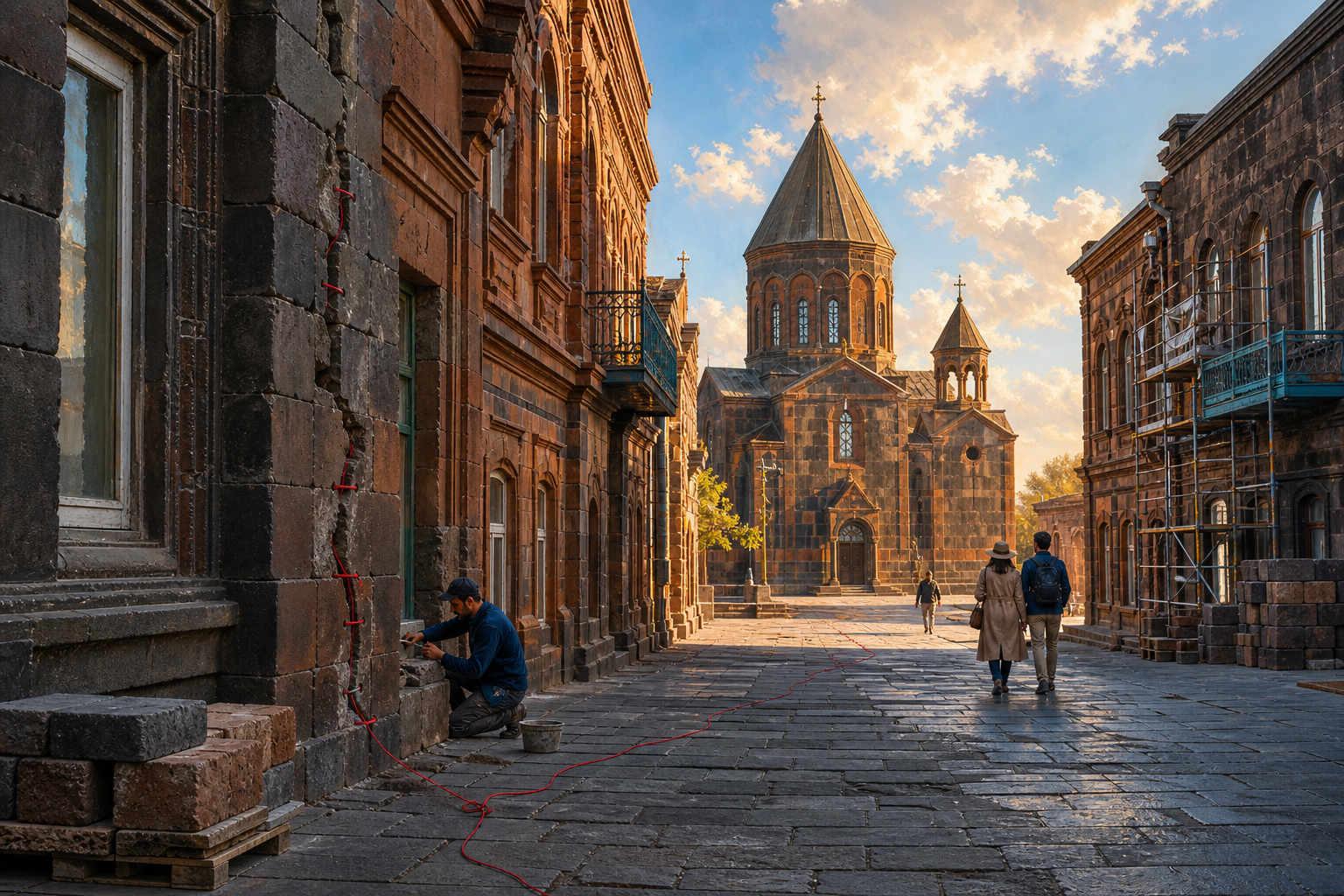
Gyumri doesn’t make most Armenia itineraries. Yerevan gets the flights, Tatev gets the monastery photographs, Lake Sevan gets the day trip — and Gyumri, Armenia’s second-largest city, gets cut entirely. That’s a genuine mistake, and an easy one to correct once you know what you’re actually going there for.
View larger map | Map data © OpenStreetMap contributors
What Gyumri Actually Is
A 6.8-magnitude earthquake in 1988 killed around 25,000 people here and leveled whole neighborhoods. The rebuilding happened slowly, incompletely, and in some cases not at all — so what you’re walking through now is Soviet-era construction sitting next to 19th-century black tuff stone townhouses, next to concrete blocks that were never fully finished, next to a few streets that feel almost entirely intact from the Alexandropol era (the Tsarist-period name tells you roughly when the original architecture dates to).
None of that is tourism brochure material. It’s also what makes the city genuinely interesting in a way that Yerevan — more polished, more obviously Instagrammable — isn’t. Gyumri has a specific texture that you either connect with or don’t, and the travelers who do tend to talk about it the way people talked about Tbilisi circa 2012: like somewhere in the process of becoming something else before it actually has.
The Architecture Specifically
The black and rust-red tuff stone in the older buildings is what most visitors mention first, and they’re right to. It’s volcanic stone quarried from the region, and the way it absorbs light — very differently at noon versus late afternoon — is worth slowing down for. The Kumayri Historic District is the preserved core of the pre-Soviet city, and it’s where a first morning is best spent. Not working through a checklist, just walking.
Vardanantz Square is the center of that district. The streets fanning out from it — particularly toward the covered market — have the densest concentration of intact 19th-century building frontages. Some are in reasonable condition. Some are actively crumbling. A few have been converted into small guesthouses or craft workshops. The mix is part of the point.
The Church of the Holy Saviour (Amenaprkich) sits right in that area — a large red tuff basilica damaged in the earthquake, left as a ruin for years, and now partially restored. You can go inside. The restoration is ongoing and visible: new stone next to original stone, no attempt to disguise the seam. It doesn’t look like a finished tourist attraction, which is, again, part of why it’s worth seeing.
Museums Worth Your Time, One That Isn’t
The Dzitoghtsyan Museum of National Architecture and Urban Life is the one to actually go to. It’s a regional history museum spread across several old buildings and covers the pre-earthquake city in real depth — photographs, material culture, architectural models. If you want to understand what Gyumri looked like before 1988 and what the earthquake did to it, this is where that context lives. Budget a full two hours rather than a walk-through.
There’s also a Sergei Parajanov museum — Parajanov being the Soviet-era Armenian filmmaker, one of the genuinely significant figures in 20th-century cinema, whose work was banned for much of his life. He wasn’t from Gyumri (he was from Tbilisi), and there’s a larger, more complete museum dedicated to him in Yerevan that has more of his actual artwork and collages. If you can only do one, do the Yerevan version.
Food and Where to Actually Eat
Gyumri has a specific place in Armenian food culture: locals consider it home to a distinct regional cooking tradition, and that pride isn’t just regionalist boosterism. Gata — a sweet bread with a buttery, slightly caramelized filling — is made differently here than elsewhere in the country. A Gyumri gata from a local bakery is a specific thing worth seeking out rather than a generic version of the category.
For actual meals, skip the restaurants immediately around Vardanantz Square that catch the limited tourist flow — the few spots that cater to visitors have priced accordingly. Walk five minutes in either direction and the options get better and cheaper. Tolma (stuffed grape leaves or vegetables), khorovats (grilled meat), and lavash baked fresh are the things to order. The bread quality specifically is something you notice.
Getting There and How Long to Stay
Gyumri is about 125 kilometers north of Yerevan — roughly 1.5 hours by car or 2.5 hours by train. The train runs from Yerevan’s main station, slower than a marshrutka (shared minibus) but more comfortable. Marshrutkas leave from Kilikia bus terminal when full, which in practice means departures throughout the morning. Either way, cost is minimal.
One night probably isn’t enough if you want to actually feel the city rather than photograph its surface. Two nights lets you do the Kumayri district properly, get out to Sev Berd fortress just outside the city — a ruined medieval fortification, not a polished site, and worth the low-key effort — and eat more than one real meal without feeling rushed. Three nights makes sense if you want to use Gyumri as a base for the surrounding Shirak region, which has several Armenian churches and monasteries at varying states of preservation and accessibility.
An Honest Caveat
Gyumri is not comfortable in the way polished European heritage cities are comfortable. The earthquake’s legacy is visible in ways that can feel heavy — there are still people living in what were meant to be temporary container homes from the late 1980s. The city’s economy has struggled for decades. Some of what you’re walking through is genuinely poverty-marked, not just charmingly rough around the edges. If that’s not a kind of travel you find engaging or appropriate, this won’t feel like the right call.
But if Sarajevo was more interesting to you than Dubrovnik, or Valparaíso more than Santiago, or you specifically don’t want the trip where everything is curated for your ease — Gyumri is worth building into an Armenia itinerary rather than cutting it to add another day in Yerevan.
One practical thing to sort before you go: accommodation options are limited compared to Yerevan, especially in the mid-range. Don’t leave it until you arrive.