
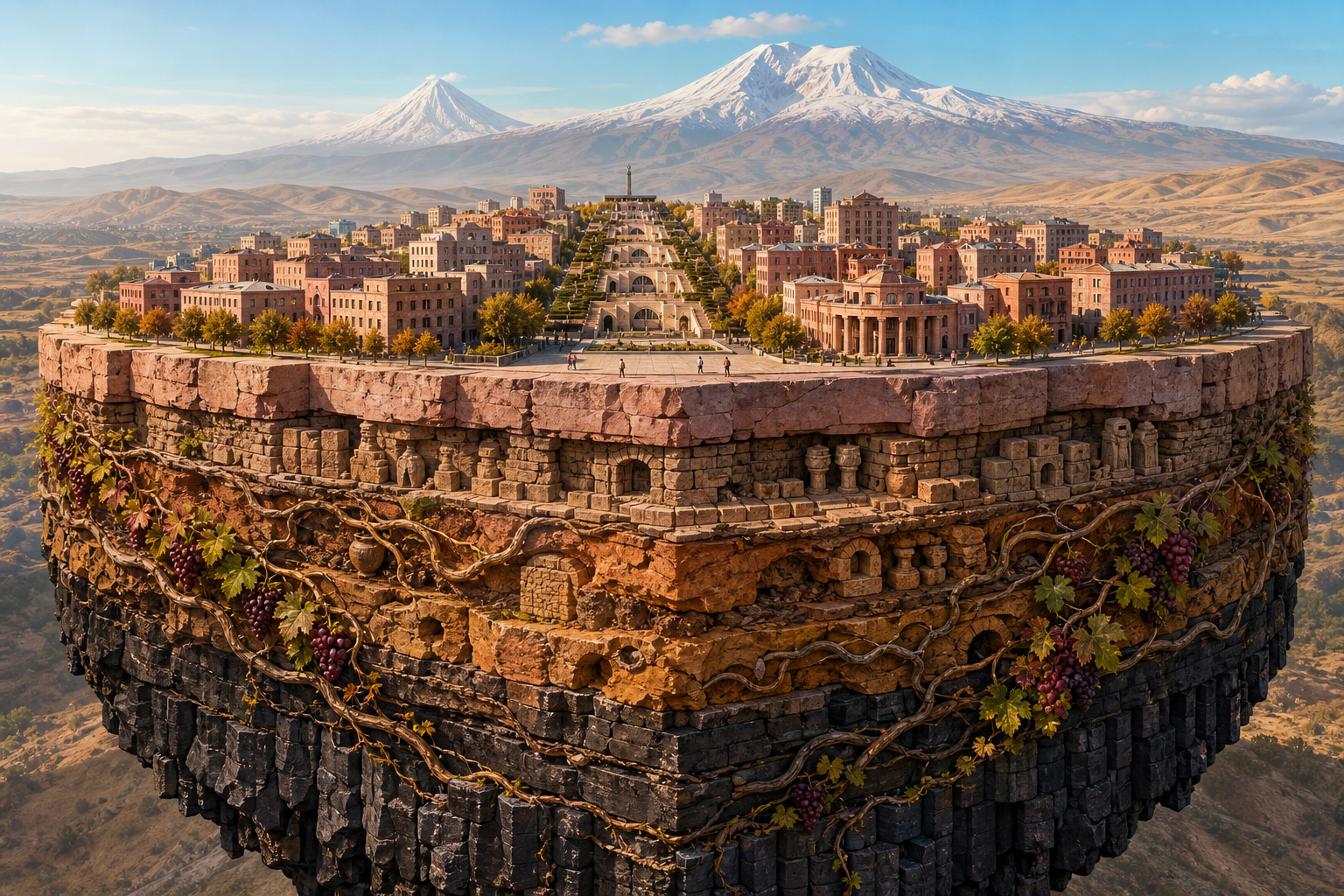
Almost every Caucasus itinerary runs Tbilisi, Tbilisi, Tbilisi — maybe Kazbegi — and then flies home. Yerevan gets tacked on as an afterthought if it appears at all, which is strange once you’ve actually been there. The city is older than Rome by any honest accounting, sits with a direct sightline to Mount Ararat on a clear day, and has a food and wine scene that most Western European capitals would be quietly envious of. It also stays cheaper than Tbilisi by a noticeable margin.
View larger map | Map data © OpenStreetMap contributors
Three full days is the right number. Two feels rushed once you realize how much there is outside the city center. Four is comfortable if you plan to do the day trips properly.
Getting Your Bearings: What Yerevan Actually Looks Like
The center is built around Republic Square — large Soviet-era travertine buildings in pink and orange tuff stone, fountains, and more outdoor café seating than the scale of the square suggests should fit. It’s more coherent than it sounds. The Cascade staircase complex to the northwest is the other anchor: a massive terraced structure climbing the hillside with contemporary sculpture installations at various levels and a view of Ararat at the top that, on a clear morning, is one of the better urban views in the region.
Ararat itself sits in Turkey, just across the border — a complicated fact for Armenians that doesn’t need unpacking here, but worth knowing before you bring it up too casually. The mountain dominates the skyline from the western side of the city, appears on the national coat of arms, and is visible from rooftop restaurants in the center and from Khor Virap monastery outside the city. On hazy days it disappears entirely. Autumn mornings are the most reliable window.
What to Prioritize in the City
The History Museum and the Genocide Memorial
The National History Museum on Republic Square covers pre-Christian and Urartian-period Armenia in more depth than most visitors expect — real archaeological material, not replica artifacts. Budget two hours minimum. The Tsitsernakaberd memorial complex is a separate half-day visit, uphill from the center. The museum portion is serious and well-documented; the outdoor eternal flame and the memorial wall are where most people go quiet. It’s not an easy visit, but treating it as optional because it feels heavy is the wrong call.
The Vernissage Market
Open every weekend, the Vernissage flea and crafts market near Republic Square is the best place in the city for Soviet-era objects, antique coins, handmade jewelry, woodwork, and carpets — all at prices that still reflect the local economy rather than the tourist one. Go Saturday morning before the heat builds. The carpet section alone takes an hour if you let it.
Mashtots Avenue and the Wine Scene
The main northern drag through the center has the expected density of outdoor restaurant seating, but the more interesting development over the past decade has been in Armenian wine specifically. The country’s winemaking tradition is among the oldest documented anywhere — the Areni-1 cave site in the Vayots Dzor region produced evidence of wine production dating back roughly 6,000 years, confirmed in peer-reviewed archaeology published in the Journal of Archaeological Science. The contemporary wine scene has caught up with that heritage slowly but genuinely. Look for producers working with the Areni Noir grape, which doesn’t show up in many other regions worldwide and has a distinctive dark-fruit, earthy profile worth trying even if wine isn’t normally your focus.
Day Trips Worth Building In
Geghard and Garni — Do Both in One Day
Garni is a reconstructed Hellenistic temple — the only surviving example of its kind in the former Soviet Union — sitting on a basalt gorge about 28km from the city. The gorge itself is the real reason to make the trip: columns of hexagonal basalt, a river below, and almost no railing between you and the drop. Geghard monastery is 7km further up the same valley, partially carved directly into the cliff face, and a UNESCO World Heritage site. The two together take four to five hours including transport. Most guesthouses and tour operators in Yerevan run shared minibus trips to both for a flat rate — cheaper than renting a car for this route, since the road dead-ends at Geghard anyway.
Khor Virap
About 40km south of the city, this is the monastery with the Ararat view, and the view is the reason to go. On a clear autumn morning the snow-capped peak fills the entire visual frame behind the church. The monastery has genuine historical weight as the site where Gregory the Illuminator was imprisoned before converting the Armenian king to Christianity in 301 AD — making Armenia the first country to adopt Christianity as a state religion. Most people who make the trip are there for the photograph, and that’s fine; the photograph is stunning. Morning light is better than afternoon. Check the forecast the night before, because a cloudy day makes the drive significantly less worthwhile.
Noravank Canyon
Further south, about two hours from Yerevan, this is the harder day trip to justify on time but the one most worth it if your schedule allows. The canyon walls are deep red and nearly vertical. The 13th-century monastery inside is built with an external staircase so narrow it functions more as a ladder — skip it if heights are a problem, commit to it if they’re not. There’s no easy shared transport here; you’ll need to arrange a car or join a tour.
Practical Details That Actually Matter
Zvartnots International Airport (EVN) has direct connections to several European hub airports including Vienna, Paris, and Amsterdam, though routing has gotten more complicated since 2022 depending on your origin. Check current options rather than assuming connections that were standard before then.
The city is walkable in the center and genuinely hot in summer — July and August temperatures regularly exceed 35°C. May, June, September, and October are the sensible window. October specifically is excellent: Ararat visibility is higher in autumn, the markets have their best produce, and the wine harvest in Vayots Dzor is happening simultaneously if you want to time a regional visit around it.
Armenian dram is the local currency. Card acceptance in restaurants and hotels has improved substantially in recent years, but cash is still useful for markets, taxis, and anywhere outside the city center. ATMs in the center are plentiful.
Armenian uses its own script — a distinct 38-letter alphabet developed in 405 AD — so street signage requires some adjustment. English is spoken in most tourist-facing businesses in the center and by most younger Armenians in the city. Russian remains widely understood across generations.
One Honest Caveat
Yerevan is a less immediately photogenic city than Tbilisi’s old town. There’s no equivalent of the sulfur bath district or the teetering balcony architecture. The center is Soviet-planned, which means wide boulevards and institutional scale rather than medieval organic clutter. If the romantic-ruin aesthetic is the priority, Tbilisi wins that comparison. But if you’re after a city with a distinct historical identity, a food and wine scene with real depth, and day trips that rival anything else in the Caucasus, the gap between the two is considerably smaller than most Caucasus itineraries imply.
The Areni wine you drink in Yerevan is a reasonable gut-check for whether to extend the trip south into Vayots Dzor. If it doesn’t interest you, save the day. If it does, the winery visits in that region are low-infrastructure and unhurried in a way that makes heavily commercialized wine regions feel overcurated by comparison — and the canyon scenery on the drive down is reason enough on its own.