
Why Plovdiv Keeps Getting Undersold
View larger map | Map data © OpenStreetMap contributors
Most Balkan itineraries drop Plovdiv in as a one-night buffer between Sofia and wherever the traveler is actually going — the coast, Bucharest, Istanbul. That’s the wrong way to use it. Plovdiv is the second-largest city in Bulgaria, has a continuous settlement history running back further than most cities in Europe (the claim that it’s one of the oldest continuously inhabited cities on the continent isn’t tourism-board noise — the archaeological evidence for Bronze Age occupation on the hills is real), and has a compact Old Town that takes actual time to absorb. One night doesn’t do it.
Two nights is the minimum that makes the trip worth booking. Three is better if your schedule bends that way.
The Old Town Is the Obvious Start — Don’t Rush It
Plovdiv’s Old Town sits across three of the city’s original seven hills — Trimontium, the Roman name, gives you the count — and the neighborhood is one of the better-preserved examples of Bulgarian National Revival architecture in the country. The houses are the signature visual: projecting upper floors that overhang the cobbled streets, façades painted in deep blues, ochres, and terracottas, many converted into house-museums.
The Hindliyan House and the Balabanov House are both worth the entrance fee. The Hindliyan House has interior murals depicting cities the merchant owner visited — Venice, Alexandria, Constantinople — which makes it an accidental record of 19th-century trade routes painted directly onto plaster walls. It’s more interesting than it sounds from the outside.
One genuine caveat: the Old Town gets crowded in summer, especially on weekends, and parts of Kapana, the adjacent arts district, have shifted from genuinely scrappy to noticeably tourist-facing over the last few years. That change is real. But enough of the Old Town remains residential that you still feel like you’re in a living neighborhood rather than a managed version of one — which isn’t something you can say about every comparably famous European quarter.
The Roman Archaeology Is Not Just Background Decoration
The Antique Theatre of Philippopolis is the site that surprises most visitors. It’s not a ruin in the collapsed, imagination-required sense. The seating is largely intact, the stage backdrop has been partially restored, and the city uses it as an active venue for concerts and opera through the summer. The combination of 2nd-century AD stonework and a functioning lighting rig is a bit jarring at first, but the theatre’s condition is genuinely remarkable for an open-air Roman site.
The Roman Stadium is a different proposition. Most of it is buried under the central pedestrian street, Knyaz Alexander I, and you access what’s visible through an underground viewing area beneath the plaza. Worth ten minutes, not an afternoon — but it reframes the experience of walking the main street once you register what’s underneath your feet.
For the archaeology without the crowds, the Regional Historical Museum on Saedinenie Square has Thracian and Roman finds that put the visible ruins into context. Few visitors bother with it, which is reason enough to go.
Kapana: Worth Your Time, but Calibrate Expectations
Kapana translates as “the trap” — the name comes from the warren layout of the former craft district, not any sinister history. It’s now Plovdiv’s bar-and-coffee neighborhood, and it has the right density of independent venues for an evening. A few things worth knowing going in:
- The coffee is genuinely good. Bulgaria has developed a serious specialty coffee culture faster than most of its neighbors, and Kapana has several roasters worth sitting in.
- Food quality varies more than the neighborhood’s Instagram presence suggests. Skip anything with a QR-code-only menu and no Bulgarian speakers on the floor — that’s a reliable enough filter.
- Friday and Saturday nights in peak season (July–August) are loud and crowded in the way of any small European nightlife district. The same bars are considerably more pleasant Sunday through Thursday.
Day Trip Worth Taking: Bachkovo Monastery
Bachkovo Monastery sits about 30 kilometers south of Plovdiv in the Rhodope Mountains and is the second-largest Eastern Orthodox monastery in Bulgaria after Rila. The bus journey through the Rhodope foothills is part of the reason to go — the landscape changes noticeably once you leave the Thracian Plain.
The monastery is active, not a museum piece, which shapes how you experience it. The ossuary fresco cycle is the single most interesting thing there from an art-history standpoint: 11th-century Georgian frescoes, reflecting the monastery’s original founding by Georgian monks under Byzantine rule. Most visitors walk past that detail without registering it.
Public buses run from Plovdiv’s Rodopi bus station and get you there in under an hour. No car rental, no tour booking required. Half a day is enough; pair it with Asenovgrad on the way if you want a longer excursion.
Practical Notes Worth Actually Reading
Plovdiv’s main train station connects to Sofia in roughly two hours on the faster services — check ahead because journey times vary significantly by train type. Sofia to Plovdiv by road is slightly faster, and buses run frequently from Sofia Central Bus Station. Coming from Istanbul, the train route through Edirne and Svilengrad continues directly to Plovdiv and avoids the Sofia detour entirely, though it’s a long day.
Hotels in the Old Town book out earlier than you’d expect for a city this size, particularly in May and June when Plovdiv’s festival calendar fills up. The city was European Capital of Culture in 2019, which built out a hospitality infrastructure that has held. Prices remain substantially lower than equivalent-quality accommodation in Prague or Budapest — that comparison is genuinely favorable, not just relative to Western European capitals.
September is the month worth pushing hardest for. Summer crowds have thinned, the Rhodope Mountains are accessible for day hiking without the heat, and the light in the Old Town in late afternoon is the best it gets all year. The grape harvest is active in the Thracian Valley wine region directly south of the city, and several wineries do informal cellar visits that don’t require much advance planning.
One Thing Most Visitors Miss
Nebet Tepe — the highest of the Old Town hills — has the remains of Thracian and Byzantine fortifications at the top and a view over the whole Thracian Plain that orients you to the city’s geography faster than any walking tour. It’s a ten-minute climb from the Old Town streets and nearly empty past 9am. Go before the tour groups assemble at the theatre and you’ll have the walls and the view to yourself.
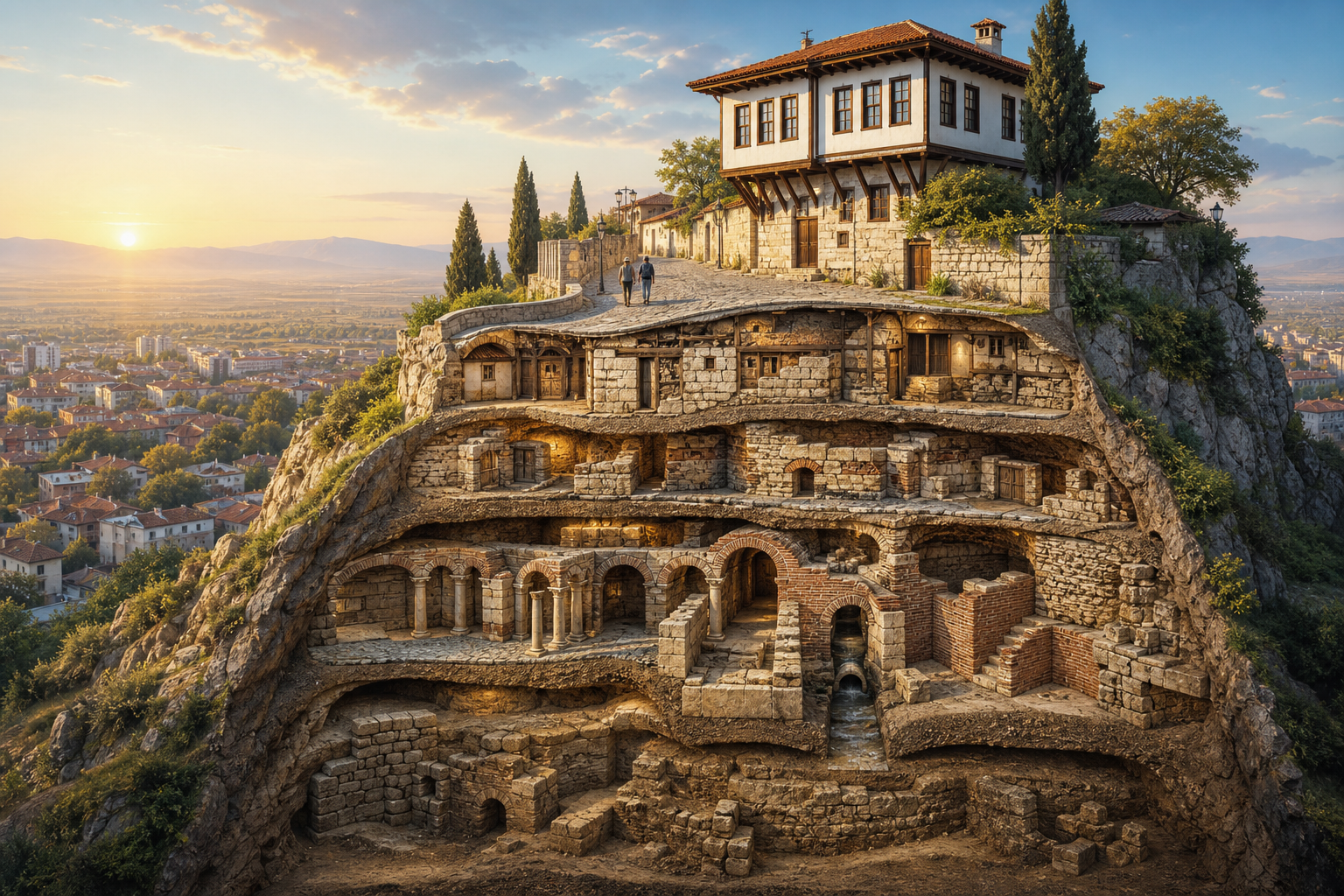
The thing Plovdiv actually has — and that most cities its size don’t — is genuine stratigraphic layering: Thracian, Roman, Byzantine, Ottoman, and Bulgarian Revival periods compressed into one compact area, each one literally built on top of the last. If you leave having only done the standard loop of Old Town, theatre, and Kapana, you’ve had a fine trip. But the palimpsest quality is the real reason to come, and Nebet Tepe at dawn is where you see it most clearly.