
Why Kutaisi Keeps Getting Skipped
View larger map | Map data © OpenStreetMap contributors
Most Georgia itineraries look like this: fly into Tbilisi, spend three days there, take a marshrutka to Kazbegi, maybe add Signagi or Mtskheta as a day trip. Kutaisi — Georgia’s second-largest city and former royal capital — appears in the footnotes, usually labeled “budget airline hub” because Wizz Air and Ryanair use Kutaisi Airport as their Georgian entry point.
That’s backwards. The airport is a reason to stop, not to transfer through.
Kutaisi sits in the Imereti region of western Georgia, about 220 kilometers from Tbilisi along the E60. Two UNESCO World Heritage monuments, one of the largest cave systems in the Caucasus, serious canyon country within day-trip range, and a city core small enough to walk without tour groups clogging every corner. Budget two nights minimum. Three is better.
Bagrati Cathedral and Gelati Monastery: Which One to Prioritize
Both are UNESCO-listed, both sit outside the city center, and they are not the same experience.
Bagrati Cathedral is the more dramatic ruin — partially blown up by the Ottomans in 1691, then put through a contested reconstruction completed in 2012 that actually got Bagrati placed on UNESCO’s “in danger” list over heritage authenticity concerns. The hilltop position over the city alone makes it worth the visit. But if you’ve already spent time at Mtskheta, Bagrati won’t recalibrate your sense of Georgian ecclesiastical architecture.
Gelati will.
Gelati Monastery was founded by King David the Builder in 1106 and served as the intellectual and spiritual center of the Georgian Golden Age for roughly two centuries. The main church has 12th-century mosaics that rank among the best-preserved Byzantine-style religious art in the Caucasus — the apse mosaic of the Virgin and Child is the kind of thing that stops you mid-stride. David the Builder is buried under the south gate specifically so that monks and visitors would walk over him as an act of humility. The academy attached to the monastery was training scholars across multiple disciplines at a time when most of Europe was barely managing the same.
Gelati is about 11 kilometers from central Kutaisi. Taxis are cheap; negotiate the price before you get in, or have your guesthouse arrange it. The monastery is still an active religious site — shoulders and knees covered, head covering for women inside.
Prometheus Cave: Not the Cave You’d Expect
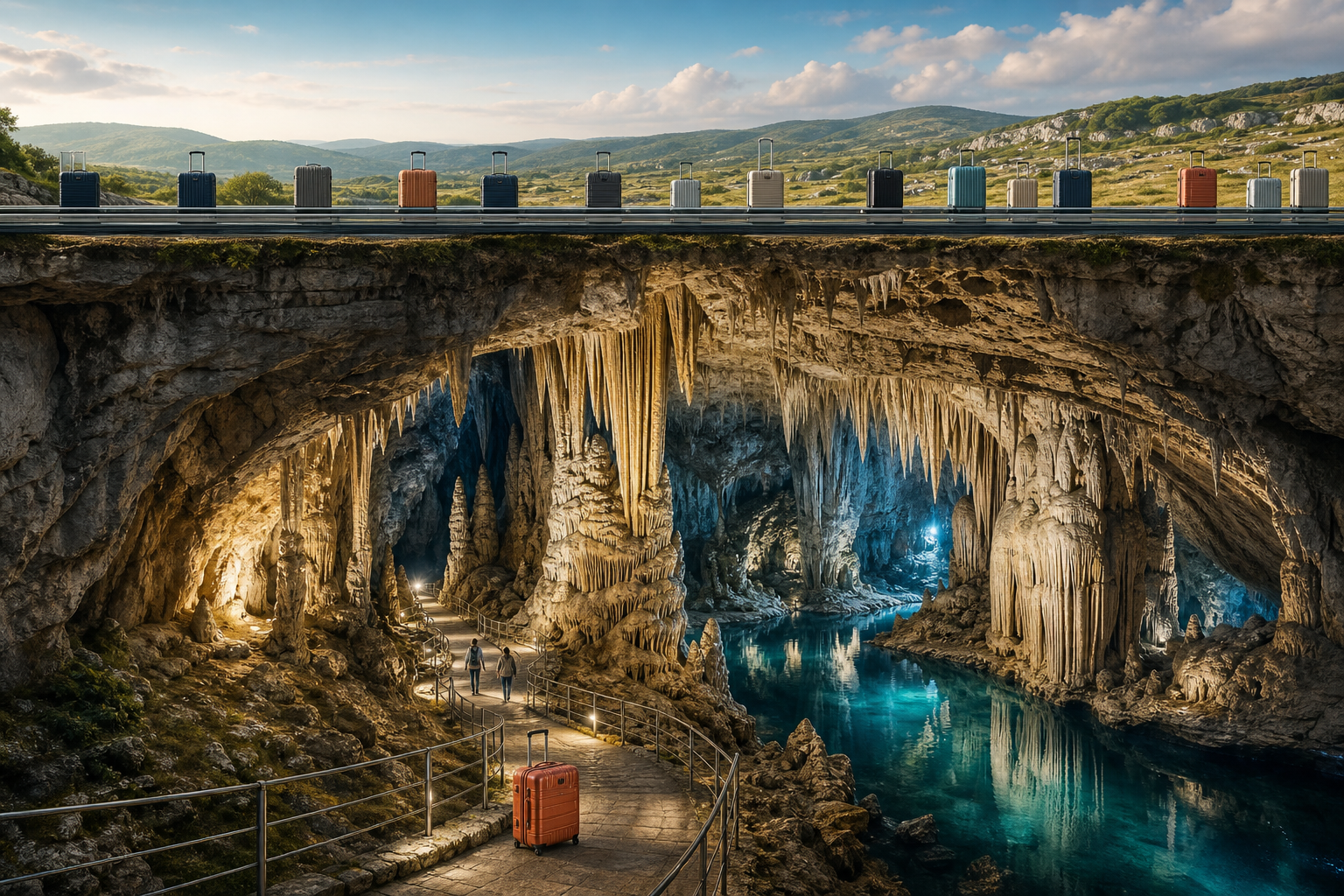
About 20 kilometers from Kutaisi near Tskaltubo, Prometheus Cave sounds like a tourist gimmick and turns out to be genuinely impressive. The full system runs roughly 22 kilometers; the tourist section covers about 1.4 kilometers across six halls, with an optional boat segment at the end through an underground river.
The formations are the real thing — stalactites and stalagmites at serious scale, curtain formations spanning several meters. The cave is lit dramatically, which can feel theatrical, but the underlying geology doesn’t need the help. Temperature holds around 14°C year-round, which is welcome in Georgian summer heat and genuinely cold in November without a layer.
Skip the organized tour if you can manage it. Groups move fast and the guides are delivering a script. Going independently and setting your own pace through the halls is a different experience. The boat ride at the end costs extra and is optional — worth it for the sense of scale it gives the cave, less so if you’re short on time.
Tskaltubo itself was a Soviet-era spa resort that’s been half-abandoned for decades. The sanatoriums are enormous, decaying, and genuinely eerie — if that kind of Soviet ruin photography interests you, it’s worth a brief wander. Just know you’re moving through structures in various states of structural disrepair.
Okatse Canyon and Martvili Canyon: Pick One if Time Is Short
Both are west of Kutaisi, both are worth building a day around. The practical difference: Martvili runs boat tours through emerald-green pools and gets crowded on weekends and through summer. Okatse has a suspended walkway above a dramatic gorge — less photographed, more physically engaging.
June through August, Martvili will be busy enough to undercut the experience. Okatse wins on the experience-to-crowd ratio during those months. In shoulder season — April, May, September, October — both are manageable, and the landscape holds up either way.
Neither canyon is easy to reach without a car or taxi. Guesthouses in Kutaisi can usually arrange a driver who’ll cover both in a long day for a fixed price, and that’s worth asking about rather than trying to piece together public transport, which exists but adds significant time and requires transfers.
The City Itself: What’s Actually Worth Your Time
Kutaisi’s center is small enough to cover on foot in an afternoon. The covered market near the central square is a working local market — produce, churchkhela (the walnut-and-grape-must candy that every Georgian region does slightly differently), chacha, local cheeses. Spend an hour there before you eat anywhere else; it calibrates your price expectations fast.
The Colchic Fountain in the center of town pulls from the Argonaut legend — this is Colchis, the land Jason sailed to for the Golden Fleece, and Imereti takes that history seriously. Visually it’s a lot, but it does orient you to how old this region’s sense of itself actually is.
Imeretian cuisine has its own character distinct from what you’ll eat in Tbilisi. Imeruli khachapuri — the flat, cheese-filled bread — originated here, and you’ll find it done better in Kutaisi than almost anywhere else. Order that, mtsvadi (grilled meat skewers), and lobiani (bean-filled bread) before you look at anything else on a menu.
Practical Notes
Kutaisi Airport (KUT) sits about 15 kilometers from the city center. Marshrutkas run to the center for a few lari; taxis are cheap by European standards. The city has enough guesthouse and small hotel inventory that you don’t need to book months ahead outside of high summer — though prices jump in July and August when domestic Georgian tourism overlaps with inbound European arrivals on those budget routes.
Tbilisi to Kutaisi by marshrutka runs three to four hours and costs very little; it’s one of the more reliable inter-city routes in Georgia. Train service exists but is slower. If you’re coming overland from Turkey via Batumi, Kutaisi makes more sense as a first stop than an afterthought you circle back to.
One honest caveat: Kutaisi’s attractions are spread out enough that without a rental car or willingness to negotiate taxis, logistics will cost more time and money than you’d budget for a compact city. Factor that in before you decide one night is sufficient — for most of what the region offers, it isn’t.
If you’re routing through KUT on a cheap Wizz Air ticket anyway, the question worth sitting with before you book onward transport is simply this: when does the next marshrutka to Tbilisi actually need to leave?