
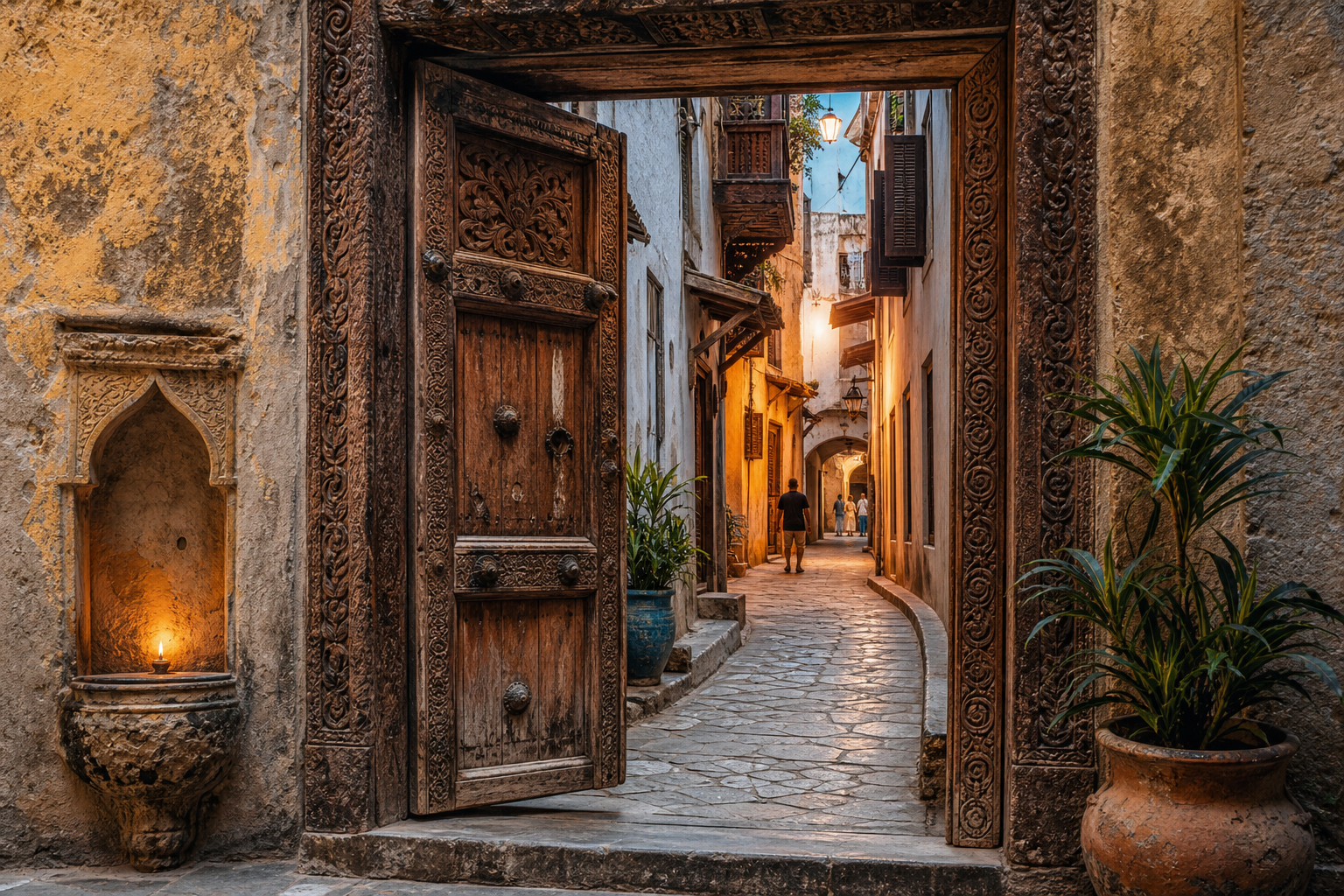
Most people who visit Zanzibar spend one night in Stone Town, check off the spice market, and move straight to the beach resorts on the northeast coast. That’s a defensible use of the island — the beaches are genuinely excellent — but it means treating one of East Africa’s most architecturally layered cities as a holding pen between the airport and a sun lounger.
View larger map | Map data © OpenStreetMap contributors
Stone Town has been a functioning urban center for over a thousand years. It was the hub of the Indian Ocean spice and slave trade, a sultanate capital, briefly a British protectorate, and you can read all of that in a single walk through its streets — not in museums presenting history behind glass, but in actual buildings you’re navigating around: some crumbling, some recently restored, most somewhere between. UNESCO inscribed it as a World Heritage Site in 2000, which matters less for how it feels on the ground and more because it has sustained pressure against the demolition-and-rebuild cycle that has gutted comparable old towns elsewhere in the region.
What the Streets Are Actually Like
The layout defeats conventional navigation. Stone Town’s interior is a dense, irregular tangle of alleys — many too narrow for a car — and the labyrinth quality isn’t a tourist metaphor, it’s structural. Getting genuinely lost happens faster than you expect, and the right response is to commit to it rather than fight it with a phone.
The carved wooden doors are the detail everyone photographs, and they’re worth looking at properly rather than just shooting. Zanzibari doors are architecturally distinct from the Indian and Omani styles that influenced them — deeper-framed, often with brass studs and chain-link carvings — and a door’s complexity historically signaled its owner’s status and trade connections. There’s no formal door tour you need to book; they’re simply on every block, in various states of preservation.
The Old Fort — Ngome Kongwe — sits right on the seafront and is free to enter. It’s one of the oldest surviving structures on Zanzibar, built by Omani Arabs in the early 1700s over the site of a Portuguese church. It functions now as a cultural center and open-air space, which makes it less reverential and more alive than a roped-off historical site. Worth walking through.
The Slave Trade History Is Not Optional
Zanzibar was the largest slave trading port in East Africa — at its peak in the nineteenth century, tens of thousands of people passed through annually. The Anglican Cathedral built in 1873 by the Universities’ Mission to Central Africa sits on the site of the last open slave market, deliberately: the altar is positioned where the whipping post stood. Beneath the cathedral, the original holding cells are preserved and accessible.
This isn’t comfortable history, and it isn’t meant to be. Skipping it in favor of only the spice market and the doors means leaving Stone Town with a sanitized version of what made the place what it is. An hour here does more to explain the city’s architecture, its cultural layering, its position in global trade networks, than anything else you’ll see.
Food and the Forodhani Night Market
Forodhani Gardens on the waterfront hosts a night market that’s been running in some form for decades. The format is consistent: small grills, plastic tables, vendors cooking Zanzibar mix (a spiced chickpea-and-vegetable street food), octopus, sugarcane juice, and the Zanzibar pizza — which is less a pizza and more a thin filled crepe, and should be approached on its own terms rather than measured against anything Italian.
Prices at Forodhani have climbed as tourist numbers have climbed; it’s not a hidden local secret. But the food is genuinely good, and the setting — the old fort lit up behind you, dhows anchored offshore — is hard to improve on. Go after 7pm when it’s properly in motion.
For eating during the day, the Darajani Market is where locals actually shop. It’s worth navigating past the spice section that tours gravitate toward: the fish hall, the butchery section, the dry goods. It gets chaotic by mid-morning. Go early if crowds are a problem for you.
How Long to Actually Stay
Two full nights minimum. One night is enough to get a feel for the alleys and have one good meal, but you’ll spend half of it disoriented and leave before the place has settled into anything coherent. Two nights lets you revisit a neighborhood in the morning after walking it at night, which is how Stone Town starts to make spatial sense.
Three nights is the point where you stop consulting a map entirely — a different experience than anything the first night delivers. If the trip is primarily beach-focused, two nights in Stone Town before moving north or east is a clean structure that doesn’t sacrifice either end.
Practical Notes Worth Having
Stone Town hotels range from renovated havelis with rooftop restaurants to genuinely bare-bones guesthouses. The mid-range here is unusually good value by East African standards — boutique properties inside historic buildings, often with internal courtyards, at prices that would be hostel-tier in comparable European cities. Book directly where possible; smaller properties have limited online inventory and some don’t surface reliably on the main aggregators.
Zanzibar requires a visa for most nationalities, separate from a Tanzania mainland visa. There’s currently a combined East Africa Tourist Visa covering Uganda, Kenya, Rwanda, and Tanzania — worth checking if you’re doing a multi-country trip. Arrival processing is generally available at Zanzibar airport, but verify current entry requirements before you travel; the rules have shifted more than once in recent years.
The heat and humidity are significant year-round. March through May is the long rains — manageable but persistent. July and August are peak season: drier, busier, more expensive. The shoulder months on either side (June, or October into November before the short rains) are worth considering if you have flexibility, though some beach days will be overcast.
One Honest Caveat
Stone Town is caught in a real tension between preservation and the economic pressure of tourism. Some of the restoration work has been excellent. Some has swapped original materials for whatever was cheapest and fastest. And some buildings that were genuinely significant have deteriorated badly because the ownership structures and funding mechanisms for repair are complicated. The window for seeing the place in anything close to its historic state is not guaranteed to stay open — which is a straightforward argument for going sooner rather than waiting for the conditions to be perfect.
Book the cathedral visit for the morning, when the light comes through the windows properly. Then give yourself one evening with no plan except walking until you find somewhere to sit down with food.