
Istanbul gets the flights, Cappadocia gets the Instagram balloons, and Izmir gets quietly passed over by most itineraries that claim to cover Turkey. That’s a planning error worth correcting. Izmir is a genuinely different kind of Turkish city — secular, coastal, dense with good food, and nowhere near as logistically exhausting as Istanbul.
View larger map | Map data © OpenStreetMap contributors
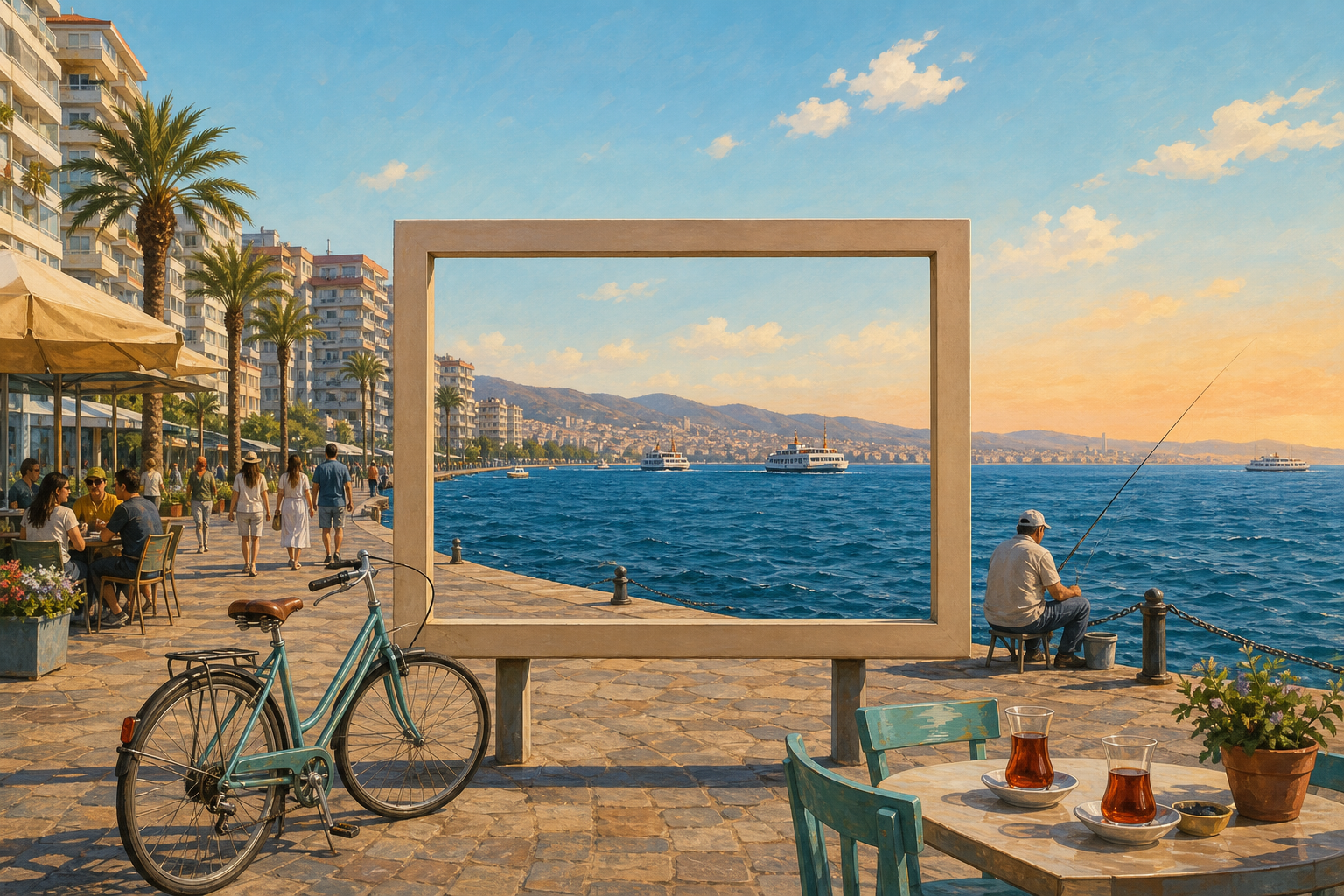
It’s Turkey’s third-largest city by population, sitting at the head of a deep Aegean gulf. The waterfront promenade, the Kordon, runs for several kilometers along the bay and is legitimately one of the better seafront walks in the eastern Mediterranean — not because it’s photogenic in a postcard way, but because it’s actually used by locals in the way a working city uses its waterfront. Morning joggers, afternoon tea drinkers, evening fish restaurants. It doesn’t feel staged.
The Actual Starting Point: Kemeraltı Bazaar
Don’t reach for the Grand Bazaar comparison — they’re not comparable in intent. Kemeraltı is a neighborhood-scale bazaar district that has been trading continuously since the 17th century, and it’s still functionally commercial rather than primarily tourist-facing. Spice vendors, fabric shops, jewelers, small lokanta restaurants serving food to the people who work there, not to the people photographing them.
The synagogues embedded within the bazaar district are easy to miss and worth the effort to find. Izmir had one of the largest Sephardic Jewish communities in the Ottoman Empire — descendants of Jews expelled from Spain in 1492 who were welcomed by the Ottomans. The Bet Israel synagogue still holds services. Several of the smaller synagogues in Kemeraltı require contacting the community in advance to visit, which is a genuine logistical step worth completing before you arrive, not something to try to sort out on the morning you show up.
Ephesus: Do It, But Do It Early and Get Out
Ephesus is about 80 kilometers south of Izmir, and it’s the reason a lot of people end up in the region at all. The ruins are genuinely impressive — the Library of Celsus facade, the Great Theatre with capacity for 25,000 people, the Sacred Way running between them. Worth visiting is not a controversial position.
What most guides understate is how brutally crowded the main site gets from 10am onward during peak season (May through September). Cruise ships dock at Kuşadası, roughly 20 kilometers away, and the timing puts large groups at the main gate between about 9:30am and 2pm. Being there before 8am is not a minor edge — it’s the difference between having actual sight lines to the architecture and shuffling through a queue behind a tour group.
The Terrace Houses (Yamaçevleri) require a separate ticket and most day-trippers skip them because of it. They shouldn’t. These are preserved Roman residential buildings with intact mosaic floors and wall frescoes, excavated and partially restored under a protective enclosure. The complexity of the inlaid floors in some rooms is harder to process in person than photographs suggest — you’re looking at second and third-century domestic interior design that somehow survived. The ticket is the friction point that filters out the crowds, which is exactly why it’s worth paying.
One real caveat: Ephesus is vast and the ground is uneven marble and limestone, which gets seriously slippery when wet and brutally reflective when dry and hot. Closed-toe shoes and sun protection are not optional suggestions.
The Food Situation
Izmir has a specific regional food identity centered on Aegean herbs, olive oil, and seafood — distinct enough from Istanbul’s that it’s worth treating as its own thing rather than a variation on a theme. The local breakfast culture is worth a full morning: the kahvaltı spreads at market restaurants in Kemeraltı or the neighborhoods around Alsancak go well past the standard Turkish breakfast template — local cheese varieties, olive preparations specific to the Aegean coast, börek made with greens rather than meat or plain cheese.
Boyoz is the one thing to eat that exists almost nowhere else — a flaky, plain pastry made with sunflower oil and a specific flour that Sephardic Jewish bakers developed in the city. It tastes like almost nothing and also like exactly the right thing at 7am with tea. Every local bakery in the market district sells them, and they’re reliably better from the oven than anything sitting in a case.
The fish restaurants on the Kordon are fine but tourist-priced. For the actual working fish restaurant experience — daily catch on display, paper menus, no English translations — the neighborhood of Konak, south of the bazaar, has a cluster of smaller places that operate primarily for locals. The fish is the same Aegean catch; the prices are noticeably not.
How Long and When
Two full days in Izmir proper plus a half-day to Ephesus is a workable minimum. Three days lets you add the cliff-top ruins at Pergamon — about 100 kilometers north, and genuinely undervisited relative to Ephesus — without feeling rushed. Pergamon’s acropolis has an unusual fan-shaped theatre built into a steep hillside, and the engineering compromises the architects made to get that geometry to work are visible if you look at it for more than five minutes.
Shoulder season — April through May and late September through October — is the obvious call. Summer heat on the Aegean coast is real, Ephesus in July is physically punishing, and August humidity makes the Kordon walk considerably less pleasant than it looks in photos. October in particular tends to be warm enough for the water to still be swimmable, clear enough for good visibility at the ruins, and quiet enough that Ephesus in the early morning is actually manageable.
Flights into Izmir Adnan Menderes Airport (ADB) connect directly from most major European hubs, which removes the Istanbul transit assumption entirely. Check ADB directly rather than defaulting to IST routing — the flight time difference within Turkey is marginal, and arriving directly cuts out the bus or train transfer from Istanbul that many people don’t fully account for when they’re building the itinerary.
What the City Is Actually Like
Izmir is emphatically not Istanbul in miniature. It votes secular, has a visible café and bar culture along Alsancak that operates openly, and moves at a pace that makes three days feel genuinely restful rather than like you’re playing catch-up. The bazaar is dense and real without being overwhelming. The ruins nearby are world-class. The food is specifically itself rather than generically Turkish.
The one thing it doesn’t have is a single iconic image — no Hagia Sophia, no fairy chimneys. If your itinerary is built around photographs you’ve already decided you want to take, Izmir will probably disappoint you. If it’s built around actually being somewhere for a few days, it’s one of the more rewarding cities on the Aegean coast.
Before you finalize dates, check whether Ephesus Terrace House tickets need to be booked online for your window — during high season they sometimes sell out by midday, and that separate entry is exactly the friction point that causes people to skip the best part of the site.