
Baku doesn’t fit the narrative travelers expect
View larger map | Map data © OpenStreetMap contributors
Most people planning a Caucasus trip build around Tbilisi, maybe add Yerevan, and treat Azerbaijan as the awkward political third wheel. That’s partly understandable — the South Caucasus border politics are real, and you can’t cross overland from Armenia into Azerbaijan — but it means Baku gets skipped by exactly the travelers who would enjoy it most.
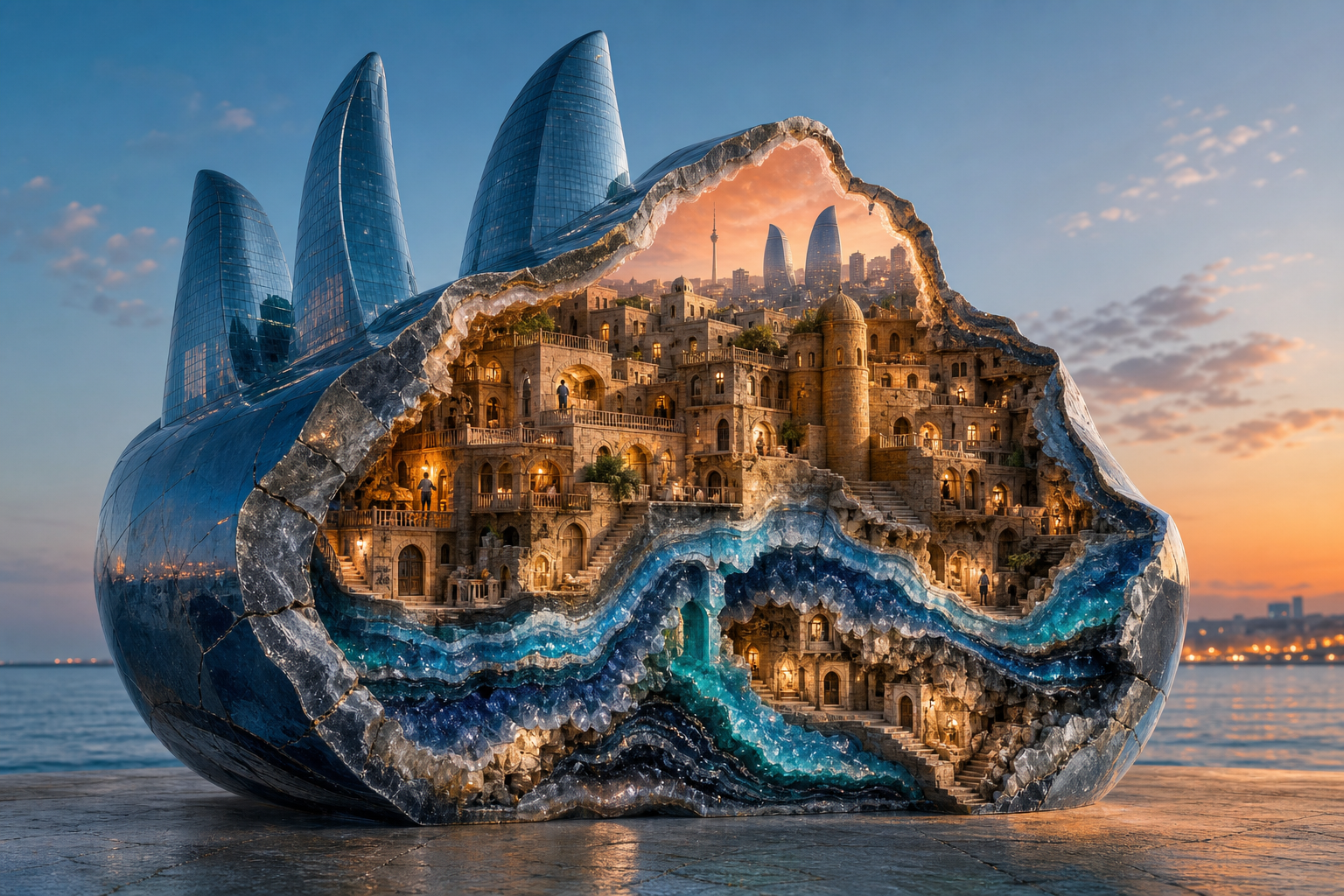
Baku is genuinely strange in a way that rewards paying attention. A medieval walled city (Icherisheher, a UNESCO World Heritage Site since 2000) sits directly underneath a skyline of flame-shaped glass towers built on Caspian oil money. Neither part cancels the other out. They coexist in a way that’s architecturally incoherent and somehow completely absorbing.
The Old City is smaller than you think — but denser
Icherisheher covers roughly 22 hectares inside its double ring of medieval walls. You can walk the perimeter in under 30 minutes, and most visitors mistake that compactness for a quick stop. That’s the wrong read.
The Maiden Tower (Qiz Qalasi) is what everyone photographs, and the views from the top over the Caspian are worth the climb. The more interesting structure nearby is the Palace of the Shirvanshahs — a 15th-century royal complex with a mosque, mausoleum, bathhouse, and court section inside one walled compound. It’s been restored repeatedly, and there’s genuine academic disagreement about how much of what you’re seeing is original versus Soviet-era reconstruction, which is worth keeping in mind as you walk it. The on-site archaeological museum is small but shows finds from the excavations here rather than generic regional objects.
The caravanserai ruins and the tangle of residential streets inside the walls are worth getting properly lost in rather than following a map. People actually live there, which changes the texture of the place — it’s not a sanitized heritage zone.
The Boulevard and what the oil money built
The Baku Boulevard (Bulvar) runs along the Caspian waterfront for several kilometers and is one of those urban promenades that cities pour enormous resource into and visitors mostly gloss over. Walk it in the evening when the offshore platforms are lit on the horizon and the Flame Towers are running their LED facade sequences. The engineering vanity of it is spectacular in a very specific way that says something real about what Azerbaijan has been doing with oil revenue since the early 2000s.
The Heydar Aliyev Center, designed by Zaha Hadid, is a taxi ride from the center but worth it if you care about architecture at all. The building is the point — the exhibits inside are secondary. It’s one of the more fully realized examples of her parametric design approach: the roof flows into the ground plane without legible joints in a way photographs consistently fail to capture.
Food is the strongest argument for staying longer
Azerbaijani cuisine gets lumped into generic “Caucasian food” in a way that flattens what’s actually a distinct tradition. A few things to look for specifically:
- Piti — slow-cooked lamb and chickpea stew served in individual clay pots, with the broth as a separate first course and the solids mashed afterward. It’s more of a northern Azerbaijani (Sheki region) dish and not on every menu in Baku, so order it when you see it.
- Lavangi — stuffed chicken or fish with a walnut-onion filling. The fish version uses Caspian sturgeon at the restaurants that still serve it, though sturgeon stocks are severely depleted — worth being aware of before you order.
- Qutab — thin stuffed flatbread, grilled, filled with greens (usually purslane or spinach), meat, or pumpkin. Cheap, everywhere, and genuinely good.
Taza Bazaar is the practical starting point for understanding what’s in season. Go in the morning. The dried fruit and nut section alone justifies the trip.
For sit-down meals, restaurants in and immediately around Icherisheher skew tourist-priced. Better value is usually a 10-minute walk north or east into the residential neighborhoods above the old city.
Practical notes that actually matter
Visa logistics come first. Citizens of many Western countries can get an e-Visa through Azerbaijan’s ASAN service online — it takes a few days and is straightforward. If you’ve traveled to Armenia and have Armenian entry stamps in your passport, there have historically been complications at Azerbaijani entry points. The situation varies by nationality and has shifted over time, so check current entry requirements against your specific passport situation before booking anything — not from a two-year-old forum post.
The manat (AZN) is pegged to the US dollar at roughly 1.7 AZN per USD. Cash is useful in markets and smaller restaurants; cards work in most modern venues. ATMs in the city center are reliable.
Getting to Baku by air is straightforward — Heydar Aliyev International Airport has direct connections from most European hubs, Istanbul, Dubai, and several Central Asian cities. If you’re building a broader Caucasus trip from Tbilisi, fly: the leg is under two hours and there’s no realistic overland alternative. The Georgia-Azerbaijan land border at Red Bridge is open and served by buses and shared taxis if you’re coming from Tbilisi rather than Yerevan.
Four days is the honest minimum to feel like you’ve actually been to Baku rather than just logged it. Two days covers the main sights but doesn’t give the food, the neighborhoods, or the Caspian coast enough time to register.
A day trip worth taking seriously: Gobustan
About 65 kilometers south of Baku, Gobustan National Park protects one of the densest concentrations of petroglyphs in the world — over 6,000 rock carvings, some dated to 40,000 years ago. The museum at the entrance is well-done by regional standards, with solid contextual material. The mud volcanoes a few kilometers further along the same road are exactly what they sound like, and worth the minor detour: Azerbaijan has an unusual concentration of them because the same subsurface geology driving the hydrocarbon deposits also produces the pressurized gas that pushes mud to the surface. Baku is one of the few places on earth where mud volcanoes appear on a normal tourist itinerary, and there’s an actual reason for that.
Hire a car for this rather than navigating public transport — the distances are manageable but the connections aren’t. A half day gets you to Gobustan and back; a full day adds the mud volcanoes and a stop at Bibi-Heybat mosque on the coast on the return.
The city is harder to read than it looks
Baku presents a very polished version of itself in the center — the promenade, the renovated old city, the Formula 1 street circuit that runs through it each June. Underneath that, it’s a city navigating an authoritarian political environment, significant inequality between the oil-wealthy center and everywhere else, and the aftermath of the 2020 Nagorno-Karabakh war, which reshaped regional dynamics in ways still unfolding. None of that is a reason not to go, but treating it as just another chic European-feeling capital doesn’t do the place justice. Sitting with someone over tea — actually talking, not just photographing their market stall — gives you a more accurate read than the boulevard ever will.
If you’re already routing through Turkey or the Gulf, Baku is a logical and genuinely interesting extension. If you’re treating the Caucasus as a single trip, don’t default to Georgia-only just because it’s easier to frame. The harder itinerary is usually the more interesting one.