
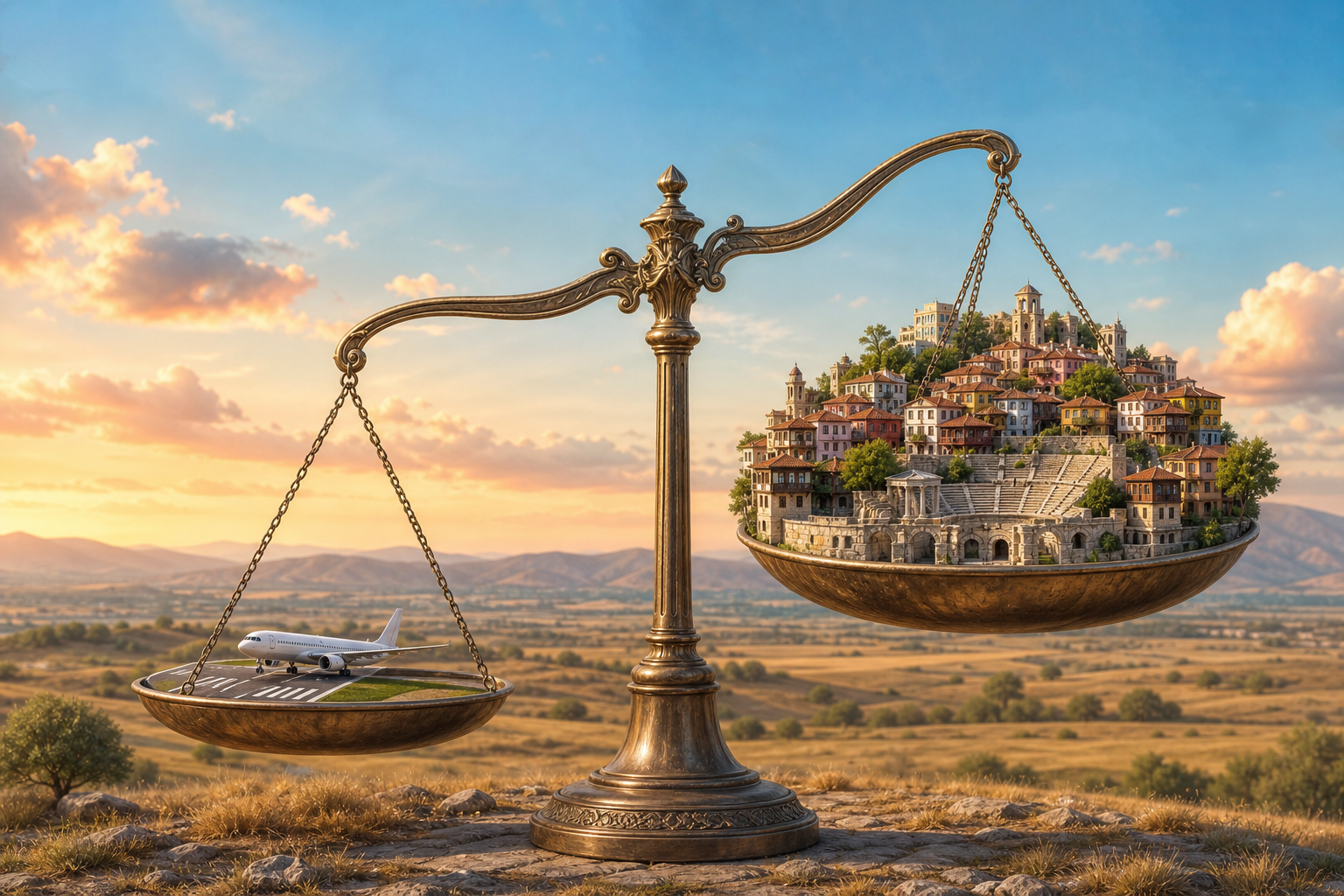
Plovdiv Keeps Getting Skipped, and That’s Genuinely Puzzling
View larger map | Map data © OpenStreetMap contributors
Bulgaria gets relatively little attention in European travel circles — most people who go fly into Sofia, do two days, maybe take the train to Rila Monastery, and leave. Plovdiv, Bulgaria’s second city and arguably its most interesting one, sits two hours east by train and gets treated as an afterthought. It’s been continuously inhabited for around 8,000 years. It was European Capital of Culture in 2019. On a typical Tuesday afternoon, the Old Town’s cobblestone lanes are quiet enough that you can hear yourself think.
None of that is secret information. The city just doesn’t have the marketing machinery that Dubrovnik or Prague or Tallinn have built up. Which, depending on your tolerance for peak-season crowds, is either a problem or the entire point.
The Old Town Needs Context to Land Properly
Plovdiv’s Old Town (the Staria Grad) sits across three of the city’s famous hills and contains a dense collection of Bulgarian National Revival architecture — large, asymmetric merchant houses from the 18th and 19th centuries with overhanging upper floors, painted facades, and elaborately carved wooden ceilings. The style is specific to this period of Bulgarian history, when wealthy traders built ostentatiously under Ottoman rule, and Plovdiv has some of the best-preserved examples anywhere.
The Hindliyan House and the Balabanov House are both open as museums, and worth the entrance fees precisely because the interiors are the point — the street-facing facades only tell you half the story. Inside you get the full proportions of the rooms, painted walls with trompe-l’oeil columns and harbor scenes (European cities the merchant had actually visited, sometimes accurately rendered), and a clear sense of what upper-class provincial life looked like in the 1840s.
The Ethnographic Museum in the Chomakov House is the third one worth doing. If you’re only going to one, make it this — the building itself is the most dramatic of the three.
A real caveat here: without any background on National Revival history, these houses blur together fast. Reading even a brief summary of the period before you go changes the experience considerably — you start reading the architecture as cultural statement rather than just old rooms with nice ceilings.
The Roman Theater Is Not a Reconstruction
There’s a well-preserved Roman theater built into the hillside at the edge of the Old Town. It seats around 7,000 people and still hosts performances — when you’re watching something there, the backdrop is the city spreading out below and the Rhodope Mountains behind it. It was only discovered in the 1970s after a landslide exposed it, which is part of why it’s in such good condition rather than picked apart over centuries for building material.
It’s one of the better-preserved examples of Roman provincial theater architecture in the Balkans, and unlike the Colosseum or Diocletian’s Palace in Split, you can walk right up to it without fighting tour groups for a sight line. Go in the late afternoon when the light hits the marble seating. If a performance is scheduled during your visit, tickets are usually easy to get and not expensive — the setting alone is worth the price of whatever they’re putting on.
Kapana: The Creative Quarter Without Much Self-Congratulation
Directly adjacent to the Old Town is Kapana, a small neighborhood of narrow streets that spent decades as a rundown craftsmen’s district before being converted into galleries, independent cafés, wine bars, and studios. The conversion happened fast around the 2019 Capital of Culture designation, and some of the usual gentrification texture is present — murals that feel curated, a few too many places with “artisan” in the name.
But it hasn’t priced out to the point of being sterile. On weekends there are small street markets with local producers that are worth actually browsing. The neighborhood is compact enough to cover properly in a couple of hours, and the better approach is to use it as a base for meals and drinks rather than treating it as a standalone destination.
On food: Bulgarian cuisine in this part of the country leans heavily on grilled meats, shopska salad (tomatoes, cucumbers, peppers, onion, grated white cheese — ubiquitous and consistently good), and banitsa, a filo pastry filled with cheese or spinach that is the correct breakfast decision at any local bakery. Wine is worth paying attention to — Bulgaria has a long winemaking history and the local Thracian valley wines, particularly Mavrud, are genuinely interesting and very cheap relative to Western Europe.
The Hills Are the Itinerary Connective Tissue
Plovdiv sits across seven hills (locally called tepeta), and moving between Old Town sites means constant climbing and descending. Nebet Tepe, the highest of them, has visible Thracian fortification walls and is a 10-minute walk from the center of the Old Town — it gives you a clear panoramic view over the city and the flat Thracian plain stretching south. It’s not a hike, it’s a viewing point at the top of a residential neighborhood, but it’s the best orientation you’ll get for understanding how the city sits in its landscape.
The walk from the Old Town down through Kapana and along the Maritsa River embankment is an underrated half-hour that shows you the parts of the city that don’t appear in tourist photography — local parks, families, an actual city operating normally. Worth doing once.
When to Go and How Long You Actually Need
Two full days is the honest minimum. Three is better if you want a half-day at Bachkovo Monastery — around 30km south in the Rhodope foothills, dating to 1083, with a gorge approach that’s striking enough to justify the trip — without feeling rushed back.
Spring (April–May) and early autumn (September–October) are the clear best windows. July and August on the Thracian plain are genuinely hot, mid-30s Celsius most days, which changes how much walking you want to do between noon and 4pm. The city doesn’t empty out in summer the way some beach-adjacent places do, but the heat is a real planning variable.
Getting there is straightforward: frequent trains from Sofia (around 2 hours, cheap), or buses that run even more frequently from the central Sofia bus station. No car needed for Plovdiv itself — the Old Town is walkable and Kapana is right next to it. Hotels in the Old Town are mostly converted merchant houses or small boutique properties, which are the right call for atmosphere; book ahead if you’re going in September, when the city sees its highest visitor numbers. The central neighborhoods just below the Old Town have more budget options if you want to keep costs down.
One Thing Worth Pushing Back On
A lot of travel writing about Plovdiv reaches for “hidden gem” or “finally being discovered.” It was European Capital of Culture. It’s Bulgaria’s second-largest city. It’s not hidden — it’s just not on the itinerary reflex of most Western European travelers planning a Balkans trip, which is a meaningfully different problem. The right framing is that it’s a well-functioning, historically dense city that gets underweighted because Sofia has the international airport and the Balkans as a whole gets underweighted relative to what’s actually there.
If you’re already going to Sofia, the question isn’t whether Plovdiv is worth adding — it is. The question is what you’re giving up two hours on a train for instead, and that answer is usually hard to justify.