
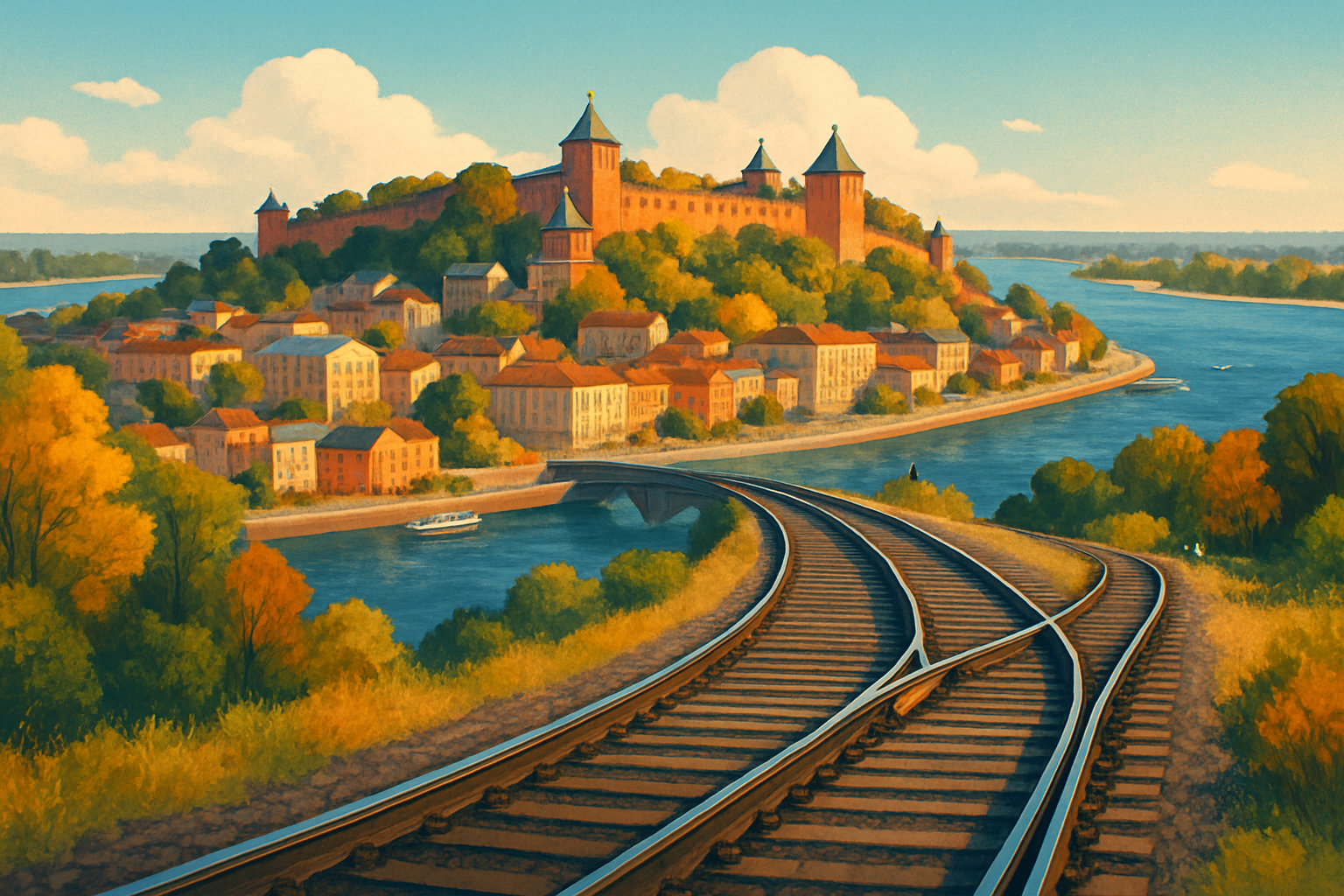
Most people who visit Russia spend their time in Moscow and St. Petersburg and call it done. That’s understandable — both cities are genuinely substantial — but it means almost everyone misses the country’s third-largest metropolitan area, sitting four hours east of Moscow at the confluence of the Oka and the Volga. Nizhny Novgorod is not a hidden gem in the Instagram sense. It’s a city of 1.3 million people with a real economy, a functioning kremlin, and a historic upper town that rewards walking in a way that neither Moscow nor St. Petersburg quite does.
View larger map | Map data © OpenStreetMap contributors
Why the Geography Actually Matters
The confluence of the Oka and the Volga is the reason Nizhny Novgorod exists at all. Founded in 1221, it controlled river trade between central Russia and everything east — which made it wealthy enough to build one of the better-preserved kremlins in the country. Thirteen of the original seventeen towers are intact, the walls are walkable, and the interior splits between local government offices and public space. You can walk the ramparts and look out over both rivers with almost no one else there. That’s a sentence you cannot write about the Moscow Kremlin.
The upper and lower towns divide sharply along the river bluff. The upper town holds the kremlin, the cathedral, and the 19th-century merchant architecture along Bolshaya Pokrovskaya Street — the main pedestrian drag, which feels genuinely lived-in rather than preserved for tourism. The lower town, down by the water, has older working-class neighborhoods and the embankments, connected to the upper town by a cable car that crosses the Oka.
What to Actually Prioritize
The kremlin warrants at least two hours, not thirty minutes. The Archangel Michael Cathedral inside it dates to the 1630s and is one of the more striking examples of Russian church architecture outside Moscow — the proportions are different from what you see in the capital, squatter and more defensive-looking, which reflects the threat environment of the era rather than any aesthetic choice. The kremlin walls take about forty minutes to walk at a deliberate pace; the view from the southeastern towers over the Volga confluence is the single best vantage point in the city.
Bolshaya Pokrovskaya gets compared to Moscow’s Arbat, which is both accurate and slightly unfair — it’s less self-consciously touristy. The architecture along it spans roughly three centuries of Russian merchant and Soviet civic building in a way that’s more instructive than pretty. Walk the full length rather than just the central section.
The Strelka — the actual point where the two rivers meet — was redeveloped around the 2018 World Cup into a public waterfront space. It’s more interesting as a geography lesson than as a destination on its own, but worth the walk if you’re already in the lower town. Standing there with the Oka coming in from one side and the Volga stretching away in both directions gives you a clearer sense of why medieval Russian princes cared about this specific patch of ground than any map does.
The Nizhny Novgorod Fair District
This is the part most visitors skip, which is a mistake. From roughly the 1820s through the early 20th century, the Nizhny Novgorod fair was among the largest trade fairs in the world by attendance — peak years drew hundreds of thousands of merchants and buyers from across Russia and Central Asia. The fairgrounds across the Oka from the main city are largely derelict now, with a 19th-century cathedral and scattered neoclassical administrative buildings in various states of repair. It’s not polished. The point is that the sheer scale of what was built there, even in decay, tells you something about how significant this city was to the pre-Soviet Russian economy that no amount of reading about it quite conveys.
Food and Where to Eat
The restaurant scene in the upper town is genuinely good by Russian regional city standards. Being a Volga city means freshwater fish shows up constantly — pike perch (sudak) and sterlet appear in ways you won’t find in Moscow restaurants, which tend toward either expensive fine dining or generic everything. Local markets, particularly the one near the kremlin, are worth a morning stop if you find produce markets more useful than restaurant lists.
One honest caveat that applies to this entire post: the practical situation for foreign travelers has changed significantly since 2022. Visa access is restricted for most Western nationalities, international payment cards don’t function, and the logistical environment is genuinely different from what pre-2022 travel accounts describe. This post is written for when those conditions change, or for travelers from countries where access currently remains open. Check your nationality’s current visa eligibility before planning anything.
Getting There and When to Go
The Lastochka express from Moscow’s Kursky station covers the 420km in around three and a half hours. A day trip is technically possible, though two nights is the more useful minimum. Flights from Moscow exist but add airport time without meaningfully cutting travel time; the train is the right call.
June through August is when the river is navigable and the embankments make sense. September is arguably better for the upper town: cooler, less crowded, and the late-afternoon light on the kremlin walls is noticeably different. January and February are extremely cold, and the river views are dramatic in a specific way — but you need to actually want to be in a Russian winter city to frame that as a selling point rather than a warning.
The city hosted several 2018 FIFA World Cup matches, which drove significant infrastructure upgrades — stadium, transit connections, hotel capacity — that are still visible. The Strelka embankment dates from that period.
How Long to Stay
Two full days covers the kremlin, the upper town, the fair district, and the Strelka without rushing. Three days lets you slow down on the embankments and explore the lower town neighborhoods more deliberately. Don’t plan Nizhny Novgorod as a half-day stop between Moscow and Kazan — the kremlin alone takes the time most people allocate for the whole city.
Kazan is a further four hours east by fast train and deserves its own dedicated time, so if you’re building a Volga itinerary, Nizhny sits naturally between Moscow and there. The framing that matters: it’s the reason to stop, not the excuse to pause briefly before continuing east. Whether you get two days or three, decide that before you book your onward train, not after you’ve already arrived tired from Moscow.