
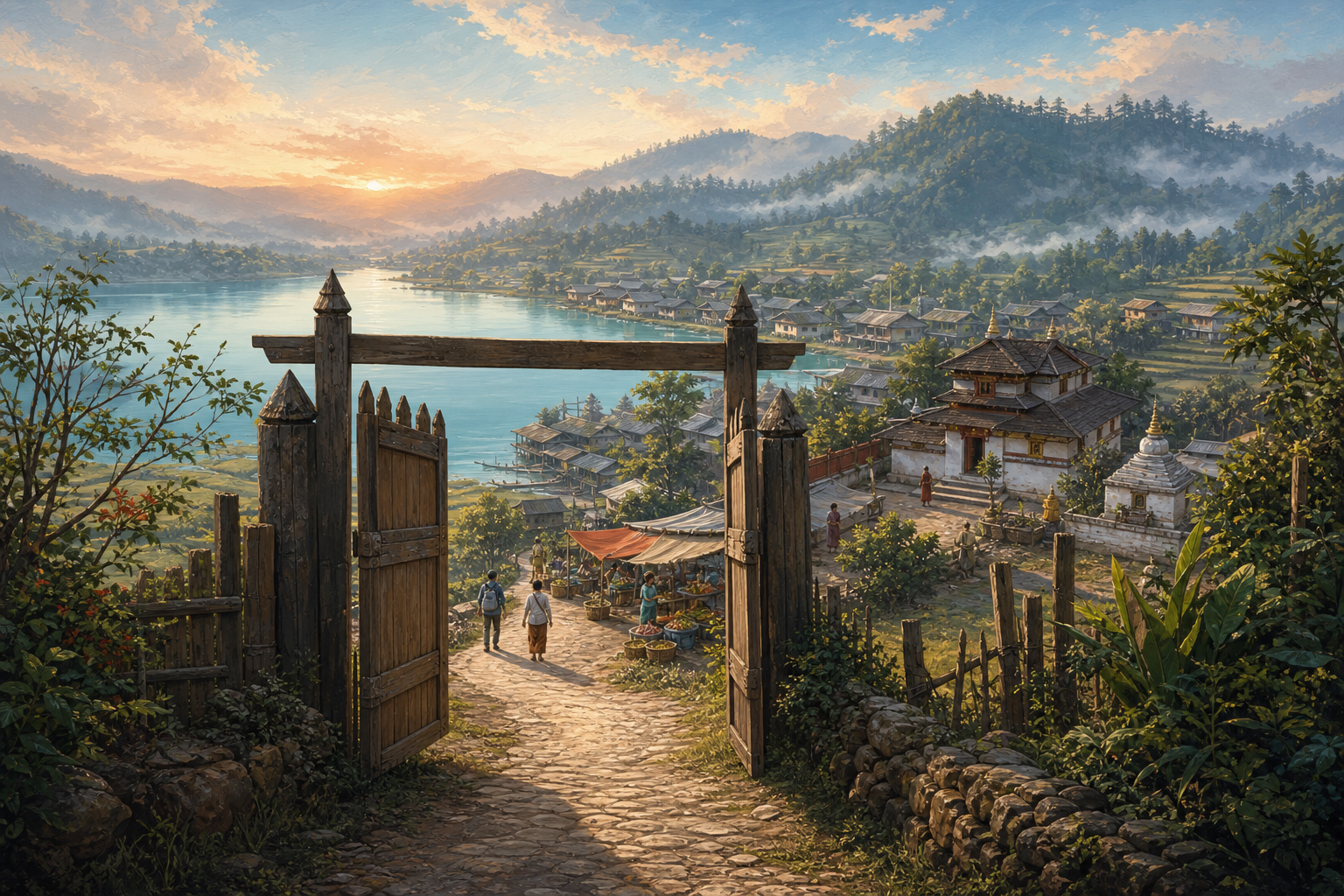
Kengtung sits in the eastern Shan hills of Myanmar, about as far from Yangon as you can get without crossing into China, Laos, or Thailand. Most people have never heard of it. The ones who have usually encountered it as a footnote in a Shan State itinerary they never actually booked. That’s a shame, because Kengtung is the kind of place that travel in Southeast Asia used to feel like more often — genuinely unhurried, with a physical landscape and a cultural mix that doesn’t exist anywhere else in the region.
View larger map | Map data © OpenStreetMap contributors
Worth being upfront: Myanmar travel has been politically complicated since the 2021 coup, and conditions change. At the time of writing, Kengtung is accessible via Tachileik from the Thai border crossing at Mae Sai, though you should check current advisories from your home government before booking anything. This is not a post that pretends the political situation doesn’t exist — but Kengtung is also a real place with real residents whose economy depends on visitors, and those two things can be held at the same time.
What Kengtung Actually Is
The town is the old capital of the Khün principality, one of dozens of small Shan states folded into Burma under British colonial administration and then into the modern Burmese state after independence. The Khün people are Tai-speaking — linguistically closer to northern Thai than to Burmese — which is why Kengtung has a different texture than most Burmese towns. That shows up in the monasteries, which follow a Shan Buddhist style distinct from the gilded Burman pagoda aesthetic, and in the food, which has more in common with Chiang Rai’s northern Thai cooking than with anything you’d find in Mandalay.
The old quarter around Naung Tung lake is walkable and largely intact — low wooden buildings, morning markets, monks collecting alms at dawn. It’s not preserved in a museum sense; people live and work in these buildings. The lake is small enough to walk around in under an hour and is lined with monasteries that function as community centers, not tourist attractions.
The Monasteries Worth Your Time
Wat Jong Kham, next to the lake, is the most photogenic and consequently the one everyone visits. Get there before 8am and it’s quiet enough to sit in the courtyard and watch monks go about their morning. Mid-morning it fills with school groups.
Wat Pha Jao Lung, on a small hill above the town, is older and less visited. The climb is ten minutes. The views over the surrounding hills are worth the effort, but what’s more interesting is the scale of the compound — large, clearly well-funded by local donors, with a working school attached. That’s the thing about Kengtung’s monasteries: they’re functioning institutions, which is a different experience from the temple-as-backdrop dynamic you get at heavily touristed sites.
There are around a dozen significant monasteries in and around town. You don’t need to visit all of them. Pick two or three and spend real time at each rather than ticking off a list. The ones on the outskirts require a motorbike or tuk-tuk, which your guesthouse can arrange for a few dollars.
The Hill Village Walks
This is the part of Kengtung that requires a local guide, both practically and ethically. The villages around town are home to Akha, Lahu, Lisu, and Ann communities — each with distinct dress, religious practice, and relationship to the tourism that has been part of their lives, in varying degrees, for several decades. Some villages are genuinely welcoming; others have a tired, performance-for-cameras quality that suggests overvisitation relative to the attention those communities actually want.
A good local guide — your guesthouse can recommend one — will know which villages are receptive on a given day and will handle introductions in a way that doesn’t reduce the visit to an awkward photo transaction. Guide fees in Kengtung are modest by any standard; pay the full rate without negotiating it down.
The walks themselves are genuinely beautiful. The Shan hills here are rolling rather than dramatic, pine-forested at elevation, with valley rice paddies below. It looks nothing like the tourist brochure version of Myanmar, which tends to feature Inle Lake or Bagan’s pagoda plains. That’s part of the point.
Food and Where to Eat
The morning market near the lake is where you want to be between 6am and 8am. Vendors sell Shan noodles — lighter broth than the Burmese version, with tomato and sesame — along with sticky rice with grilled meats and various preparations involving fermented soybeans that are worth trying even if you’re not sure what you’re ordering. Prices are local prices. Pointing works fine.
For sit-down meals, a handful of small restaurants around the market area serve basic Shan and Chinese-Shan dishes. The Chinese influence is real — Kengtung has had a significant Yunnanese community for generations, and you’ll find Yunnan-style tofu dishes and pressed teas that make the cultural geography of this corner of Southeast Asia legible in a way that’s hard to get from a map.
There’s no restaurant scene in the Chiang Mai or Luang Prabang sense. If that’s what you’re looking for, this isn’t the right stop.
Getting There and How Long to Stay
The standard entry point for most foreign visitors is the land border at Tachileik, directly across from Mae Sai in Thailand’s Chiang Rai province. From Tachileik, Kengtung is roughly four to five hours by road through the hills — do that drive in daylight, not just for the scenery but because road conditions after dark are variable. Domestic flights into Kengtung from Mandalay or Yangon exist, though schedules shift frequently and reliability has historically been uneven.
Two nights is the minimum to see the lake monasteries and do one half-day village walk without rushing. Three nights is better — it gives you a second walk, time to sit in the market over two mornings, and enough margin that a slow day doesn’t feel like a logistical problem.
Accommodation options are limited and range from basic to adequate. Harry’s Guesthouse and similar family-run places near the lake have historically been well-regarded by independent travelers. Book ahead — not because rooms are scarce in aggregate, but because the better-run places fill up fast when any cluster of independent travelers converges on the same week.
The Honest Caveat
Kengtung sits in a part of Shan State that has seen intermittent armed conflict between the Myanmar military and various ethnic armed organizations for decades. The town itself has generally been stable enough for visitors, but the broader regional picture is not simple, and “eastern Shan State” covers a lot of ground with very different conditions depending on which direction you go from town. Check current FCO, State Department, or equivalent advisories for eastern Shan State specifically — not just generic Myanmar advice — before you commit. The situation in 2025 is not the same as 2019, and the same town can be accessible one month and inadvisable the next depending on activity in surrounding areas.
That’s a real constraint, not boilerplate. Build flexibility into your booking and don’t prepay anything you can’t recover.
If you’re already planning a trip to Chiang Rai and looking at the map wondering what’s on the other side of Mae Sai — Kengtung is the answer, assuming conditions hold. Check the advisories, then decide. It’s one of the few places in the region that still feels like you’re visiting somewhere rather than consuming it.