
The Problem With Every Standard Georgia Itinerary
View larger map | Map data © OpenStreetMap contributors
Tbilisi, Kazbegi, maybe Batumi. That’s the template, and it’s not wrong — those places are genuinely good. But between Tbilisi and the western half of the country sits a stretch almost every tour group drives straight through: the Mtkvari River valley, where the town of Gori and the cave city of Uplistsikhe sit about 80 kilometers from the capital. Most people treat them as a long day trip at best. One night in Gori changes what you’re actually able to do there.
Uplistsikhe: What It Actually Is
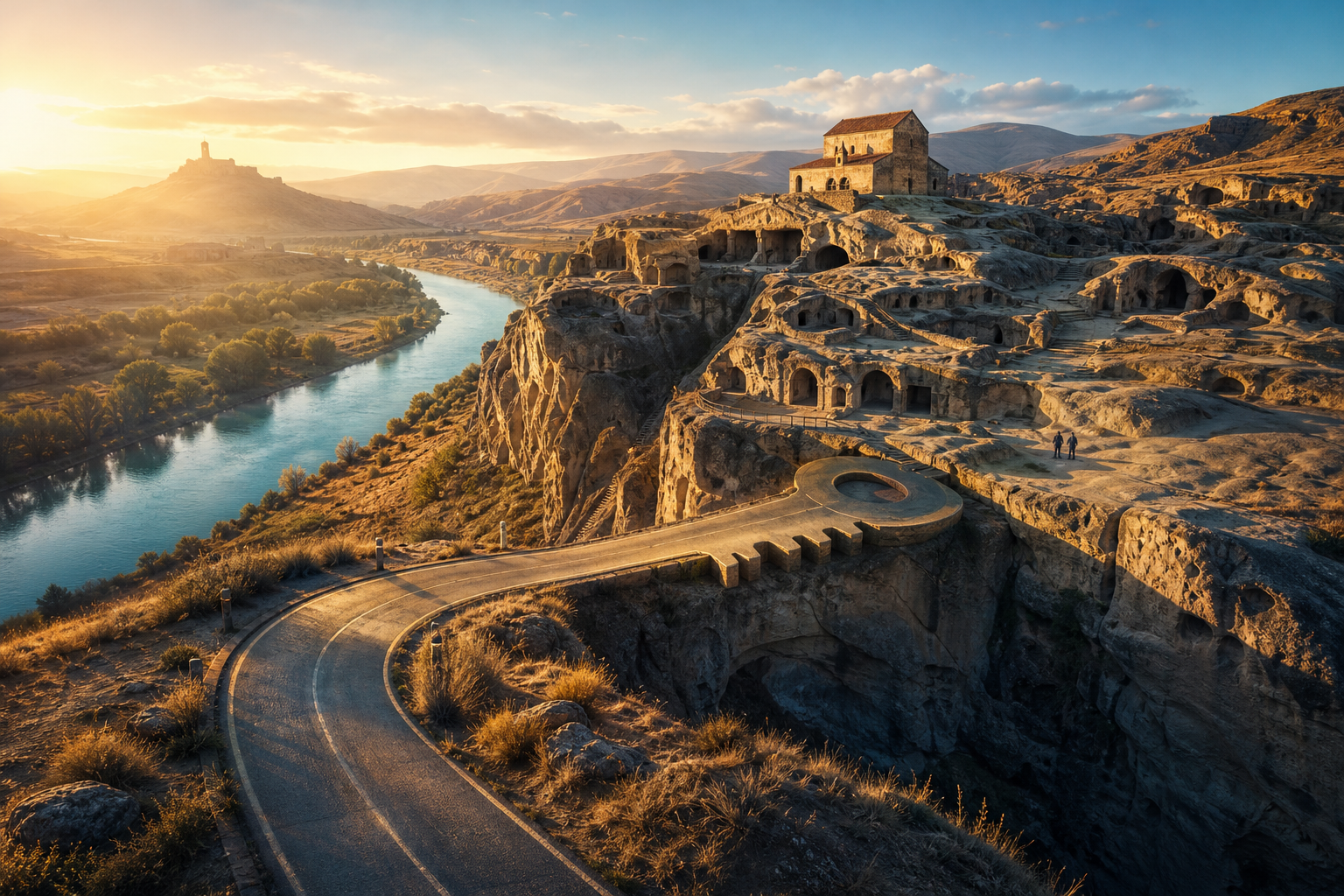
Uplistsikhe is a rock-hewn city carved directly into a sandstone cliff above the Mtkvari River. It was continuously inhabited from roughly the early Iron Age through the late medieval period — something like 2,500 years as a functioning urban center. At its peak it held tens of thousands of people. The caves aren’t storage rooms; there are wine cellars with carved grape-pressing troughs still visible in the rock, a pharmacy with niches for medicinal herbs, a theater with a carved proscenium arch, and a Christian basilica built directly over what had been a pagan sacrificial chamber.
That layering of religious use is visible in the stonework itself. You can see where older carved niches were partially filled in when the basilica was constructed on top of them. No placard explains it as well as standing there and looking at the joins in the stone.
The site is managed by the Georgian National Museum network and is straightforward to visit — entrance fee, a footpath up to the main plateau, nothing technically difficult. The problem is time. Most day-trippers from Tbilisi arrive late morning, spend forty-five minutes, and leave. The site is larger than it looks from the road: lower section, main plateau, and a higher ruined area above that most visitors never reach. Two hours is a realistic minimum; three if the light is cooperating and you want to sit at the top and look at the valley properly.
Early morning, before the tour vans from Tbilisi arrive, is noticeably better. The sandstone goes warm gold in the first hours of light in a way that midday flattens completely. Staying in Gori is the only way to get there at that hour without leaving the capital before dawn.
Gori: More Than the One Obvious Museum
Stalin was born in Gori, and the Stalin Museum is the thing everyone knows the town for. It’s worth going — and it’s a genuinely strange experience. The exhibit tone sits somewhere between neutral documentation and something closer to reverence, which tells you something real about how differently that history reads inside Georgia versus outside it. The house he was born in is preserved under a neoclassical canopy that dwarfs it absurdly. His personal railway car is parked in the grounds. Whether you find the whole thing fascinating or unsettling probably depends on what you’re bringing to it, and both are reasonable responses.
What most people walk past on their way to the museum is Gori’s old quarter. The hilltop fortress — Goristsikhe — overlooks the city from the same kind of dramatic outcrop position as Uplistsikhe does over the river valley. It’s partially ruined, partially restored in the way many Caucasian fortresses have been, and almost always empty. The view from the top covers the Liakhvi and Mtkvari confluence in a way that makes the strategic logic of the location immediately obvious.
The town is small enough to cover the main things in a day. The case for sleeping there isn’t that there’s more ground — it’s that you get Uplistsikhe at the right time of day without leaving Tbilisi at 5am.
Practical Logistics
Marshrutky (shared minibuses) run from Tbilisi’s Didube terminal to Gori regularly; journey time is an hour to ninety minutes depending on traffic. Uplistsikhe is about 15 kilometers from Gori. Local taxis cover the route, but there’s no reliable public transport between the town and the site, so arrange a return trip with a driver before you go rather than hoping to find one at the ruins.
Accommodation in Gori is limited. Guesthouses work fine, but this isn’t a place with much of a hotel market — check availability and book ahead rather than assuming you’ll sort it on arrival. Eating options are similarly modest: a handful of local restaurants serving standard Georgian food competently. Nobody is coming to Gori for the restaurant scene, and that’s fine.
One thing worth knowing before you arrive: Gori sits about 20 kilometers from the South Ossetia administrative boundary line, and the broader Shida Kartli region was the center of the 2008 conflict. The town is completely normal to visit and has been for years, but the context surfaces at the Stalin Museum in the exhibit on the war. Better to know that going in.
How to Fit It Into a Georgia Trip
Gori works best as a one-night stop between Tbilisi and the west — Kutaisi, Borjomi, or the Svaneti road if you’re going that far. Drive or bus through rather than doubling back. You’re not burning a day on a round-trip from Tbilisi; you’re building a logical westward route with one overnight in the middle.
Uplistsikhe in the morning, the fortress and museum in the afternoon, a solid night before continuing west — it’s the kind of day where you actually absorbed something rather than checked locations off a list.
If you’re only doing Tbilisi and Kazbegi, skip it. But if you’re heading west at any point, the cave city predates most of what you’ll see anywhere else in the Caucasus. That’s worth one honest stop on the way through.