
Most people who fly into Bishkek are already mentally in the Tian Shan. They land at Manas International, spend one night in the capital, buy some dried fruit from a supermarket, and head south toward Karakol or west toward Song-Köl. The city barely registers as a destination. That’s understandable — Kyrgyzstan’s mountains are genuinely extraordinary and Bishkek is not, by any normal measure, a spectacular city. But dismissing it in under 24 hours means missing the thing that actually makes it interesting: how strange and specific its Soviet-to-Central Asian transition looks up close.
View larger map | Map data © OpenStreetMap contributors
Two full days is probably the right amount. Not more. But not eight hours either.
What the City Actually Looks Like
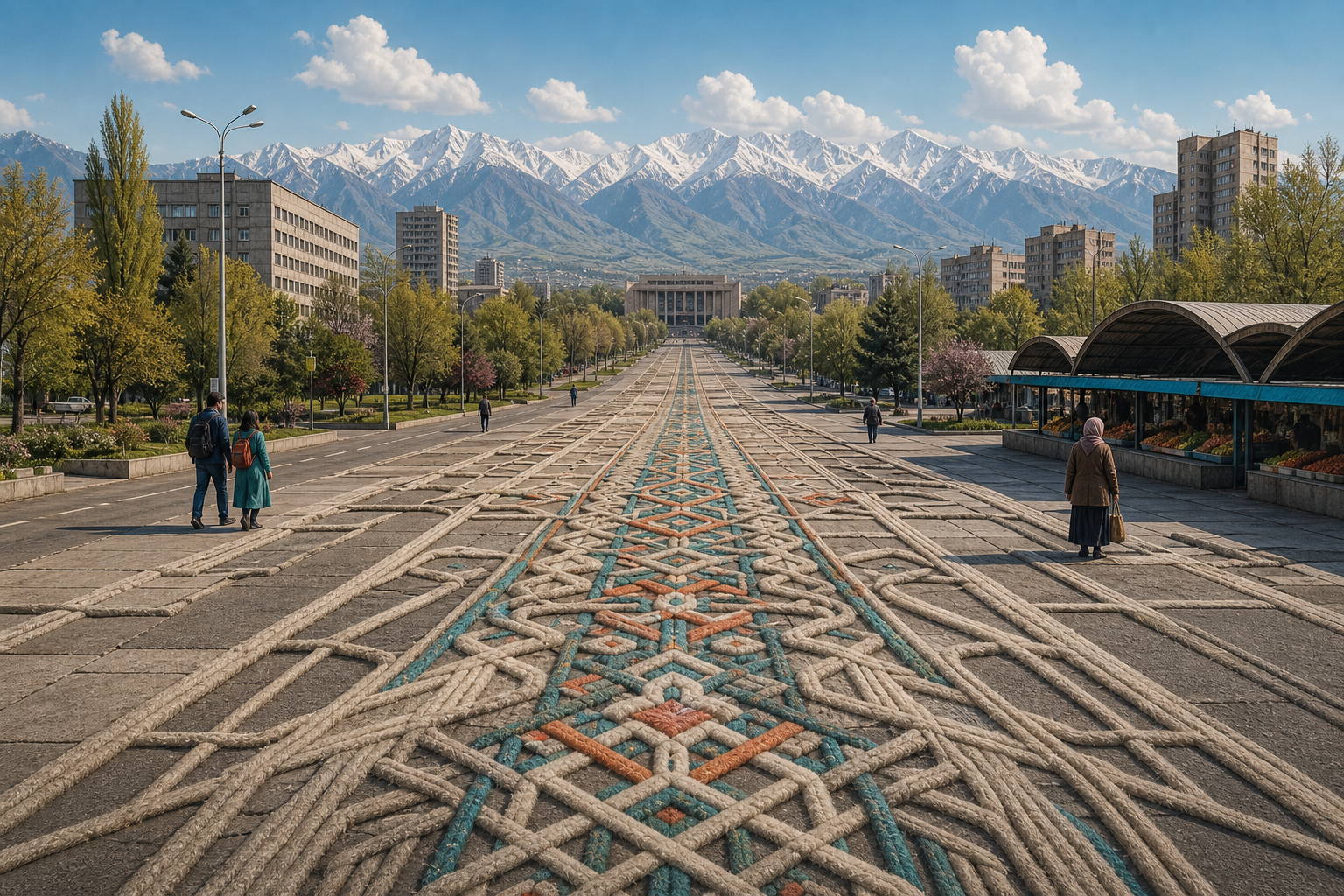
Bishkek was built almost entirely during the Soviet period as Frunze — named after a Bolshevik military commander — and the urban grid still reflects that: wide boulevards, generous parks, brutalist administrative blocks sitting next to Russian Orthodox churches sitting next to mosques. The main drag, Chuy Prospekt, runs east-west through the center and is genuinely pleasant to walk on a clear day, with the Kyrgyz Ala-Too range visible to the south. On a really clear morning in spring or autumn, the mountains sit above the city in a way that makes the whole place feel improbably dramatic for a flat Soviet grid town.
Ala-Too Square is the formal center: big Soviet plaza, government buildings, a yurt-shaped cultural center. It’s not Tiananmen, but it’s not nothing either. The changing of the guard happens at regular intervals and draws a mix of local families and perplexed tourists who weren’t expecting to find it affecting. Worth twenty minutes.
Osh Bazaar, Not the One in Osh
The single best reason to spend a proper morning in Bishkek is Osh Bazaar, which is not in Osh (the southern city) but on Bishkek’s western edge. It’s a full-scale working market: meat, dairy, bulk spices, dried fruit, bread, livestock feed, and a section selling traditional felt goods and embroidered textiles that isn’t performatively tourist-facing. The kalpak hats — white felt, structured brim, distinctively Kyrgyz — are cheaper here than anywhere you’ll find them near Song-Köl or Issyk-Kul.
Go in the morning, before noon. Bring cash in som; many stalls don’t deal in anything else. Skip the outer ring of fixed stalls near the main road and go deeper into the covered sections where the actual produce vendors are. The density of activity per square meter is high enough that navigating it slowly, without an agenda, is the point.
The Russian Legacy, Honestly Assessed
Bishkek is one of the few Central Asian capitals where Russian is genuinely co-equal with the national language in daily street life — more so than Almaty, arguably, and certainly more than Tashkent or Dushanbe. Signs, menus, and conversations switch fluidly. This is partly demographic history and partly practical: Russian remains the default language of business and interethnic communication in a country with substantial Uzbek and Dungan minorities alongside the Kyrgyz majority.
That linguistic overlap makes Bishkek easier to navigate than you’d expect if your only script knowledge is Cyrillic, since transliteration is relatively consistent. It also means the cafe culture is unexpectedly functional — there are actual espresso bars in the center, not just chaikhanas (tea houses), and they work well.
The State History Museum on Ala-Too Square covers pre-Islamic nomadic culture through the Soviet period, with some genuinely good yurt reconstruction displays and felt artifact collections. English signage is minimal, but the objects are worth seeing without it. Budget 90 minutes if you’re interested in material culture; less if you’re not.
Eating in Bishkek Without Making a Bad Decision
Bishkek’s food scene rewards the specific over the famous. Lagman (pulled noodles in a meat broth, usually lamb or beef) and manti (steamed dumplings) are the reference dishes, and you can eat them well at any busy local cafeteria — look for a place where the menu is written on a whiteboard and the seating is communal. Avoid anywhere near the tourist stretch of Erkindik Boulevard with backlit photographs of dishes on the menu board; the places that look more like a school canteen from the outside tend to be significantly better.
Dungan food is the specific thing worth hunting down. The Dungan people — Chinese Muslims who migrated to Central Asia in the 19th century — have a culinary tradition that sits between western Chinese cooking and Central Asian technique. Ashlyamfu, a cold noodle dish with starch jelly, vinegar, and spiced broth, is the canonical Dungan dish and genuinely unlike anything else in the region. It’s typically sold only in warm weather and you’re more likely to find it in Karakol, but a few Bishkek spots serve it year-round.
The One Day Trip Worth Doing
Ala Archa National Park is 40 kilometers south of the city center: a proper alpine gorge starting at around 1,750 meters, with trails climbing toward glaciated peaks above 4,000 meters. You don’t need to be a serious mountaineer to get something out of it. The valley floor trail along the Ala Archa river gets you into real mountain terrain within an hour of parking. Entry requires a permit, purchased at the gate for a small fee, and you’ll need a car — shared taxis from the southern part of Bishkek are the practical option if you’re not renting.
Don’t combine this with a full day in the city. Either do Osh Bazaar and the museum on one day and Ala Archa on another, or accept that you’re doing the park properly and treating Bishkek as arrival and departure logistics. Trying to cram both into one day means rushing the park, which defeats the purpose.
Practical Logistics
Bishkek runs on Kyrgyzstani som. ATMs in the center reliably dispense it, and the exchange rate from USD is usually better at exchange bureaus than at the airport. Visa policy depends on your passport — citizens of roughly 60 countries get visa-free entry for varying durations, and the e-visa system covers most others. Check the current list before you book, because it changes: some nationalities that were visa-free in 2019 are not in 2025.
The best months are May through early June and September through mid-October. July and August are fine but dusty and hot in the city, though ideal at altitude. Winter is viable if you’re interested in cross-country skiing at Noruz ski base, but the city itself is grim in January.
Manas Airport is small and straightforward. Turkish Airlines connects through Istanbul with reasonable frequency; Air Astana routes through Almaty. Direct connections from Moscow and several Chinese cities exist, though those schedules shift more than the European routes.
One caveat worth stating plainly: Bishkek’s accommodation infrastructure is thinner than Almaty or Tashkent. There are solid mid-range options and decent budget guesthouses around the center, but if you’re expecting the quality-to-price ratio that makes somewhere like Tbilisi feel like a genuine find, you won’t quite get there. The city works best for travelers who’ve already calibrated toward function over boutique.
Build at least two nights into the trip rather than treating Bishkek as a same-day pass-through — and if you’re skeptical, spend one morning at Osh Bazaar before you decide the mountains are the only reason you came.