
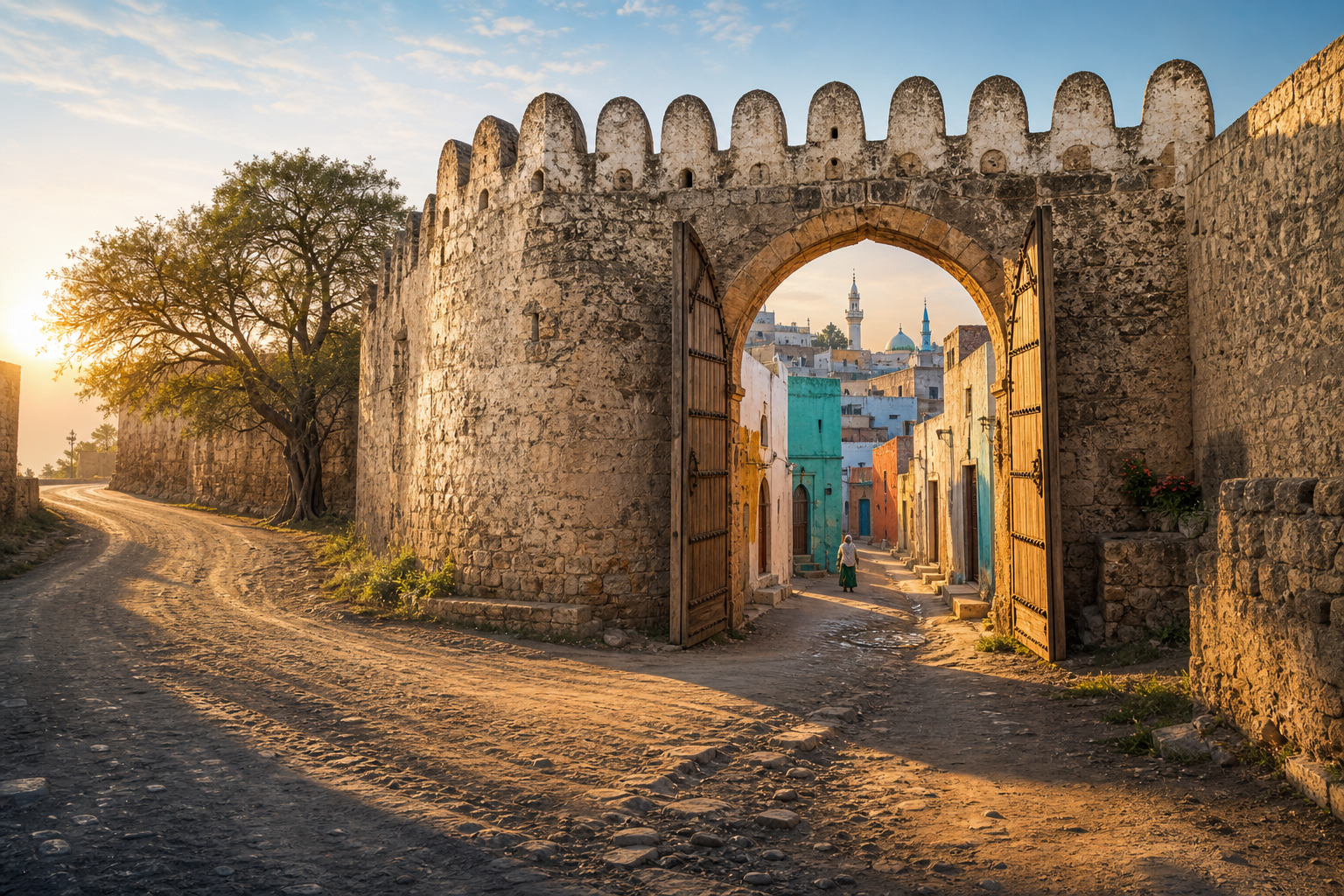
The case for Harar before anyone else figures it out
View larger map | Map data © OpenStreetMap contributors
Most Ethiopia itineraries go: Addis Ababa, Lalibela, maybe the Simien Mountains, done. Harar doesn’t make that list for most visitors, which is almost entirely a failure of planning rather than a reflection of what the city actually is. Harar Jugol — the old walled city — is a UNESCO World Heritage Site, considered the fourth holiest city in Islam after Mecca, Medina, and Jerusalem by many scholars, and home to 82 mosques inside a medieval wall roughly 900 years old. It also has one of the most genuinely strange and memorable rituals in East Africa: men hand-feeding wild spotted hyenas by mouth, at night, just outside the city walls. That’s not a tourism gimmick. It’s been happening for centuries.
Getting there honestly
Harar sits about 525 kilometers east of Addis Ababa, near Dire Dawa. Ethiopian Airlines runs frequent domestic flights into Dire Dawa (IATA: DIR) — the flight takes around an hour and costs significantly less than you’d expect for a domestic leg. From Dire Dawa, Harar is a roughly one-hour minibus or taxi ride up into the highlands. The road is good. You can also do it by overnight bus from Addis if cost is the priority, but the flight makes more practical sense for most people’s time budgets.
Don’t conflate the two cities — they’re separate places with very different characters. Dire Dawa is flat, hot, and commercial. Harar is elevated (about 1,850 meters), cooler, and enclosed. Worth knowing before you book a hotel in the wrong one.
The Jugol: what you’re actually walking into
The walled old city has five gates, each historically associated with a different ethnic group that used it. The lanes inside are narrow enough that motorbikes barely fit, house walls are painted in layered blues, greens, and ochres, and the ground plan makes no concession to grid logic. You will get disoriented. That’s fine — the Jugol is roughly 48 hectares, so you’re not going to lose yourself for more than twenty minutes before hitting a wall or a gate you recognize.
What’s inside: the 82 mosques, a dense residential neighborhood that has been continuously inhabited for centuries, a handful of small museums including the Rimbaud House (Arthur Rimbaud lived and traded here in his post-poetry life — the connection is strange and genuinely documented), and market areas near the Shoa Gate that blur into the surrounding city. The mosques are generally not open to non-Muslim visitors for prayer, but the architecture and the lane-to-lane layout built around them is the experience, not any single interior.
Hire a local guide for the first half-day. Not because you’ll be permanently lost without one, but because the context inside the Jugol isn’t self-evident — who built which mosque, why the house layouts look the way they do, what the painted facade designs signify. Guides operate around the main Feres Magala square. Agree a rate before you start walking.
The hyenas: what’s actually happening
Two families in Harar maintain what are called hyena men traditions — feeding wild spotted hyenas that come into the city’s outskirts each night. The practice predates tourism entirely; it historically kept hyenas from raiding livestock and was tied to specific beliefs about the animals carrying away evil spirits. It still happens every night regardless of whether any visitors show up.
After dark — typically around 7 or 8pm — visitors can watch and, if they choose, participate. The handler holds a short stick with meat on the end and the hyenas take it; visitors who want to try hold the stick themselves, or in the more intense version, hold the meat in their mouths while the hyena takes it directly. These are wild animals. They’ve been habituated to this specific feeding interaction, but they are large and powerful, and the handlers are genuinely experienced, not performing for the photo. The experience is viscerally odd in a way that photos don’t quite prepare you for — the size and sound of spotted hyenas at close range is a different register from any zoo encounter.
There are two main spots: one near the Fallana Gate, one near the Argob Gate. Small entrance fees apply. Ask your guesthouse which is running well on a given night — the experience varies slightly depending on the handler and how many hyenas show.
What to eat in Harar
Harar has its own distinct food culture, separate from the injera-and-tibs baseline of the rest of Ethiopia. Look for Harari dishes specifically: maraq (a bone broth soup typically eaten for breakfast), dishes made with sorghum rather than teff, and the city’s own style of bread. The market near the Shoa Gate sells fresh khat, the mildly stimulant leaf that’s legal in Ethiopia and a central part of daily social life here — chewing it is an option if you’re curious, though the effect is mild and the taste is very bitter.
Coffee matters here too. The Harar region is one of Ethiopia’s significant growing areas, and dry-processed Harari beans have a distinct fruit-forward character that’s quite different from the washed Ethiopian coffees most specialty cafes carry. Buy actual roasted beans in the market to take home — the quality is genuine and the prices reflect the local market, not the export premium.
Practical notes worth having before you go
Two nights minimum inside the Jugol or immediately adjacent to it. There are guesthouses within the walls, and staying inside matters for the early morning — the calls to prayer from 82 mosques starting before dawn is one of those rare sensory experiences that’s impossible to replicate from a hotel a kilometer away.
October through February is the most reliable window — Ethiopia’s dry season in this region. The rains from roughly June through September make the smaller lanes muddy and slippery, though Harar doesn’t flood the way low-lying cities do. The lowlands around Dire Dawa get genuinely brutal heat from March through May, but Harar’s elevation keeps it manageable year-round relative to the rest of eastern Ethiopia.
Check current UK FCDO or US State Department advisories before travel to eastern Ethiopia. Harar specifically has been stable for visitors for years, but it sits close enough to areas with different threat levels that the distinction matters — read the advisories rather than skipping them.
Photography inside the Jugol’s residential lanes requires more sensitivity than most travelers default to. Ask before pointing a camera at people in their doorways. The neighborhood is a living city, not a set.
Why this city doesn’t get more visitors
Partly routing — Lalibela’s rock-hewn churches are genuinely spectacular and rightly dominate Ethiopia itineraries, and adding Harar requires either a separate domestic flight or extending the trip. Partly awareness — Harar doesn’t have the international profile of the Simien Mountains or the Omo Valley. And partly the absence of a single obvious hero image the way the churches or the communities of the south provide.
That’s almost the argument for going. The Jugol at 6am, before the lanes fill, with light coming through the gates and the mosques audible in every direction, is the kind of travel experience that doesn’t photograph cleanly but stays with you. That’s a different return on a trip than what most Africa itineraries are optimizing for.
If you’re building an Ethiopia itinerary and already have Lalibela locked in, price out the Dire Dawa flight before you default to a third day in Addis — it’s usually cheaper than people assume and changes what the trip actually is.