
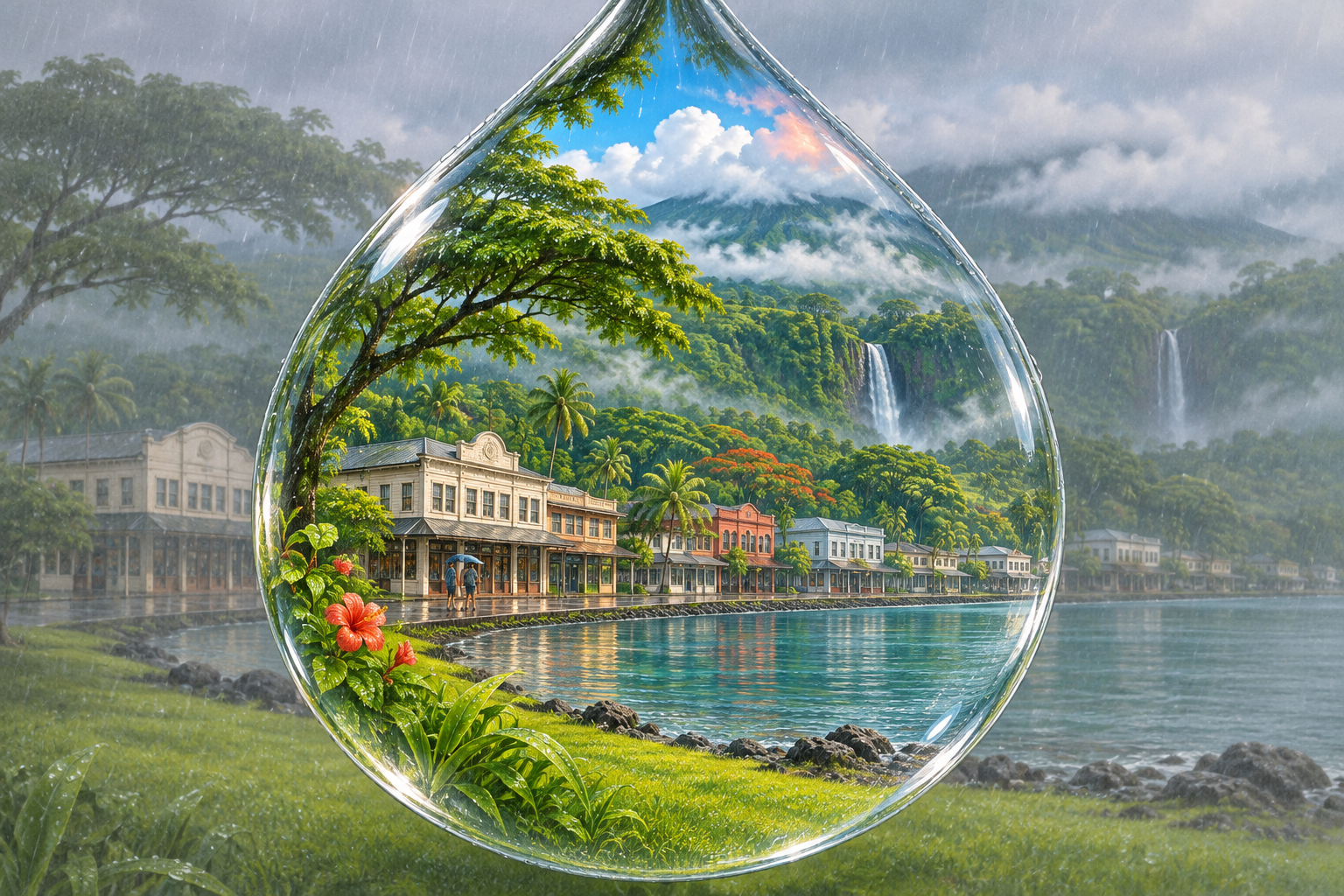
Most people flying to the Big Island land at Kona, pick up a rental, and spend the week on the dry western coast. Hilo sits on the other side of Mauna Kea — 90 miles and a full climate zone away — and gets skipped by a majority of visitors despite having the more interesting town, better botanical gardens, and direct access to Hawaiʻi Volcanoes National Park. The logic for skipping it is always the same: it rains in Hilo. And it does, more than almost anywhere else in the United States. But the rain is what makes it what it is.
View larger map | Map data © OpenStreetMap contributors
What Hilo Actually Is
It’s a small working city — population around 45,000 — with a genuinely intact historic downtown that wasn’t bulldozed for a resort strip. The buildings along Kamehameha Avenue date mostly from the early 20th century, many of them surviving two separate tsunamis (1946 and 1960) that destroyed the bayfront and reshaped where people chose to build afterward. The low grassy buffer along Hilo Bay that looks like an oddly placed park is not a design choice. It’s the zone nobody wanted to rebuild on.
That history is visible if you know to look for it. The Pacific Tsunami Museum on the main drag documents both events clearly and is worth an hour not as a curiosity but as actual context for why the town looks the way it does.
Hawaiʻi Volcanoes National Park
This is the main reason to base yourself in Hilo rather than attempting a day trip from Kona. The park entrance is 30 miles from downtown — maybe 45 minutes — versus 95 miles from Kona, which is two-plus hours each way and effectively means you rush it. Rushing Volcanoes is the wrong move.
The Kīlauea caldera is the centerpiece, and what you see depends entirely on when you go. Lava activity in the summit crater has been intermittent in recent years, cycling between active eruptions and quiet periods that can last weeks. The USGS Hawaiian Volcano Observatory posts daily status updates at volcanoes.usgs.gov, and checking those before your visit is worth doing before you build expectations. Some visits get the full glow at the overlook after dark; others get a dormant crater and sulfur vents. Both are worth the trip, but only one is the experience people come hoping for — and there’s no way to guarantee which you’ll get.
Beyond the caldera, the Chain of Craters Road descends roughly 3,700 feet to the coast across hardened lava fields that read like a different planet. The Thurston Lava Tube — properly called Nāhuku — runs about 500 feet through a tunnel formed when the outer crust of a lava flow cooled and the molten interior drained out. The geology here is not decorative; it’s actively explaining itself if you’re paying attention.
Stay for sunset and into early darkness if activity permits. The park is open 24 hours.
Akaka Falls and the Hāmākua Coast
North of Hilo, Highway 19 runs up the Hāmākua Coast past sugar plantation remnants, sea cliffs, and gulches that look engineered by someone with an excessive special effects budget. Akaka Falls State Park is a 20-minute loop trail through genuinely dense rainforest to a 442-foot single-drop waterfall — taller than Niagara by a significant margin, and usually uncrowded before 9am. Get there early.
The town of Honoka’a, about 40 miles north, has a main street that feels suspended in the 1950s without being self-consciously preserved that way. It’s a small agricultural town that hasn’t been redeveloped. Worth a stop for lunch before continuing to the Waipiʻo Valley overlook, where the valley floor — reachable only by 4WD or on foot — was once the most sacred in all of Hawaii and is still taro-farmed by residents today. The overlook at road’s end gives you the whole thing without descending, and the view is enough.
Hilo’s Farmers Market
Wednesdays and Saturdays, the market at the corner of Mamo and Kamehameha runs genuinely local — tropical fruit you won’t recognize, vendors selling everything from fresh lilikoi to prepared Filipino food, and prices that reflect what people actually pay rather than what tourists are expected to pay. This is not a craft market with ukulele keychains. Go hungry.
Suisan Fish Market near the harbor is worth knowing about for poke — not the mainland version with everything in it, but the actual local thing. They’ve been selling direct from the counter since the early 1900s.
Liliʻuokalani Gardens
The largest ornamental Japanese garden outside of Japan sits on a peninsula jutting into Hilo Bay and gets almost no foot traffic relative to its size and quality. It was developed in the early 20th century to honor Japanese immigrant laborers who worked the sugar plantations, and the stone lanterns, koi ponds, and teahouses are maintained properly rather than left to slowly deteriorate. Mid-morning on a weekday you can walk through it nearly alone, which is a strange thing to be able to say about a place that good.
When to Go and What to Expect
Hilo averages around 130 inches of rain a year. Most of it falls at night or in short afternoon showers rather than all-day downpours, but it’s genuinely wet and you should pack accordingly. The drier stretch runs roughly May through September; December through March brings the heaviest rainfall.
The tradeoff is that everything is green in a way the Kona side simply isn’t. The botanical gardens — Hawaiʻi Tropical Bioreserve and Garden in particular, which takes its plant collection seriously — exist here because of the rain. You can’t have both the landscape and the drought.
Flights into Hilo Airport (ITO) are fewer than into Kona (KOA), and inter-island connections are thinner, so most visitors still route through Kona. But if you’re renting a car anyway — and you should be, because the Big Island without a car is just a hotel — crossing the island and spending two or three nights in Hilo adds something the western side genuinely can’t offer: a town with some texture to it, and enough proximity to Volcanoes National Park that you can actually stay until dark.
Practical Notes
- Getting there: ITO has direct mainland flights (United, Southwest from some hubs), but inventory is limited. Kona to Hilo is a 90-minute drive through Waimea — scenic, worth doing in daylight.
- Volcanoes entry: $35 per vehicle, valid for seven days. The America the Beautiful annual pass covers it if you’re doing multiple parks.
- Eruption status: USGS HVO updates at volcanoes.usgs.gov — check the day before and the morning of your visit.
- How long to stay: Two nights minimum to do Volcanoes properly and catch the farmers market. Three nights if you want the Hāmākua Coast without rushing it.
One honest caveat: if what you want from Hawaii is beach time and consistent sun, Hilo is the wrong base. The beaches on this side are mostly black sand or rocky shoreline, and the weather doesn’t cooperate for lounging. That’s a feature or a bug depending on what you’re actually after.
The Kona resort books itself. The question worth sitting with before you confirm it is whether you’ve actually looked at the other side of the island, or just assumed there was nothing there.