
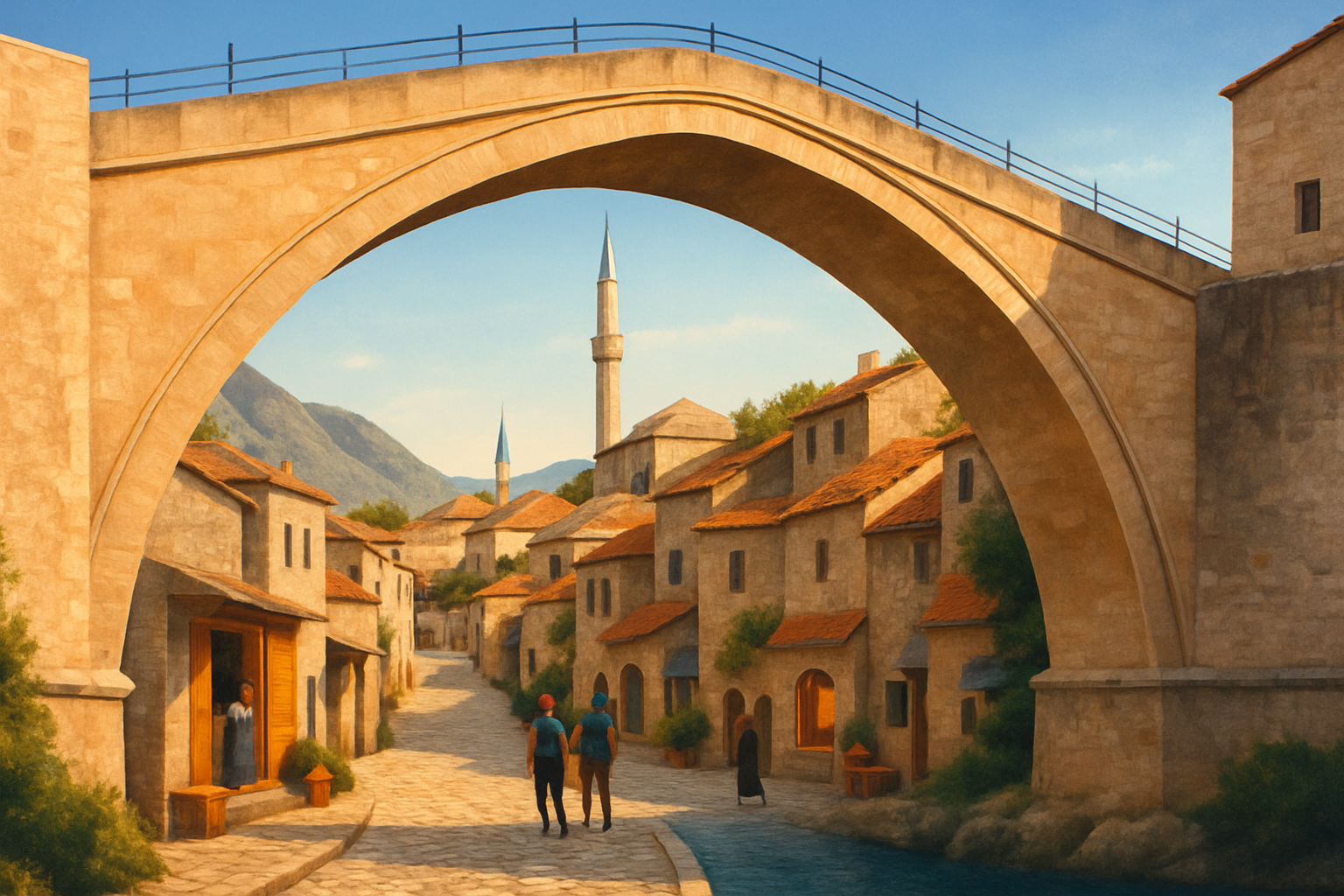
Mostar has a problem that most beautiful places eventually develop: the thing it’s famous for has become so dominant that visitors build entire itineraries around a single bridge. The Stari Most is genuinely stunning — a 16th-century Ottoman arch rebuilt after it was deliberately shelled into the Neretva in 1993, reopened in 2004, and now listed as a UNESCO World Heritage Site. Worth seeing. But it’s also about a ninety-second walk from the tourist drop-off point, and by 11am the surrounding streets are so thick with day-trippers from Dubrovnik and Split that what should be a deeply affecting experience feels more like a theme park queue.
View larger map | Map data © OpenStreetMap contributors
The fix isn’t a different time of day. It’s staying overnight, and using the hours before and after the crowds arrive to actually walk this city.
What Mostar Actually Is
Mostar is the cultural capital of Herzegovina, the southern region of Bosnia and Herzegovina that most people don’t realize is geographically and culturally distinct from Sarajevo. The city sits in a narrow river valley flanked by limestone karst hills, and it runs significantly warmer and drier than the rest of the country — the surrounding area grows some of the best wine in the Balkans, which surprises people who associate Bosnia primarily with harsh winters and mountain terrain.
The Stari Grad (old town) has a genuine Ottoman street layout — not a reconstruction of one — with coppersmiths’ workshops, mosques, and covered bazaar lanes that predate the 20th century by several centuries. The Kujundžiluk bazaar, which runs down to the bridge, is heavily touristed but not fake. The craftspeople selling copperwork and textiles there are part of an actual tradition, not a performed one.
When to Arrive, and Why It Matters
Day-trippers from the Dalmatian coast arrive in volume between 10am and 4pm. Sleep in the city and you have the Stari Grad essentially to yourself from about 7am until 9:30am. That window is worth protecting — the light on the bridge in the morning is better anyway, and you can walk the full span without dodging selfie sticks.
Late afternoon, after the coaches leave, is the second quiet window. The locals who actually live in the Stari Grad use the streets again after about 5pm, and the city takes on a completely different character. Sit at one of the terraced cafes overlooking the river and watch the bridge divers — young men who jump from the arch into the Neretva for money, a tradition that predates the tourist economy by quite a long stretch.
July and August are the worst months for crowds and the most brutal for heat — the valley traps it. June or September are meaningfully better. The city stays warm enough to swim in the river as late as October.
Past the Bridge: What’s Worth the Walk
The Koski Mehmed Pasha Mosque, up a short staircase from the river, has a minaret you can climb for a view down onto the bridge that you won’t get from the bridge itself. The climb is tight — not for anyone claustrophobic — but it’s a one-euro entry and entirely absent from the average tourist route. Worth doing.
Across the river from the main tourist cluster, the west side of the city is predominantly Croat and tells a different part of the post-war story. The Bulevar — the front line during the 1992–1993 Croat-Bosniak conflict — runs north-south through what’s now a fairly normal commercial street, but the pockmarked facade of the Aleksa Šantić school is still visible if you look. The Lucki Most, one of the reconstructed pedestrian bridges, is a five-minute walk and has almost nobody on it.
For the full context of what the war did to the city, the Museum of War and Genocide Victims in the Stari Grad is small but well-curated. It’s direct about what happened in a way that some museums in the region are not. Budget 45 minutes.
Blagaj — Don’t Miss It
About 12 kilometers southeast of Mostar, where the Buna river emerges from a cliff at the base of a 200-meter rock face, there’s a 16th-century Dervish monastery called the Blagaj Tekke. The spring discharges an enormous volume of water for a single karst source — one of the largest in the Balkans — and the monastery itself is still a functioning Sufi site, not a preserved ruin. The turquoise water and the limestone cliff above make for one of the more unusual 30-minute drives in the region.
Buses run infrequently. A taxi from Mostar is more practical and costs around 15–20 KM each way. Most people skip this entirely in favor of more time at the bridge. That’s the wrong call.
Food and Drink — the Honest Version
The restaurants immediately adjacent to the Stari Most are almost uniformly tourist-priced and mediocre. Walk three minutes in any direction and the prices drop noticeably and the food improves. Ćevapi — small grilled minced-meat sausages served with flatbread and raw onion — is the thing to eat here, as it is across Bosnia. The local version uses a mix of beef and lamb rather than the mostly-beef Sarajevo style.
Herzegovina’s wine is genuinely underrated. Žilavka is the white grape variety native to the region — dry, high-acid, with a mineral edge that makes sense once you’ve seen the limestone terrain it grows in. A glass at a cave-level terrace restaurant on the river runs about 3–4 KM. It feels like a discovery even though it’s not secret at all.
Skip the burek in the tourist zone and find it at a pekara (bakery) one street back — you’ll pay a third of the price and get something made that morning.
Getting There and Staying
Mostar has an international airport but very few scheduled commercial flights. Most people arrive by bus from Split (roughly 3.5 hours), Dubrovnik (about 2.5 hours, through some exceptional mountain scenery), or Sarajevo (2.5–3 hours). The Sarajevo route passes through a canyon section that’s worth the trip on its own. There’s also a train from Sarajevo that takes about 2.5 hours through the same canyon — it moves at exactly the right speed to watch the landscape go past.
The Stari Grad has guesthouses in genuinely old stone buildings at prices that would seem absurd anywhere on the Dalmatian coast. Two nights is the right amount — one to orient, one to actually use the city at its quieter ends. One night works if you’re connecting somewhere else, but you’ll leave feeling like you only saw the bridge.
One thing worth being upfront about: the reconciliation between the two communities that share Mostar is incomplete in ways that are visible if you’re paying attention. The city still has parallel institutions — two school systems, separate cafes with different clienteles, political signage that tells different stories on different streets. It’s not tense in a way that should concern a visitor, but noticing it is part of understanding the place. The more you treat Mostar as simply a pretty bridge in a scenic valley, the less of it you actually see.