
The Bay of Kotor’s Forgotten Entrance
View larger map | Map data © OpenStreetMap contributors
Almost everyone who visits the Bay of Kotor arrives by bus from Dubrovnik, passes straight through Herceg Novi without stopping, and ends up in Kotor’s old town by lunch. That’s the standard itinerary. It’s efficient and it misses something genuinely interesting — a small, layered coastal town at the mouth of the bay that climbs a steep hillside through four distinct altitude zones and carries almost none of Kotor’s crowd pressure.
Herceg Novi isn’t a secret. It’s a major Montenegrin resort town in summer. But the version worth your time isn’t the beach resort version — it’s the out-of-season or early-morning version of a place with more history per square meter than it gets credit for.
What the Town Actually Looks Like
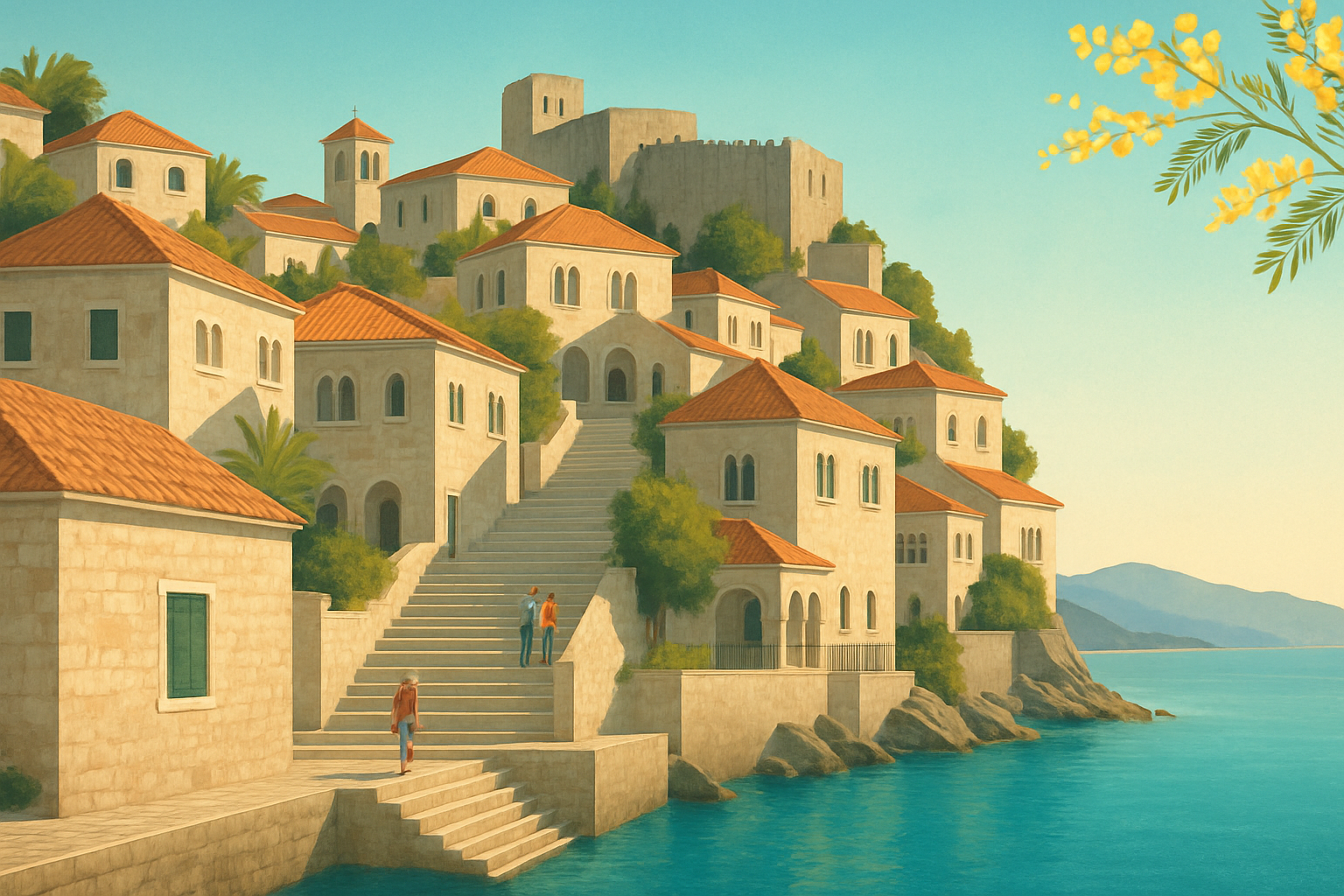
The geography is the first thing to understand. Herceg Novi doesn’t sit flat against the water — it rises sharply from sea level to around 150 meters over a very short horizontal distance, and each level has a different character. The seafront promenade (the Šetalište) runs west from the main harbor and is pleasant enough, but the old town is up the hill, reached by a steep staircase that most day-trip bus tours never bother with.
The Stari Grad is compact: a fortified medieval quarter with two Venetian-era towers — Forte Mare at the waterfront and Kanli Kula slightly above — and a central square, Belavista, where an Ottoman clock tower built in 1667 and a Baroque church from the early 1700s sit within about 40 meters of each other. That overlap is the physical result of Herceg Novi having changed hands between Bosnian nobles, the Ottomans, the Spanish, Venice, Russia, and eventually the Austro-Hungarian Empire before WWI. The architecture doesn’t try to reconcile itself — it just accumulates.
Kanli Kula Is the Reason to Climb
The Kanli Kula fortress — the name translates roughly as “Bloody Tower,” a reference to its use as an Ottoman prison — is the most underrated single stop in town. It sits above the old town on the hillside, about fifteen minutes on foot from Belavista Square, and gives you an unobstructed view across the entire mouth of the bay: the water, the Prevlaka peninsula on the Croatian side, and on clear days the open Adriatic further west.
Because the fortress now operates as an open-air theatre in summer, the interior is actually well-maintained and walkable — not the overgrown ruin you get at a lot of similarly-situated sites. A good portion of the perimeter walls are intact enough to walk along.
Entry runs a few euros, and there’s almost never a line. That last part isn’t a caveat — it’s the point. You can spend 45 minutes here without being jostled, which is a rarer thing in this part of the Adriatic than it should be.
The Mimosa Problem (and Why It’s Actually Useful)
Herceg Novi brands itself heavily around mimosa — the tree, not the drink. The Mimosa Festival runs late January into early February, timed to when the trees along the seafront promenade are in full bloom, and the town treats it as a real event rather than just a naming exercise. If your dates happen to fall near that window, it’s worth knowing: the weather is mild (10–14°C is typical for the bay in February), the crowds are minimal by any other comparison point, and hotel rates drop substantially from summer highs.
The broader point is that the Bay of Kotor generally is far more manageable from November through March. Kotor’s old town gets genuinely claustrophobic in July and August — cruise ships dock and funnel thousands of passengers into the same 500-meter radius. Herceg Novi in that same peak window is busy but functional. Off-season, both towns are excellent; Herceg Novi is just more honest about what it is when it’s not performing for summer tourists.
Getting There and Getting Around
From Dubrovnik, Herceg Novi is about an hour by bus, crossing the Croatian-Montenegrin border at Debeli Brijeg — typically 10–20 minutes outside peak summer, potentially longer in August when Adriatic coastal traffic backs up. From Tivat Airport (IATA: TIV), a taxi or rideshare runs 45 minutes to an hour depending on traffic through the bay’s winding single-road geography.
Within the bay, the Kamenari–Lepetane car ferry is the logistics detail most people miss. It cuts significantly off the drive between Herceg Novi and Kotor, runs frequently, costs a few euros, and saves you from the full loop around the bay’s southern end. If you’re splitting time between the two towns, take the ferry at least one direction rather than driving the whole bay twice.
Herceg Novi itself is walkable if you’re staying near the old town, but the hillside climbs are steep. The staircase access to the Stari Grad is the primary route and it’s not gradual — worth factoring in if mobility is any kind of consideration.
Where to Base Yourself
The choice is essentially seafront versus old-town hillside. Seafront accommodation puts you closer to ferry connections and the bus station; hillside or old-town-adjacent places put you closer to the Stari Grad and Kanli Kula, which is where the actual time goes.
For a two-night stay, old-town-adjacent makes more sense. The walk down to the seafront is easy; walking up from a seafront hotel to the old town twice a day adds up faster than it looks on a map. There are small guesthouses and apartments around Belavista Square that book quickly in peak summer but have good availability any other time. Book directly with smaller properties where possible — the price difference over the major OTA platforms is often meaningful enough to be worth the extra email.
Day Trips Worth Considering
Kotor is the obvious one — 45 minutes by car through the bay, or longer via the ferry route. The old town walls climb is worth doing once, early morning before the cruise-ship crowd arrives (ships typically dock late morning). It’s a 1,350-step ascent to the fortress of San Giovanni, takes about 45 minutes going up, and the views down into the bay are genuinely dramatic. Go early and it’s one of the better things you can do in Montenegro; go at noon in August and it’s a very different experience.
Perast, a smaller Baroque village further into the bay, is about 40 minutes by car from Herceg Novi and has two island churches sitting in the middle of the bay — Our Lady of the Rocks is the man-made one, built over centuries on a shoal that locals reinforced by sinking ships on a specific feast day each year. Reaching the islands requires a local boat from Perast’s waterfront, which runs frequently in season and is easy to arrange on the spot.
On the Croatian side, Cavtat — a smaller town about 20km south of Dubrovnik, with its own old town on a peninsula — is roughly 45 minutes from Herceg Novi and worth an afternoon if you want the Croatian coast without the full Dubrovnik machinery.
One Honest Caveat
If the primary goal is a beach holiday, Herceg Novi isn’t the strongest option in Montenegro. The town has pebble beaches and concrete platforms; the water clarity in the bay is genuinely good, but Budva has far more beach surface and a livelier night scene for that purpose. Herceg Novi’s value is the history, the hillside character, and the position as a western base for exploring the bay. Arrive expecting that and you won’t feel misled.
Two nights is the right amount of time. One night doesn’t get you above the Stari Grad. Before you book anything else, sort out whether you’re coming in summer or off-season — that single variable changes the experience more than any specific site recommendation on this list.