
Salta, Argentina: The Northwest That Most Southern Cone Itineraries Skip
View larger map | Map data © OpenStreetMap contributors
Most Argentina itineraries look like this: Buenos Aires, then Patagonia, maybe Mendoza for wine. Salta sits 1,500km north of Buenos Aires at 1,187 meters, anchoring a corner of the country that looks nothing like the Pampas and gets a fraction of the foreign visitors. That’s not a hidden-gem cliché — it’s a routing problem. Getting there takes either a two-hour flight from Buenos Aires or an overland push that most travelers don’t want to do on a fixed schedule. Fix the routing, and Salta rewards three days easily.
The City Itself First
Salta’s centro is one of the better-preserved Spanish colonial centers in South America — not because everything is restored to a museum shine, but because the scale still feels like a working city rather than a stage set. The Plaza 9 de Julio is the organizing point: the cathedral on the eastern side is painted a shade of salmon-pink that photographs absurdly well but is genuinely that color in person, not a filter. The MAAM (Museo de Arqueología de Alta Montaña) on the plaza’s north side is the single most important stop in the city and possibly in the country for pre-Columbian history.
The MAAM houses three Inca child mummies recovered from the summit of Volcán Llullaillaco in 1999 — at 6,739 meters, the highest archaeological site in the world. Only one mummy is displayed at a time, rotating every few months. The preservation is extraordinary, and the museum’s ethical framing is careful: it acknowledges the ongoing disagreement among indigenous communities about whether the remains should be on display at all. Worth knowing before you go, not as a reason to skip it, but because the context makes the visit more meaningful rather than just macabre.
Cerro San Bernardo: Cablecar or Steps
There’s a teleférico (gondola) up Cerro San Bernardo, and there are 1,070 steps if you’d rather earn the view. The steps take around 40 minutes at a reasonable pace and most of the climb is shaded. The view over the city and the mountains to the west is genuinely good — this is one of those overlooks that earns the effort rather than just giving you a slightly elevated angle of a parking lot. Ride the teleférico down if your knees don’t want the stairs both ways; the ticket is cheap either direction.
Day Trips Worth Structuring Around
Quebrada de Humahuaca
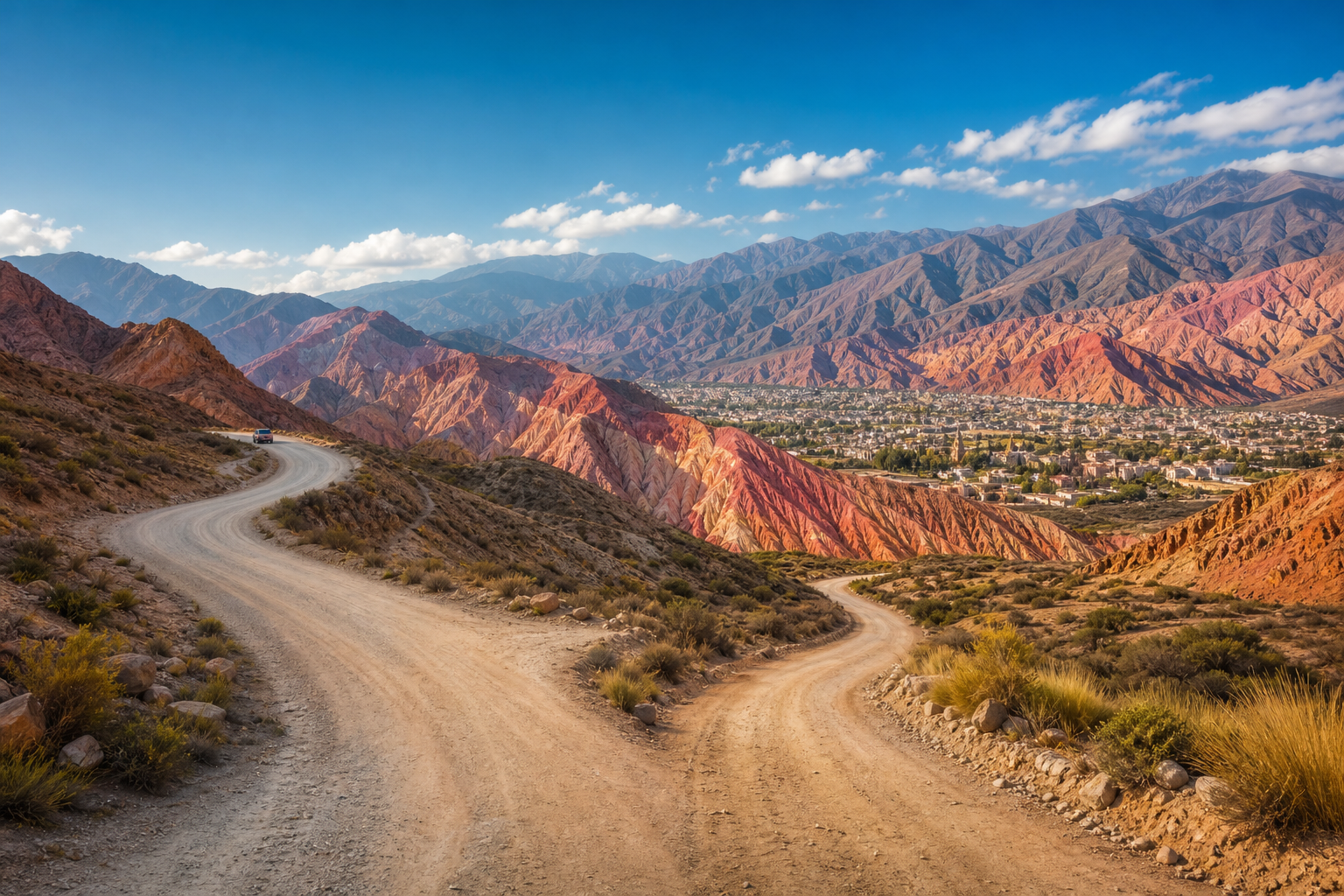
The Quebrada de Humahuaca is a UNESCO World Heritage valley running north from the town of Jujuy, about 90km from Salta. The polychrome geology — the Cerro de los Siete Colores above Purmamarca being the most photographed section — is real and worth it, but the area works better as two days than one rushed loop. Purmamarca itself has a small artisan market that sells the same things as every other Andean market in South America, but the surrounding rock formations at dawn, before the tour buses from Salta arrive around 10am, are genuinely quiet and strange in the best way.
Tilcara, further north in the valley, has a pre-Inca hilltop fortress — the Pucará de Tilcara — that takes two hours to explore properly and draws far fewer visitors than the colored hills. If you’re choosing between the two, Tilcara gives you more actual history and fewer tour groups. Ideally you’d do both by sleeping in the valley rather than day-tripping from Salta.
The Cafayate Loop
The road south from Salta through the Quebrada de las Conchas toward Cafayate, then back north through Cachi, is one of the better multi-day drives in South America if you have a rental car. The Conchas formations are wind-eroded sandstone that reads as vaguely Martian; Cafayate produces Torrontés, a white grape variety that’s essentially Argentina’s own and grows almost nowhere else in the world. Whether wine is the draw or not, Cafayate as a town is worth a night: smaller than Salta, slower, and bodega visits here are walk-in rather than pre-booked. The cloud forest (Yungas) you pass through on the descent out of Salta before the terrain dries back out is its own thing entirely — subtropical and dense in a way that feels completely disconnected from the quebrada landscape an hour later.
Food Worth Actually Seeking Out
Salta has its own regional food culture that’s distinct from Buenos Aires, and the difference matters. Tamales salteños are masa-wrapped packages of meat and egg, steamed rather than baked, sold from market stalls and small restaurants around the Mercado San Miguel. Locro — a slow-cooked stew of corn, beans, and meat — is a winter staple across the northwest; ordering it in August in Salta is the right move, ordering it in Buenos Aires in January is the tourist version. The Mercado San Miguel is a genuine food market rather than a tourist recreation, and the empanadas here (fried, filled with hard-boiled egg) are the local style that’s noticeably different from what you get in Buenos Aires or Mendoza.
Practical Timing
The northwest has distinct dry and wet seasons. May through October is dry, clear, and cooler — peak season for a reason, because the quebrada colors read sharper under blue skies and road conditions are reliable. November through April brings rain, which can make unpaved mountain roads genuinely impassable after a storm; some of the more remote valley routes get cut off for days at a time, not hours.
Altitude isn’t a serious problem in Salta city at 1,187m — most people adjust within half a day. It becomes relevant if you push further north toward Salinas Grandes at around 3,450m or anywhere near Llullaillaco. Same basic protocol as anywhere in the Andes: move slowly on day one, stay hydrated, and don’t schedule a strenuous hike for your first afternoon if you’re flying in from sea level.
Flights from Buenos Aires Aeroparque (AEP) to Salta (SLA) run multiple times daily and take around two hours. That’s the routing fix that makes Salta genuinely accessible without losing a full travel day to ground transport.
One Honest Caveat
Salta’s tourist infrastructure has gentrified quickly, and some of the boutique hotels and wine bars near the centro now charge prices that don’t match what the city actually delivers compared to Mendoza. The regional food at the market is excellent and cheap; the “elevated” Andean cuisine at the higher-end restaurants near the plaza is often the same ingredients dressed up with a pricing structure that’s hard to justify. Eat at the market, stay somewhere mid-range, put the saved money toward a rental car for the quebrada loop.
If Salta isn’t on your southern cone draft yet, look at what’s filling that equivalent time — it’s probably a second city that gives you roughly the same thing as the first. The northwest doesn’t.