
Most Peru itineraries look like this: Lima, Cusco, Machu Picchu, maybe Arequipa or the Sacred Valley if there’s time. Cajamarca doesn’t appear on that list despite being the place where Francisco Pizarro captured the Inca emperor Atahualpa in 1532 — the single event that unraveled the largest empire in pre-Columbian American history. That it gets skipped this consistently says more about how itineraries calcify around famous names than about what’s actually worth seeing.
View larger map | Map data © OpenStreetMap contributors
The city sits at around 2,750 meters in Peru’s northern highlands — high enough that you’ll feel it coming from sea level, but meaningfully lower than Cusco’s 3,400 meters. If altitude has derailed a trip for you before, that gap matters. Acclimatizing in Cajamarca first is a practical argument for routing north-to-south rather than the standard reverse.
The Plaza de Armas and the Room That Changed Everything
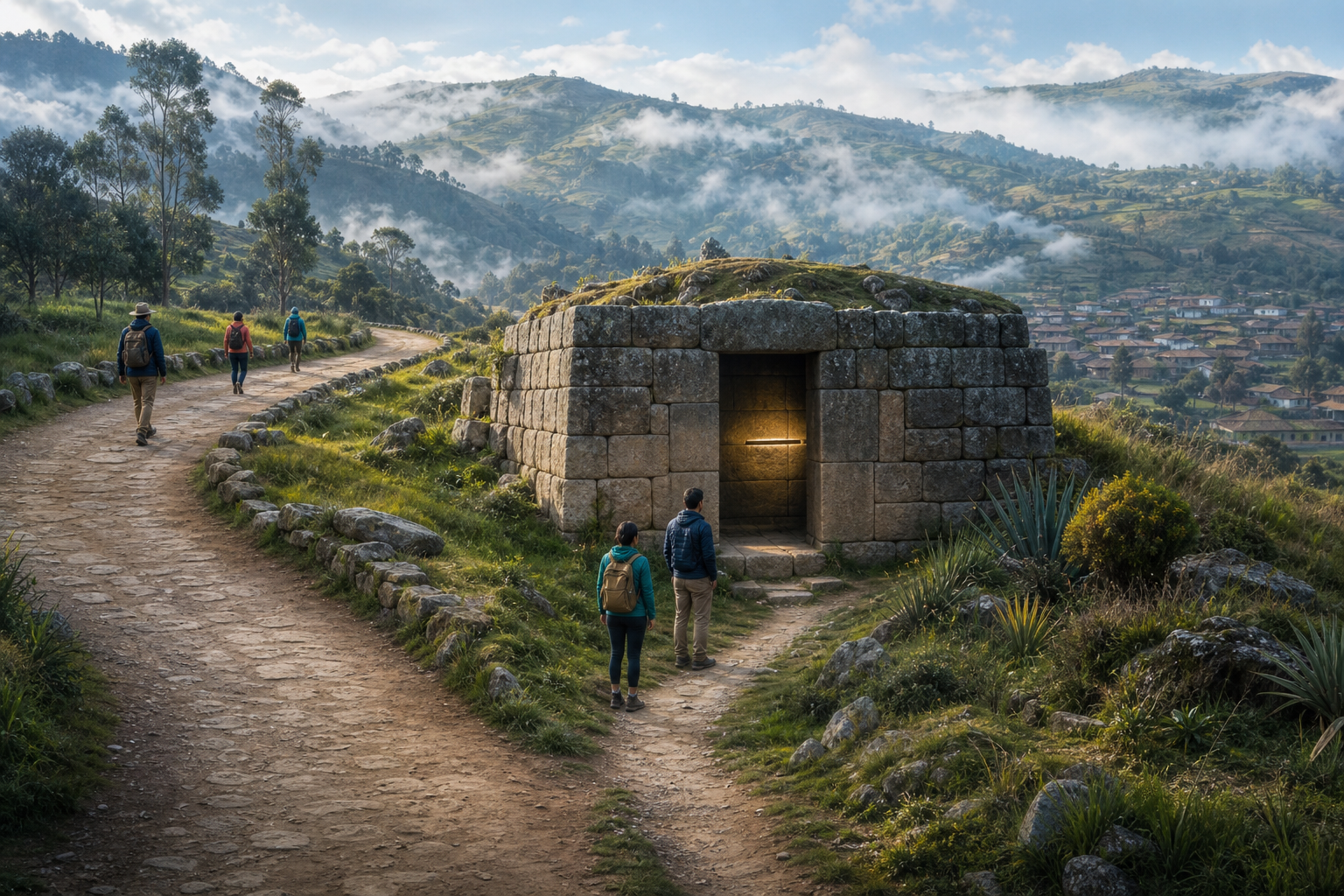
The Cuarto del Rescate — the Ransom Room — is the one non-negotiable. Atahualpa offered to fill the room once with gold and twice with silver in exchange for his freedom. Pizarro accepted, collected the ransom, then executed him anyway. The room still stands: a small stone chamber where you can see the line scratched into the wall showing how high Atahualpa promised the gold would reach. It’s the only surviving Inca structure in Cajamarca, and standing in it is genuinely disorienting in a way no museum exhibit replicates.
Entry requires a combined boleto turístico covering several sites — buy it at the Cuarto del Rescate itself or at the tourist office on the Plaza de Armas. The room isn’t large and the site isn’t crowded the way Inca Trail waypoints are, which makes it easier to actually think about what you’re looking at rather than waiting for tour groups to clear.
The Plaza de Armas itself is one of the better colonial squares in Peru. The Cathedral and the Iglesia San Francisco face each other across it — the Cathedral took 300 years to build, which shows in the way the facade’s ornamentation changes registers as it goes up. Neither church is the most spectacular you’ll see in South America, but the square functions as a real center of city life rather than a preserved tourist zone, and that makes the difference.
The Baños del Inca
Six kilometers east of the center, the Baños del Inca thermal baths are where Atahualpa was camped when Pizarro arrived in 1532. Original Inca stonework channels are still visible in places. Today it’s a functioning thermal complex — you can rent private pools fed by geothermal springs that emerge at around 72°C and are cooled to usable temperatures before reaching the water.
Skip the public pools. The private cabins, rented by the hour, are quieter, cleaner, and give you enough time in the water for it to actually mean something. Go early — the complex opens at 5am, and the hour between 5 and 6am on a cold Andean morning, hot water, fog on the hills, is not something you’d stumble onto by following a standard itinerary.
Cumbe Mayo and the Pre-Inca Aqueduct
Twenty kilometers southwest of Cajamarca, at around 3,500 meters, Cumbe Mayo is a pre-Inca ceremonial site built around a stone aqueduct that dates to roughly 1000 BCE — placing it among the oldest man-made structures in South America. The engineering is the genuinely interesting part: the channel cuts through rock with 90-degree turns deliberately designed to slow the water’s flow and prevent erosion. They worked this out without modern surveying tools, and the channel still functions.
The landscape around it is also unusual — eroded rock formations the locals call los frailones (the friars) rise from the grassland in irregular columns, and in the afternoon, clouds move through at eye level. Guided tours leave from Cajamarca’s Plaza de Armas most mornings, or you can hire a taxi and negotiate waiting time. The final stretch of road isn’t paved, but standard vehicles manage it fine in dry season.
One real caveat: if you’ve come straight from sea level, Cumbe Mayo at 3,500 meters will remind you of that immediately. Save it for day two or three rather than your first afternoon in the city.
Food and the Cajamarca Dairy Culture
Cajamarca produces most of Peru’s artisanal cheese, and dairy is genuinely central to the food culture here in a way that’s unusual for the country. The local manjar blanco — a cooked milk caramel similar to dulce de leche but with a denser, drier texture — shows up in shops throughout the center. The Mercado Central on Amazonas has the most concentrated version: stalls with fresh white cheese, manjar in ceramic jars, and chicha de jora alongside standard market produce.
For meals, the blocks around the Plaza de Armas cover the range from set lunch menus aimed at locals — cheap, filling, soup followed by a meat dish and rice — to slightly more polished restaurants on the tourist circuit. Order the caldo verde wherever it appears: a potato-based soup with local cheese melted in, regional to the north, and absent from most Peru itineraries for exactly that reason.
Getting There and How Long to Stay
Cajamarca has its own airport (CJA), with daily flights from Lima on LATAM and Sky Airline — roughly 1 hour 20 minutes. There’s no direct connection from Cusco, which is part of why it stays off the standard loop. If you’re building a Peru trip from scratch, routing Lima → Cajamarca → Trujillo (on the coast, for the Chan Chan adobe ruins) → south gives you a completely different country than the Cusco-centric version, and sidesteps the serious altitude problem almost entirely.
Two full days is the minimum. Three is better if you want to do Cumbe Mayo without rushing and still have an unhurried morning at the Baños del Inca. The city is small enough that you don’t need to plan obsessively, but it functions as a real city rather than a heritage site with services attached.
High season runs June through August — drier, clearer, busier. The Carnival celebration in February draws visitors from Lima specifically for it, and accommodation books out weeks ahead in that window. The rest of the year is wetter but navigable; the Andean rainy season typically means afternoon showers rather than all-day rain, so mornings are generally still workable.
Cajamarca is the place where the history that made Cusco what it is actually happened. Almost nobody goes there to see it. That’s worth sitting with before you point your itinerary straight south from Lima out of habit.