
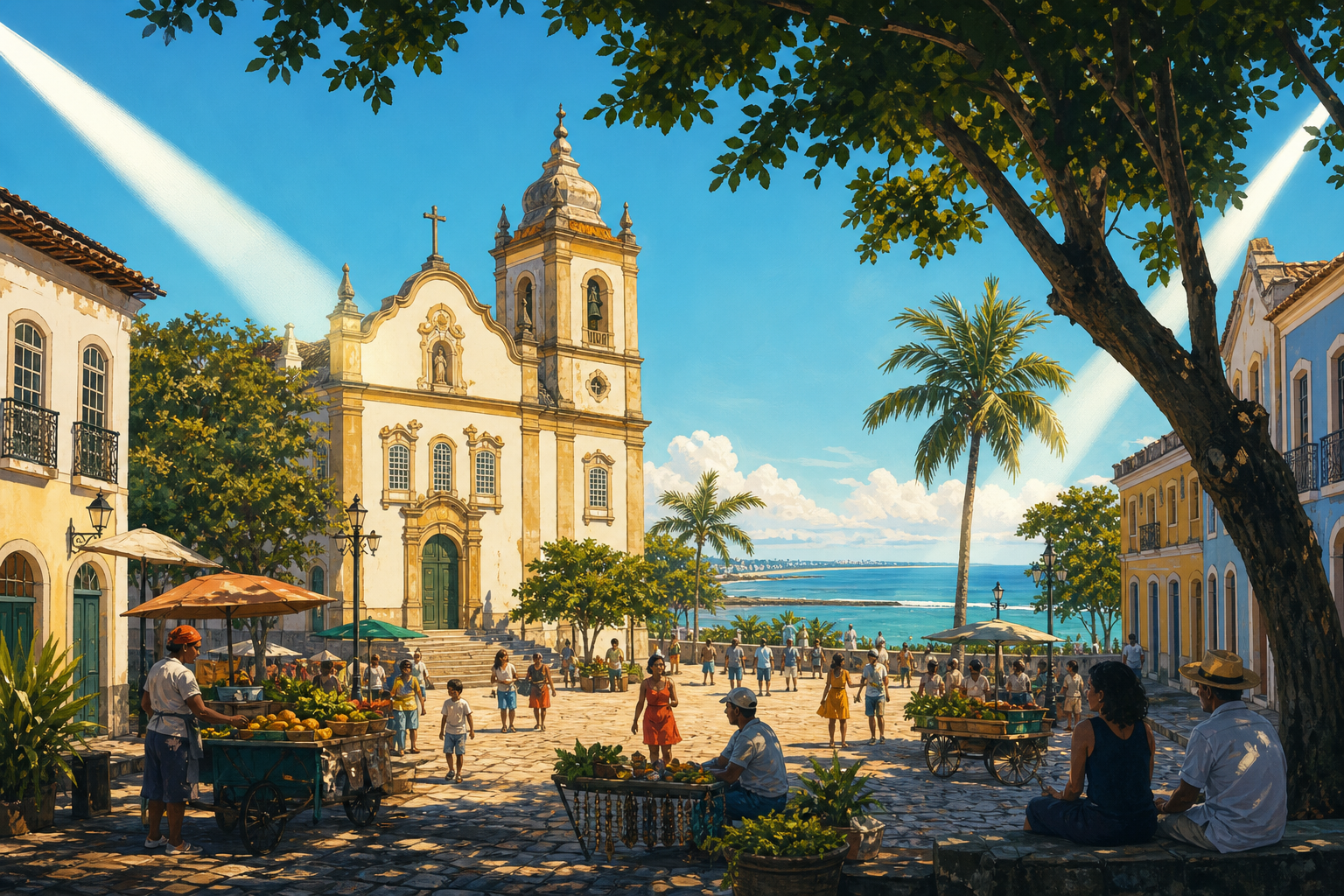
Why João Pessoa Keeps Getting Skipped
View larger map | Map data © OpenStreetMap contributors
Recife gets the flights. Natal gets the dune-buggy tourism. João Pessoa, capital of Paraíba state and technically the easternmost city in the Americas, sits between them and gets almost no international attention — which is exactly why it’s worth going.
The city has around 800,000 people, a colonial center that’s genuinely intact rather than partially preserved for tourists, and a stretch of Atlantic coastline where the reefs flatten the surf and turn the water the kind of green-blue that makes people assume the photo has been edited. It hasn’t. The iron content in the reef algae actually does that.
One honest caveat upfront: there’s no Pelourinho-style centrepiece here, no Carnaval circuit drawing international crowds. What the city has is a coherent, walkable old center that hasn’t been sanitized for visitors, beaches that don’t require an hour’s transfer to reach, and food that’s specific to the Nordeste without being packaged for export. If your trip needs a headline attraction, look elsewhere. If you want two or three days of a Brazilian city operating at its own pace, this works well.
The Historic Center: What’s Actually Worth the Walk
The Centro Histórico is small enough to cover on foot in a morning. The Igreja de São Francisco is the obvious anchor — a Franciscan complex that took over two centuries to complete, with azulejo tile work covering the interior walls and a cloister that’s quieter than its counterpart in Olinda. Most visitors treat it as a ten-minute photo stop. Spend thirty instead, because the detail in the carved cedar altarpieces disappears if you’re moving fast.
Praça João Pessoa, the main government square, has the 18th-century governor’s palace and a handful of buildings that survived Brazil’s colonial period without being knocked down or badly restored. It’s a working square — civil servants walking between buildings, vendors selling tapioca from carts — not a preserved-for-tourism set piece.
The Mercado Central is worth an hour, less for shopping and more for the stalls selling dried meat, rapadura (raw cane sugar), and bags of farinha that make clear you’re in a different food culture than São Paulo or Rio. Buy the caju (cashew fruit) juice if it’s available fresh — the carton version sold elsewhere in Brazil tastes nothing like the real thing.
The Beaches: Which Ones and When
Praia de Tambaú is the city beach — urban, accessible by local bus from the center, lined with informal beach bars (barracas) that sell cold Skol and grilled fish by weight. It’s crowded on weekends. That’s not necessarily a reason to avoid it; that’s what a real city beach looks like.
Praia do Jacaré, about 25 kilometers north, is where the Rio Paraíba meets the sea, and it has a specific ritual that borders on the absurd: every evening around sunset, a man named Maneco Esquentado plays saxophone on a small boat while the sun drops behind the dunes and tourists applaud. It sounds like something invented for a tourism brochure. It has been happening daily for decades. It’s worth going once, partly for the sunset, partly because it’s a genuinely strange and specific thing that exists only in this one place.
Praia de Coqueirinho, further south toward the Pernambuco border, requires a car or a hired driver — about an hour from the city. The reef system here creates natural tidal pools large enough to swim in at low tide. Check a tide table before you go; at high tide the pools disappear entirely and you’re left looking at surf crashing on rock.
Getting the Timing Right
João Pessoa’s dry season runs roughly July through January — the Northeast trades on that inverted calendar compared to the south. June and July are peak months locally because São João festival season drives domestic travel hard, which means accommodation fills up and prices climb. February and March bring rain but also fewer visitors and lower rates. The rain tends to come in concentrated afternoon bursts rather than all-day grey, so mornings are usually workable even in the wet season.
Food Worth Seeking Out
The Nordeste has its own distinct culinary logic, and João Pessoa is a good place to eat it without paying Recife prices. Baião de dois — rice and beans cooked together with coalho cheese and dried meat — is on menus everywhere, but quality varies considerably. The versions at lunch-only places (look for the hand-painted signs reading prato feito) are consistently better than anything served in the evening at restaurants aimed at tourists.
Tapioca here is not the boba tea version. It’s a flatbread made from hydrated tapioca starch, cooked dry on a griddle, filled with cheese or shredded coconut or carne de sol. You can eat one for breakfast for a couple of reais from a street cart and it will be better than most things you’ll eat in a sit-down restaurant. This is not an exaggeration.
The fish is genuinely good because the city is genuinely on the coast. Lobster from the Paraíba coastline is cheaper here than anywhere you’ll find it in São Paulo, and considerably fresher.
Getting There and Getting Around
Aeroporto Internacional Presidente Castro Pinto (IATA: JPA) handles direct flights from São Paulo, Rio, and Brasília. There are no direct international routes that I’m aware of — most international visitors come through Recife (REC), about 120 kilometers south and reachable by bus in roughly two hours. The Recife–João Pessoa bus connection runs frequently and costs very little; it’s the obvious pairing if you’re flying into the Northeast from outside Brazil.
Within the city, 99 and Uber both operate and work fine. The local bus network covers the main beaches but runs slowly and the routes aren’t intuitive if you don’t speak Portuguese. A hired driver for a full-day beach run north or south is worth the cost — negotiate a flat rate rather than using the meter for longer trips.
Where to Stay
Most accommodation clusters around Tambaú beach, which is convenient for the coast but a twenty-minute taxi from the historic center. If the old city is your primary interest, look for pousadas in Miramar or Beira-Rio — smaller, quieter neighborhoods that put you closer to the Centro Histórico without needing a car to reach it.
If you’re booking in the Tambaú area, check the actual beach access before you confirm — a few of the larger hotels face the lagoon rather than the open sea, which matters if the beach is why you came.
Two full days is enough to see João Pessoa without rushing. Three is comfortable if you’re adding a day trip south to Coqueirinho. Beyond that, a bus north to Natal or south to Recife makes more sense than staying put — both cities have their own logic, and the region rewards moving through it rather than anchoring in one place.
The question worth sitting with before you book: are you comfortable in a city that doesn’t perform for visitors? Because João Pessoa genuinely doesn’t — and that’s either its biggest draw or its biggest limitation depending on what you want from a trip.