
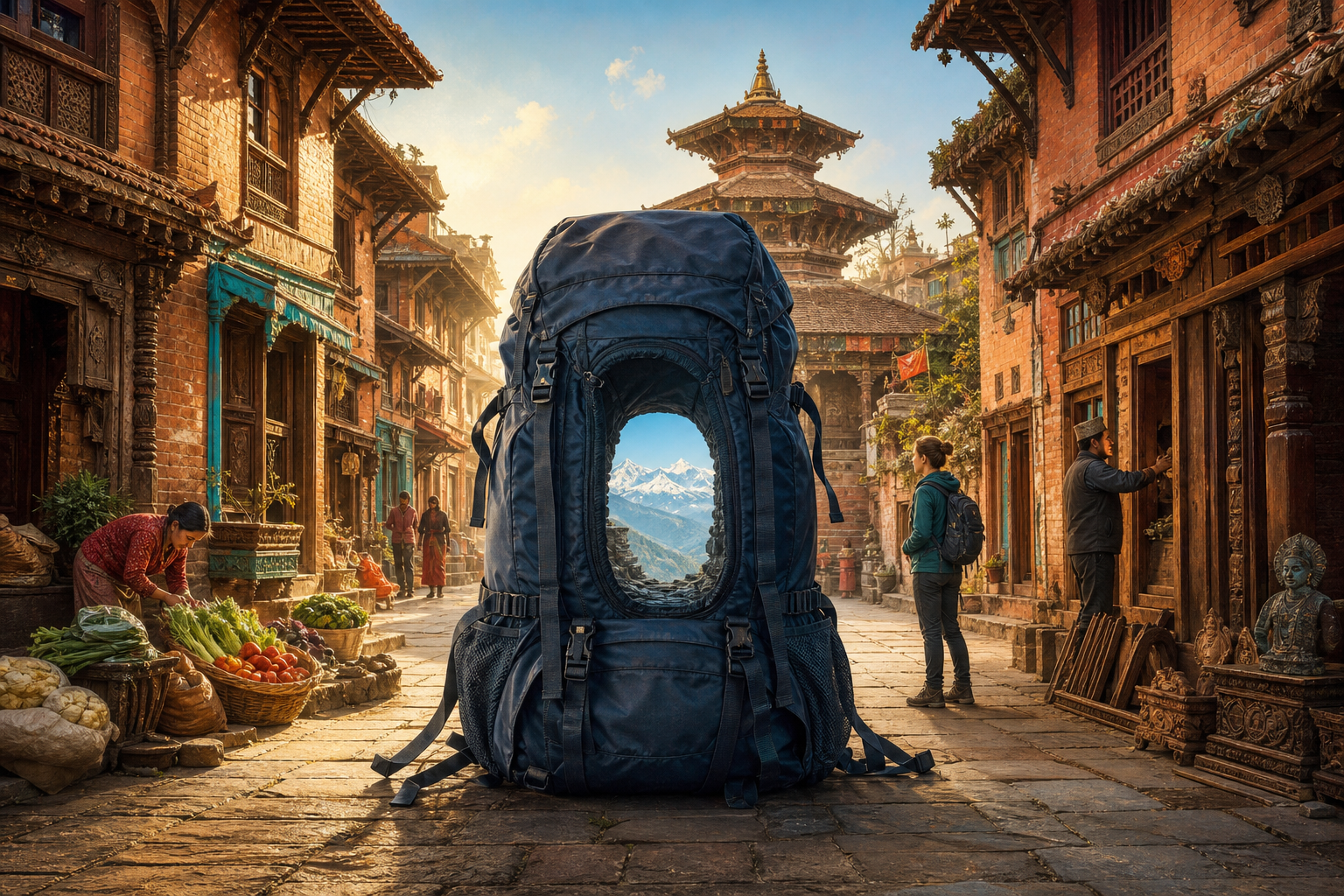
Most people who pass through Kathmandu treat it as a gear-shopping, permit-filing layover before the real trip begins somewhere above 3,000 meters. That framing isn’t wrong exactly — but it means they spend two days in Thamel hunting down a down jacket and leave with almost no sense of the actual city. Kathmandu is a proper, strange, ancient place, and most trekking itineraries completely fail to use it correctly.
View larger map | Map data © OpenStreetMap contributors
The Old City Is Not the Tourist Quarter
Thamel is where the trekking agencies and gear shops cluster. It’s also where the streets smell like pizza because someone figured out decades ago that altitude-anxious Westerners want comfort food before they go suffer voluntarily. Spend a night there if you need to sort logistics. Don’t confuse it with Kathmandu.
The old city starts at Indra Chowk, roughly ten minutes’ walk south, and doesn’t stop rewarding you until you’ve crossed into Patan. The street pattern in this part of the city genuinely dates to medieval urban planning — narrow, irregular lanes between brick-and-timber buildings where the ground floors are still active workshops and shops. Metalworkers, fabric merchants, dried goods sellers. Not a recreation; the actual working city. The Ason intersection is one of the more kinetic market crossings in South Asia, and it costs nothing to just stand there and watch for twenty minutes.
Durbar Square: Which One, and What You’re Actually Looking At
There are three Durbar Squares in the Kathmandu Valley — Kathmandu, Patan (Lalitpur), and Bhaktapur — and most first-time visitors only go to one and don’t really understand what they’re looking at when they get there.
Kathmandu’s Durbar Square was badly damaged in the 2015 earthquake. Some of the most important structures, including the Kasthamandap pavilion that gave the city its name, collapsed entirely and are being rebuilt. That’s not a reason to skip it — the remaining structures are still genuinely extraordinary, and the active restoration work is itself interesting to watch — but go in knowing you’re seeing the square at an incomplete moment, not its historic full form.
Patan’s Durbar Square, across the Bagmati River in Lalitpur, is in considerably better shape and arguably more concentrated. The density of 17th-century Newari temple architecture in that single courtyard is hard to overstate. The Patan Museum inside the old royal palace is one of the better-curated museums in the region — not the usual underfunded-but-well-meaning situation you find elsewhere. It’s worth two hours, not a quick scan.
Bhaktapur requires a half-day and a separate entry fee (around $15 USD for foreign visitors at time of writing — verify before you go, it changes). It’s the most intact of the three medieval cities in the valley. The earthquake affected it too, but the overall urban fabric survived better than in Kathmandu proper. If you only have time for one day outside the immediate city center, Bhaktapur is the clearest choice.
Boudhanath and Pashupatinath Are Not Interchangeable Day Trips
Both get listed in the same paragraph in most itineraries, as if they’re a matched pair you tick off together. They are completely different in character and deserve separate mental framing.
Boudhanath is one of the largest Buddhist stupas in the world — a 36-meter whitewashed dome ringed with 108 small niches. The circuit (kora) around the base is a living religious practice: Tibetan Buddhist monks, Newar Buddhists, and pilgrims from across the Himalayan world walk it in the early mornings and evenings. Go at 6am and you’ll be mostly walking among people who are there for reasons that have nothing to do with tourism. By 10am the tour groups arrive. That’s the whole calculation.
Pashupatinath is a Hindu temple complex on the Bagmati River — one of the holiest Shaivite sites in the world, and where Kathmandu’s cremation ghats operate. Bodies are burned at the riverbank ghats daily, in public, in keeping with Hindu custom. It is not a performance for tourists. The appropriate response is to be quiet, not photograph the deceased or the grieving family, and accept that you are a visitor to something that isn’t about you. That should go without saying, but the behavior at the ghats is sometimes genuinely poor. The complex itself (not the inner sanctum, which is restricted to Hindus) rewards a slow walk — the sadhus along the ghats, the subsidiary temples, the monkey-populated hill across the river — though be prepared to navigate real hustle near the main entrance.
Swayambhunath in the Morning, Not the Afternoon
The Monkey Temple sits on a hill west of the city and requires climbing 365 stone steps. The hilltop complex has an ancient stupa, several temples, and a large population of rhesus macaques that will take food directly out of your hands if you’re not paying attention. The views across the valley are worth it — if the haze cooperates, which it often doesn’t by midday when particulate pollution from traffic accumulates in the bowl of the valley. Go before 8am and the light is better, the crowds are smaller, and the city below is still mostly quiet.
The Food Is Not What Most Travelers Spend Time On — That’s a Mistake
Thamel has made a generation of visitors think Nepali food means dal bhat (lentils and rice), which is both true and misleading. Dal bhat is genuinely good when made properly and eaten where locals eat it, not in a tourist-optimized version. But Kathmandu’s Newari cuisine is a separate and considerably more complex tradition — buff (water buffalo) dishes, chatamari (a rice crepe that “Newari pizza” badly undersells), sukuti (dried meat), aila (a traditional grain spirit). The old city neighborhoods around Kel Tole and the alleys off Indra Chowk have small Newari restaurants that don’t make it onto most radar. They’re not secret, exactly, but finding them requires walking past Thamel and actually looking, which most people don’t do.
Altitude Is a Real Consideration Even in the City
Kathmandu sits at roughly 1,400 meters — not high enough to cause serious altitude sickness for most people, but high enough that if you’re flying in from sea level and immediately doing a lot of walking and stair-climbing across Swayambhunath, Boudhanath, and the hills around Bhaktapur, you’ll feel it more than you expect, especially layered on top of a significant time zone shift. This matters less for the city itself than it does for people using Kathmandu as their pre-acclimatization window before Namche Bazaar or Langtang. Either way, don’t schedule your most physically demanding days as day one.
Practical Notes
Most nationalities can get a visa on arrival at Tribhuvan International Airport (IATA: KTM) — bring a passport photo and USD or EUR cash as a backup even though they take cards. Air quality is the bigger variable: winter temperature inversions trap emissions in the valley and the difference from a clear October day is significant. Spring (March–May) and autumn (September–November) are the clearer windows, and they overlap with main trekking seasons for good reason. October and November accommodation books out faster than most visitors expect — don’t leave that until the last minute.
One honest caveat: Kathmandu can feel chaotic in a way that takes adjustment. The traffic, the noise, the density, the volume of hustle in Thamel — it’s a lot on day one. Most people who’ve spent real time there say the city clicks into focus somewhere around day three. If your itinerary only gives you two days before the bus to Pokhara, you probably won’t get there. That’s worth knowing before you book.
Give the city at least three nights before anything else — and spend at least one of them not in Thamel.