
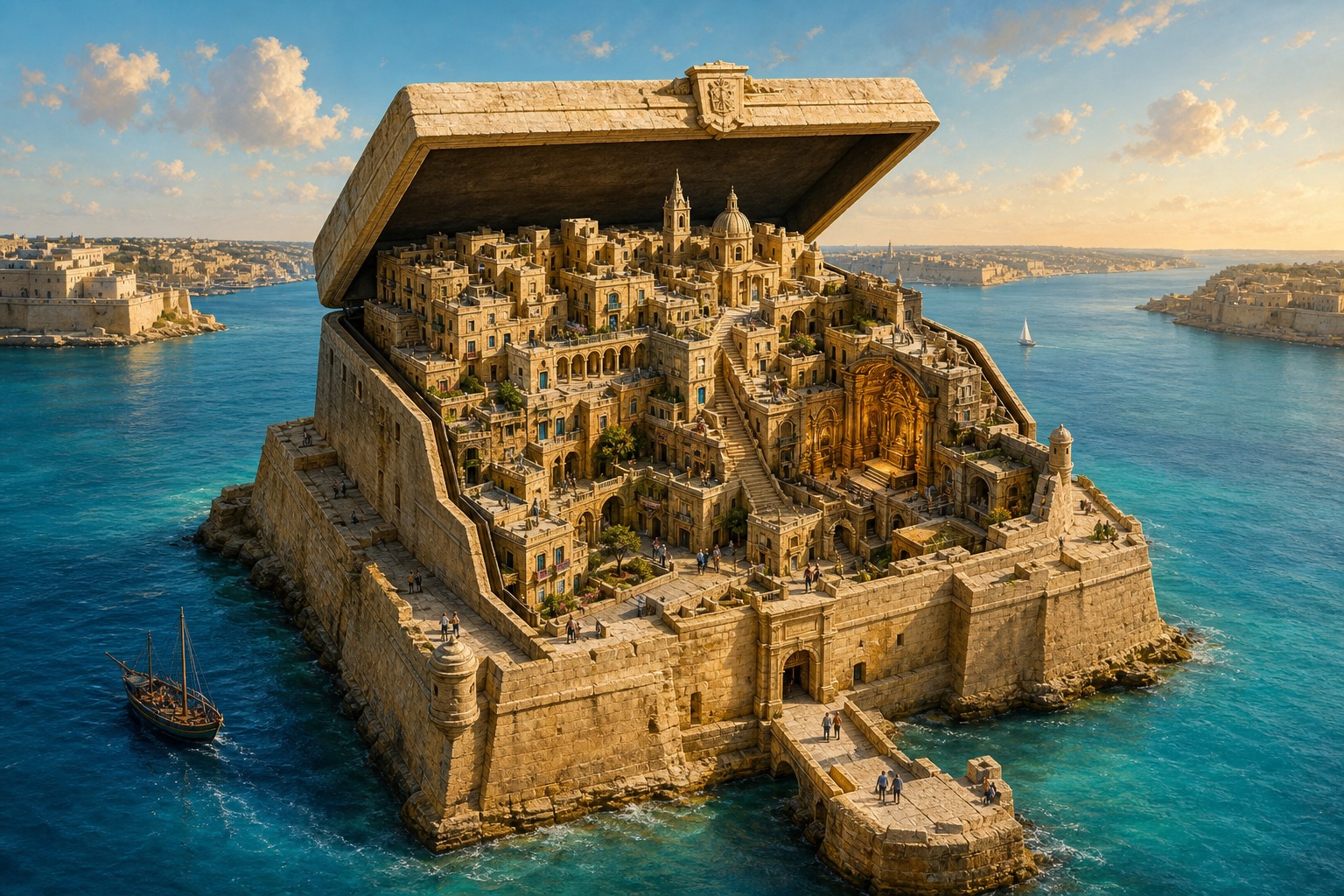
Europe’s Smallest Capital Has a Density Problem — in the Best Way
View larger map | Map data © OpenStreetMap contributors
Valletta fits inside roughly one square kilometer. The entire city is a UNESCO World Heritage Site. Those two facts together mean almost every street you walk down has something genuinely old on it, and the problem isn’t finding things to look at — it’s figuring out what actually deserves time versus what you can walk past without guilt.
Most visitors spend half a day and leave. That’s enough to get a surface impression, but Valletta rewards at least two full days if you want to understand why the Knights of St. John built this place the way they did, and why the Maltese kept layering their own identity on top of it for the centuries that followed.
Start with the Co-Cathedral, But Actually Look at It
St. John’s Co-Cathedral is the single most important building in Valletta, and it earns that status honestly. The exterior is deliberately plain — a military-order aesthetic that signals nothing of what’s inside. Step through the door and the interior is one of the most aggressively ornamented spaces in Europe: every inch of the nave floor is a marble tombstone, the side chapels each dedicated to a different langue (the national divisions of the Knights), and the Caravaggio hanging in the oratory — The Beheading of Saint John the Baptist — is the largest painting he ever completed and one of the only works he signed, here in the blood of the painted Saint John.
Book tickets online before you go. The walk-up queue in summer is not theoretical.
The Upper Barrakka Gardens: Worth the Walk, Not Just the Photo
Every travel photo of Valletta shows the view from the Upper Barrakka Gardens across the Grand Harbour to the Three Cities — Vittoriosa, Senglea, and Cospicua — arranged on the peninsulas opposite. The photo doesn’t lie, but it also doesn’t convey what you’re actually looking at: one of the deepest natural harbors in the Mediterranean, ringed by fortifications built to withstand a siege that actually came. The Great Siege of 1565, Ottoman forces against the Knights, is the event the entire island still orientates its history around. The noon cannon salute fires daily, has since the 19th century, and hearing it while you’re looking down at the harbour does something to that history that reading about it doesn’t.
Cross the Harbour to the Three Cities
Most itineraries skip this. Don’t. The Three Cities — particularly Vittoriosa (Birgu) — predate Valletta itself. The Knights operated from Birgu before Valletta existed, and the Inquisitor’s Palace there is one of the best-preserved Inquisition buildings in the world, which sounds grim and is worth your time precisely because of that. The dungeons still have graffiti carved into the walls by prisoners.
Take the dgħajsa (traditional water taxi) across from the Valletta waterfront rather than going by road. The crossing takes a few minutes and gives you the harbour at water level — a genuinely different perspective from the elevated garden view, not just a scenic alternative. The boats are easy to find at the waterfront; the price is a short negotiation, nothing complicated.
Strait Street Tells You More Than the Museums Do
Strait Street — il-Kenur, or “the Gut” in British naval slang — ran through the city as its entertainment and red-light district during the era of the Royal Navy’s Mediterranean Fleet. Every sailor who passed through Malta in the 19th and 20th centuries knew this street. It’s narrow even by Valletta standards, a canyon of tall limestone buildings, and it went quiet after the British left in 1979. It’s been gentrifying slowly — bars and restaurants in buildings that used to be something else entirely — but it hasn’t been sanitized into a pedestrian mall. Walking it in the early evening when it’s starting to fill up is still the best way to feel the city’s layering: Knights’ grid, British colonial period, Maltese independence, current.
The Food Situation, Honestly
Maltese cuisine is genuinely its own thing, not Italian with a different flag. Ftajjar (Maltese flatbreads), fenek (rabbit, the national dish, stewed with wine and herbs), and ġbejniet (small sheep’s milk cheeselets, fresh or dried and peppered) are all worth seeking out in places that aren’t catering entirely to tourism. The waterfront facing the Marina has decent options but the pricing drifts there. The streets behind Republic Street — particularly toward the old market — have restaurants where the lunch crowd is actually Maltese office workers, and that’s a reliable proxy for both quality and price.
One practical caveat: Valletta is small enough that the genuinely good local spots are well-known and fill up. For dinner rather than lunch, book ahead even mid-week in summer. The island runs a substantial conference and events calendar, and the city can flip from quiet to fully booked faster than its size suggests.
Practical Logistics
Malta’s airport is at Luqa, about 8km south of Valletta. Taxis are metered and straightforward. Valletta itself is almost entirely walkable — which is the main argument for staying inside the city walls rather than in Sliema or St. Julian’s. Those neighborhoods are more hotel-dense but less interesting, and you’ll spend time on a bus or ferry for everything you actually came to see.
The best months are April–June and September–October: warm, dry, and not yet at the peak summer temperatures that push Valletta’s limestone streets into oven territory by midday in August. The city has limited shade, and this matters more than it sounds when you’re on foot for most of the day.
If you’re combining Malta with Sicily, the fast ferry from Valletta to Pozzallo runs about 90 minutes and operates regularly in season — one of the more civilized short sea crossings in the Mediterranean, and it makes the combination genuinely practical rather than aspirational.
One Thing to Push Back On
The “hidden gem” framing for Valletta is about a decade out of date. It was European Capital of Culture in 2018, there’s been real investment in the cultural infrastructure, and the waterfront redevelopment is significant and visible. This is not an undiscovered place.
What it is, consistently, is a city people underestimate in duration — treating as a stopover when it works better as a base. Two nights inside the walls, using Valletta as a center rather than a checkbox, is the version of this trip that actually pays off. And if you have the time, the ferry to Gozo from Ċirkewwa takes 25 minutes and delivers a pace the capital can’t. Worth a day, maybe two — but Valletta first.