
Paramaribo Is Probably Not on Your List. It Should Be.
View larger map | Map data © OpenStreetMap contributors
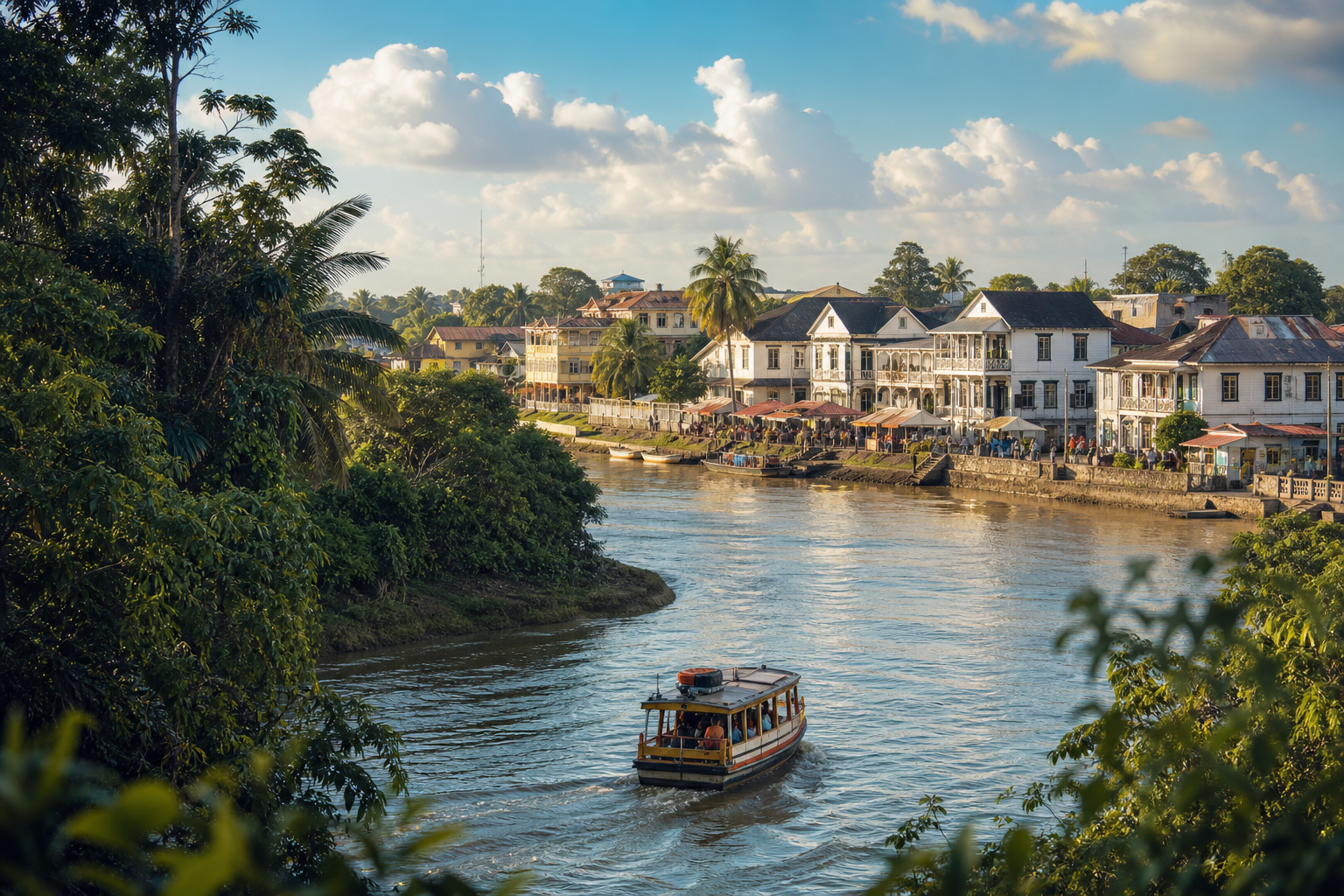
Suriname is the smallest country in South America, the only one where Dutch is the official language, and — with some regularity — the one that gets left off maps in continental roundups. Its capital, Paramaribo, sits on the Suriname River about 15 kilometers inland from the Atlantic coast, in a city that genuinely doesn’t look like anywhere else on the continent. The historic center is a UNESCO World Heritage site made up almost entirely of 18th and 19th-century Dutch colonial wooden buildings — not stone, not brick, wood — painted white and cream, set against the heat and noise of a functioning tropical city of around 250,000 people.
Most travelers skip it because of logistics. There are no overland border crossings worth the effort from neighboring Guyana or French Guiana, and the flight network is thin. Direct services run from Amsterdam; connections exist from the Caribbean and Miami. But you have to actually decide to go — it won’t happen by accident on a continent-wide swing — and that’s probably why it remains one of the more genuinely unhurried capitals in the hemisphere.
The Historic Center Needs Time, Not a Speed Walk
Fort Zeelandia, the 17th-century Dutch fort on the river bend, is the oldest surviving structure in the city and worth an hour of real attention rather than a photo from the road. The fort’s history runs well beyond colonial-era trade: it was used as a detention and torture site during the military dictatorship of the 1980s, and the small museum inside addresses that directly. It’s one of the more honest historical museums in the region, which is part of why it’s worth the visit rather than a quick exterior shot.
The wooden buildings of the inner city — particularly along Waterkant, the riverside esplanade — are in various states of repair, which makes walking them interesting rather than photogenic in a sanitized way. Some are immaculate government buildings. Others are clearly in slow decline. The Neveh Shalom synagogue, built in 1735 and one of the oldest synagogues in the Western Hemisphere still in active use, sits directly next to a mosque, the two institutions sharing a courtyard wall. That’s not a metaphor somebody invented — it’s geography, and it says something real about how this city’s population actually settled.
The Food Situation Is Unusual and Worth Pursuing Seriously
Suriname was a Dutch colony that used enslaved African labor, then brought in indentured workers from Java and from British India after abolition. The result is a population that includes significant Javanese, Hindustani, Creole, Maroon, Chinese, and indigenous communities, all of which have distinct culinary traditions that have been cross-pollinating in a city of this size for over a century.
The Central Market is the practical entry point — a working market, not a tourist recreation of one. The stalls inside and around it sell things you won’t find with this density anywhere else: pom, a Sephardic-Jewish Surinamese dish made with chicken and tayer root that worked its way into the broader Creole cooking repertoire; bara, Hindustani fried lentil fritters; Javanese soto, a turmeric-heavy broth that tastes genuinely distinct from Thai or Malaysian versions of the same base. The Javanese roti here — stuffed flatbreads with curried filling — is different enough from Indian roti and from Trinidadian roti to justify direct comparison, and the comparison is interesting.
One real caveat: the restaurant scene is uneven, and the best food is usually at market stalls or small family operations with no online footprint worth trusting. Budget time to wander rather than pre-booking, and ask at your accommodation for specific stall recommendations instead of leaning on review aggregators.
Going into the Interior: The Maroon Villages Are Not an Optional Add-On
The Surinamese interior — mostly dense Amazonian rainforest — is home to the descendants of escaped enslaved Africans who established independent communities in the jungle, known as Maroons. The Saramaka and Ndyuka peoples maintained autonomy for centuries, and their villages along the Suriname and Marowijne rivers are not historical recreations. They are functioning communities with distinct language, art, and governance traditions.
Getting there from Paramaribo typically involves road travel followed by river travel, with small boats handling the final stretches. The most commonly visited area is around Brownsberg Nature Park and the W.J. van Blommestein reservoir, roughly 130 kilometers south of the city. Longer trips to the Upper Suriname River villages take two to three days minimum and require more planning — but the payoff is real: Suriname has recorded over 650 bird species, a striking number for a country this size, and the level of cultural specificity in the interior communities is something most South American eco-tourism doesn’t come close to.
Worth asking before you book: some village visits are set up with genuine community involvement and revenue sharing; others function as tourism products that extract more than they return. Five minutes of direct questions to a tour operator is not overthinking it.
Practical Logistics
The local currency is the Surinamese dollar (SRD). Exchange rates from USD or EUR vary enough between banks and street cambios that checking before or just after arrival is worth doing rather than assuming parity. The city is hot and humid year-round, sitting about five degrees north of the equator. The drier periods — roughly February through April and August through November — are the better windows for interior travel in particular, since rainfall affects both river levels and trail accessibility.
Accommodation is limited compared to more touristed South American capitals. A handful of mid-range hotels sit in or near the historic center, with a few guesthouses offering decent river views. Book ahead rather than assuming availability, especially during the August–November dry window when interior trips are most practical.
Dutch gets you further here than Spanish will, which wrong-foots travelers arriving from the rest of the continent. English is widely understood in the city. In the interior, Sranan Tongo — a creole language — is often the practical lingua franca.
Who Should Go and Who Shouldn’t
Paramaribo rewards travelers who are comfortable with logistical friction — thinner infrastructure, fewer English-language resources, a need to ask questions rather than look things up — and who are genuinely interested in a city that is culturally plural in a way that hasn’t been commodified yet. If you want smooth tourist infrastructure and well-worn pathways, this isn’t that. If you want three days in a place that resists easy categorization, where the food, the architecture, and the street mix don’t map onto anywhere else you’ve been, the friction is exactly the point.
The routing to get here is annoying. That’s the whole reason the city still feels the way it does.