
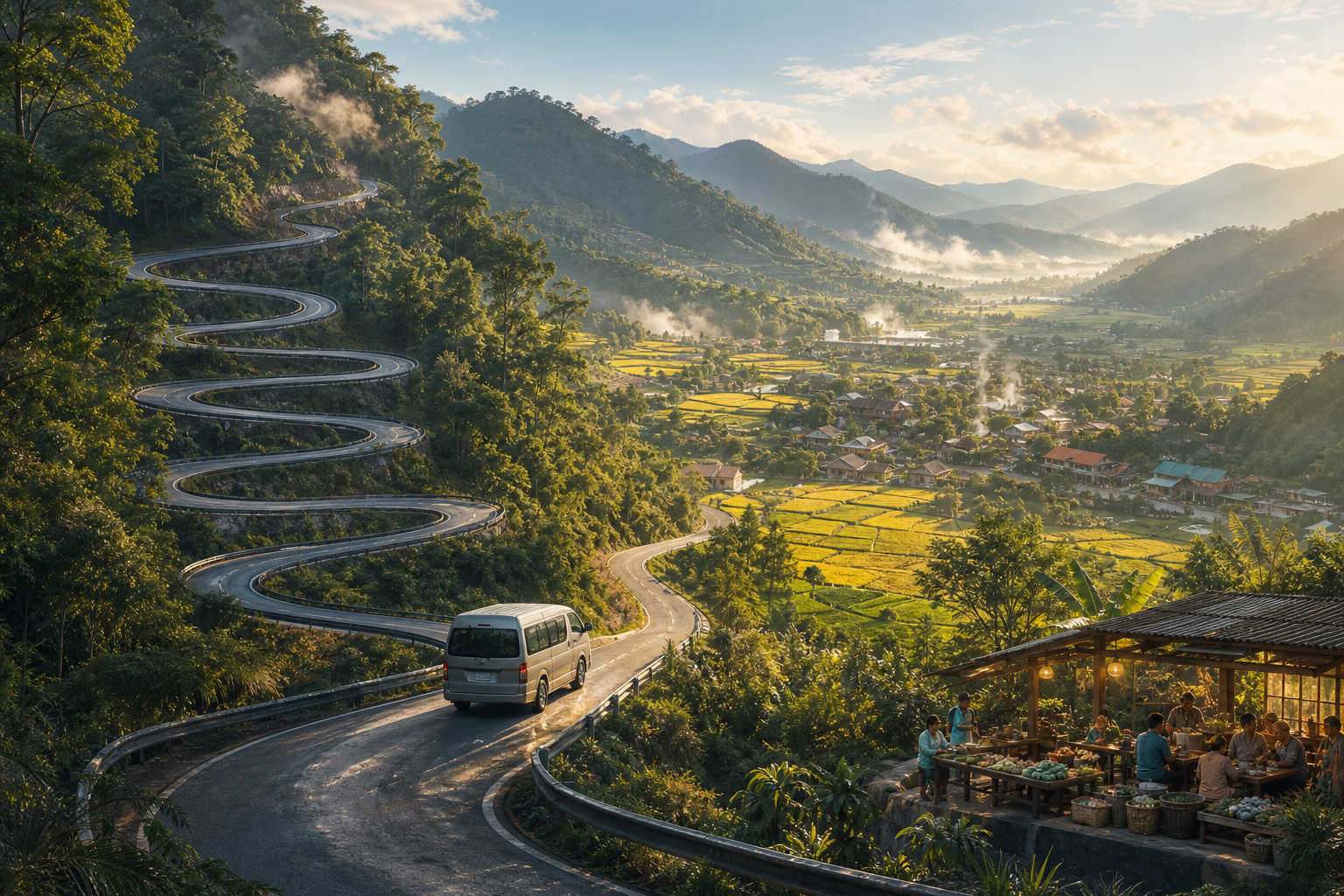
The road from Chiang Mai to Pai has 762 curves. Someone counted, and now the number is printed on T-shirts you can buy in both towns. That’s either a warning or a sales pitch depending on how your inner ear handles mountain switchbacks — and it’s genuinely relevant trip-planning information. The minivan takes around three hours. Most people who do it once say it was worth it. A fair number feel sick for the first hour after arrival.
View larger map | Map data © OpenStreetMap contributors
Take the bus if you have any doubt at all about motion sickness. The road is beautiful but relentlessly, almost comically curvy, and the minivans don’t slow down for the scenery.
What Pai Actually Is
Pai sits at around 800 meters in Mae Hong Son Province, a small valley town that got discovered by backpackers in the 1990s and never quite shed the infrastructure that came with them. There are still too many reggae bars and walking street vendors selling the same dreamcatchers you’ll see in every Thai tourist town. None of that is a reason to skip it.
The reason to go is the landscape immediately around town — rice fields, hot springs, waterfalls, and hill tribe villages within easy motorbike distance — combined with a food scene that punches well above what a town this size should sustain. The permanent expat and long-stay community has kept restaurant quality unusually high, in the same way that happens in a handful of small northern Thai towns where people come to stay a month and end up opening something.
Rent the Motorbike
You can walk the town itself in twenty minutes. Everything worth doing in the surrounding area requires wheels. Motorbike rentals run 150–250 baht a day for a manual or semi-automatic, more for an automatic step-through. The roads outside town are in decent shape and traffic is genuinely light compared to Chiang Mai. If you’ve never ridden a motorbike before, Pai is a better place to learn than a city — but that’s a low bar, not a recommendation.
The classic loop takes in Pai Canyon in the late afternoon (the light is better after 4pm, and the walk along the narrow ridge has no guardrails — fine if you pay attention, alarming if you don’t), Mae Yen Waterfall as a morning stop before it gets hot, and the Tha Pai Hot Springs about 45 minutes southeast of town. The hot springs there are worth the drive over the developed pools closer to town, which are fine but crowded in the way that anything marketed as a shortcut usually is.
The Chinese Village and Yunnan Food
About 4 kilometers north of town is Ban Santichon, a Yunnan Chinese settlement established by Kuomintang soldiers who fled south after 1949 and eventually put down roots in the Thai highlands. The village is now partly a tourist attraction with tea houses and horse rides, which you can skip. The food is the actual reason to go.
Yunnan-style noodles, cured ham, and pressed tofu from the village vendors or the small restaurants just outside it are worth the ride on their own. This is a genuinely distinct culinary tradition from standard Thai food, and you won’t encounter it anywhere else on a typical Thailand itinerary. The tea is also good and cheaper than comparable quality in Chiang Mai’s specialty shops — buy some to take back.
Where to Actually Eat in Town
The walking street that runs through the center every night has its moments — grilled corn, sticky rice and mango, freshly pressed sugarcane juice — but the sit-down restaurants on and just off the main drag are where Pai’s food reputation actually comes from.
Edible Jazz has been there long enough to be either an institution or past its peak, depending on who you ask. It’s still worth one dinner. The vegetarian options are unusually serious for a town this size. For coffee, Pai has a density of small roasters that reflects proximity to northern Thai growing regions — don’t settle for the first place you walk past, because the quality varies sharply and a genuinely good cup is often only fifty meters past a mediocre one.
If you’re there on a Saturday, the small market near the main bridge has local hill tribe produce and prepared food that the walking street doesn’t replicate. Worth the early start.
How Long to Stay
Two nights is the honest minimum. One night means you spend half your time managing arrival and departure logistics around the mountain road and never actually get out to the surrounding landscape. Three nights is comfortable, and it’s what most people who’ve done it say they wished they’d booked.
The town slows significantly in the low season (May through September) when rain is frequent and the road can get genuinely unpleasant. The rice fields are greener and the waterfalls stronger in the wet season, which has its own appeal — but Pai Canyon is better dry and the hot springs feel less redundant when the air is cool. November through February is the sweet spot: dry, cooler evenings, and valley mist in the mornings that makes the surrounding landscape look like it’s at a different altitude than it is.
A Practical Note on Accommodation
Pai has an unusually wide range of places to stay relative to its size — bamboo bungalows in the rice fields at the low end up to well-designed small resorts with proper beds and hot water for ten times that. The bungalows-in-the-fields experience is worth doing if it’s your first time and you’re traveling light. If you’re a medium-light sleeper, read reviews carefully about noise before you book anywhere near the walking street — it can stay loud until midnight, and a room fifty meters off it can feel like a completely different town.
Book ahead for the November–February peak. Pai is small enough that decent mid-range options fill up faster than the price point would lead you to expect.
The 762 curves matter more to your trip planning than most statistics in travel posts — figure out who in your group needs the front seat before you book the minivan, not while you’re already on the road.