
Most people get Hualien wrong before they even arrive
View larger map | Map data © OpenStreetMap contributors
The standard move is to fly into Hualien, drop bags at a guesthouse near the station, do Taroko Gorge in a long day, and leave on the next eastbound train. That’s not a trip to Hualien — that’s a trip to Taroko Gorge with a hotel attached. The city itself, the Pacific coastline, and the Hualien County interior are all doing something genuinely different from the gorge, and most visitors never find out what any of it is.
Taroko is worth it. The marble canyon walls, the Shakadang Trail along the river, the Swallow Grotto section where you’re walking through tunnels cut into sheer cliff face with the gorge dropping away a meter from your shoulder — none of that is overhyped. Push into the Zhuilu Old Trail if you want the more exposed version; it requires a permit through the Taroko National Park office, applied for at least two days ahead. That’s a full day. After that, most itineraries have no answer for what comes next, which is where the real trip starts.
The city itself has a logic people miss
Hualien city isn’t pretty in a Jiufen-postcard way, but it has a density of good food and a low-key evening pace that rewards walking without a plan. The night market near Zhongshan Road is the obvious entry point — the gua bao here are noticeably better than what you find at tourist-facing night markets in Taipei, partly because the crowd is mostly locals and there’s no premium for atmosphere. Go once, go early before it gets dense.
What actually merits a slower look is the Hualien Cultural and Creative Industries Park, housed in a converted Japanese-era sake brewery complex. “Creative” in Taiwan tourism marketing has been diluted to mean almost nothing, but this site is one of the places where the label holds up — the colonial-era timber and brick architecture is intact, there are working studios inside, and the weekend market draws makers from around Hualien County. Not curated-for-tourists craft; more like the kind of thing where you can watch someone doing traditional Amis weavework and buy directly from them. The Amis are the largest of Taiwan’s sixteen officially recognized indigenous peoples, with deep roots in eastern Taiwan, and Hualien is one of the better places to encounter that culture with any real substance rather than a hotel lobby display.
The coast east of the city is the underused asset
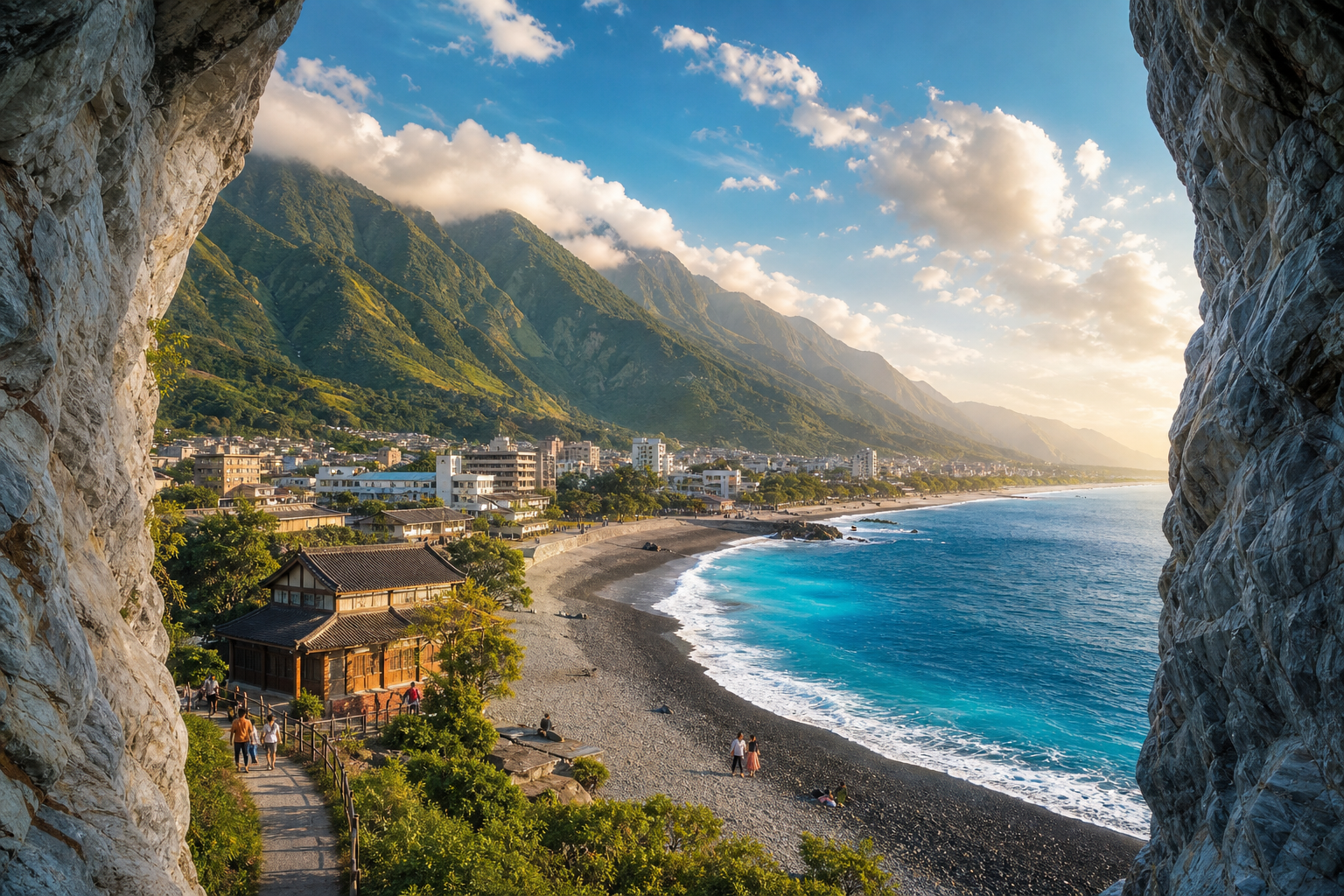
The Pacific coastline running south from Hualien toward Fuyuan National Forest Recreation Area gets almost no international coverage, but it’s dramatic in a way that’s completely different from the gorge. Qixingtan Beach — about 5 kilometers from the city center — is black pebble, not sand, which means it’s nearly empty even when Hualien is busy, because it’s not a swimming beach. The coastline bends east here in a way that gives you a clean Pacific horizon with the central mountain range behind you. It’s one of the more disorienting geographical moments in Taiwan: you’re simultaneously facing open ocean and a 3,000-meter ridgeline.
Provincial Highway 11 running south along the coast is worth at least a half-day if you can rent a scooter or a car. The road cuts between the mountains and the sea for most of its length with almost no inland buffer — the range drops close to directly into the coast in places. Xiaoyeliu, roughly an hour south of the city, has the same kind of wave-eroded rock formations as the more famous Yehliu on the north coast, but with a fraction of the visitors. The geology is coral limestone carved by wave action and wind, and it’s strange-looking enough to earn a stop even if you’ve already done Yehliu.
One honest caveat about timing
Hualien sits in a typhoon corridor. Between July and October, the eastern coast takes direct hits at a frequency the western side of Taiwan avoids — the Central Mountain Range blocks weather systems moving in from the Pacific, but only if you’re west of the range, which Hualien isn’t. A typhoon during your trip doesn’t just mean rain; it can mean the Suhua Highway north toward the gorge closes entirely, trains get cancelled, and you’re in the city waiting it out. Hualien handles this calmly and the city is perfectly functional, but if schedule certainty matters, go in spring (March through May) or early June. The weather is drier, the gorge stays accessible, and the coast is still cool enough to walk comfortably.
Getting there and how long you actually need
The Puyuma and Taroko Express trains from Taipei take roughly two hours through the mountain tunnels on the east line — book through the Taiwan Railways Administration site well ahead, because weekend trains sell out. Flying from Songshan airport takes 45 minutes, but the train is more reliable given how often fog closes Hualien Airport, and the mountain tunnel journey is itself worth experiencing once.
Three nights is the minimum that makes the trip feel like its own thing rather than a gorge day trip with extra steps. One day for Taroko with an early start on the Shakadang Trail, one day for Highway 11 south and Qixingtan in the evening, one day loose in the city for the market, the sake brewery, and eating your way through whatever looks right. That’s a paced itinerary, not a packed one — which is the point.
The guesthouses near Hualien station are fine and central, but better-value options tend to be a kilometer or two south in quieter residential streets. Worth looking there before defaulting to the station cluster, which is priced for transit convenience rather than anything else.
If your Taiwan trip has been Taipei and Jiufen with a Taroko day trip bolted on, three nights based in Hualien is the single change that makes the whole thing feel more like the country and less like the infrastructure built around it.